

Our Blog
From the Dirt Up: After the Revolution, how can Swartland sustain the momentum?
When you speak to Johan Meyer, even on a whatsapp call with a slight time delay, you feel an energy and a passion about what he does. Just as well because he’s a busy guy, working on several ranges of wines from grapes farmed across multiple regions in the Western Cape. It’s his first year working in his new cellar in Hermon, about 10 minutes from Riebeek Kasteel, and he’s recently bought some farmland further north in Picketberg. More on this later…
Like most young winemakers these days Johan is well travelled. He spent two years in California with the Trinchero Family in Napa (of White Zin fame!) and at the Tantara Winery in the Bien Nacido, learning the nuts and bolts of winemaking. He then returned to South Africa and spent time at Old “Tony Bianco” winery in Tulbagh and Mount Abora in Riebeek Kasteel, where he still consults. I asked him where or who had been most influential in his approach to making wine – his answer was incredibly pragmatic:
JM “Winemakers need to learn both sides: commercial and boutique production. The winemaker who has most influenced me is Tom Lubbe.”
Tom is another well-travelled South African, he grew up in New Zealand, has made wine in Swartland, but settled in the Roussillon. His biodynamically run Domaine Matassa is somewhat of a beacon in the natural wine world, working with low yielding old bush vines and traditional Mediterranean varieties. Johan spent three months in the wine village of Calce with Tom in 2014, learning the importance of biodynamics in a holistic sense. The soil, vineyards, and farming practices all come together, impacting not just the finished wine but the people working on the estate: the alchemy of organic wines if you like. He found this approach energising and still maintains a close connection with Tom.
The Swartland is the Cape’s traditional breadbasket, but the region’s wine quality was often overshadowed by areas like Franschhoek, Paarl and Stellenbosch. The Swartland Revolution, an event set up in 2010, driven by Adi Badenhorst, Chris and Andrea Mullineux, Callie Louw, Eben Sadie, and other Swartland Independent Producers set out to change that.
The mission was: to improve quality standards and educate consumers about the unique “Swartlandness” – what traditionalists might call terroir – found within the region’s wines.
Six glorious, sometimes riotous, years followed. The last event was in 2015 but most would argue it spectacularly achieved its objective of putting Swartland on the map – quite literally for many people by bringing the winemaking world to the area to see for themselves what was going on there. It didn’t just provide a forum.
JM “It opened doors for the younger producers in South Africa such as myself. I met a great group of people there, and the contacts I made have helped me to build my business and continue to develop as a winemaker”.
It was at the event in 2012 that Johan came across our very own Ben Henshaw, who was there spending time with Craig Hawkins, of Testalonga fame. At the time Johan was starting to make his JH Meyer Signature Wines part-time sourcing fruit from the cooler regions of Elgin for Pinot Noir, and Walker Bay for Chardonnay. Ben was impressed and decided to bring them to the UK. Johan was also starting to develop relationships with grape growers in the Swartland region, and had gained access to some of the best fruit in the region, which he was using to create honest, clean natural wines, showcasing terroir rather than a style. Ben, coincidentally, had noticed a gap in the market for artisan South African Chenin at an accessible price. You could call it fate: the Force Majeure label was born! Initially with around 3000 bottles coming to the UK in early 2014, the wine was a huge success and was swiftly followed by a Cinsault Rosé and a Red Blend from Syrah, Pinotage, Grenache, Cinsault, Carignan and Mourvedre, both produced with the same principles as the original.
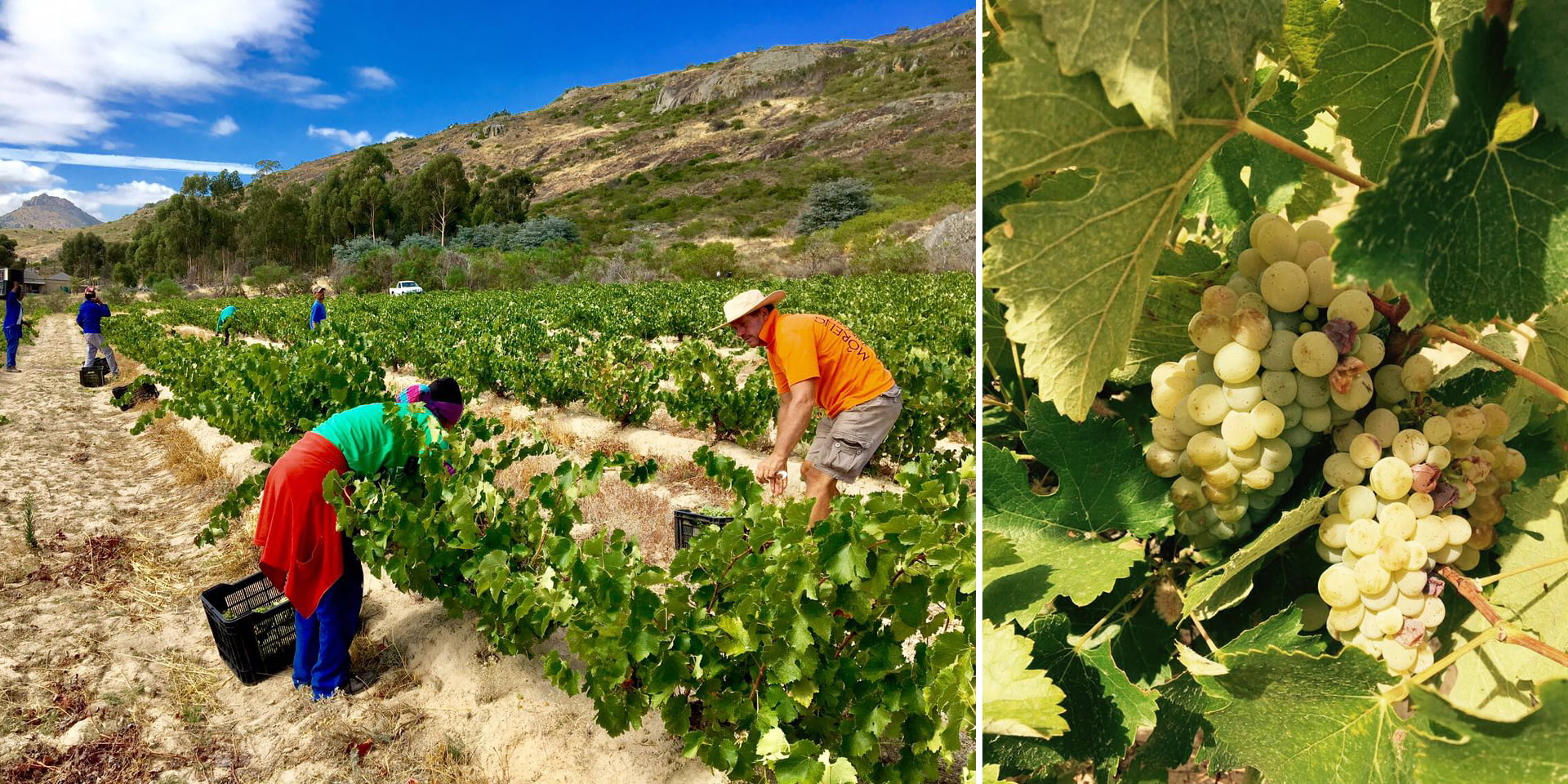 Chenin vineyards in Paardeberg, picking for the 2017 vintage.
What next for Swartland? In Johan’s opinion the key is sustainability, and not just in an environmental sense, but also sustaining the momentum, quality and excitement that the Swartland Revolution ignited in the area.
JM “It’s no good just making good wine for a couple of vintages, we have to make good wine for the next 50 years! We have to live up to our reputation.”
The biggest challenges he faces as a winemaker in Swartland today are finding new vineyard sites, painstakingly recovering the old abandoned ones and keeping fruit quality consistent. For Johan the key is working closely with the hundreds of small farmers who own the land, and whose families have grown grapes there for generations. He has worked at getting to know these farmers establishing long term relationships. This builds trust and also enables him to work with them to improve their land, look after their vines, and adapt them to organic and biodynamic principles. He believes this is the key not just to great wines, but also to a sustainable future for the area.
JM “I worry that some of the younger guys have been enticed by the sexy image of South African wines but don’t work with the farmers to build something for the long term”.
On the flip-side he has the freedom to find the best grapes and identify abandoned older vines he thinks have potential. Again, the relationship is key: for the first three years of working with a farmer Johan sells the grapes and doesn’t use the crop for his own wines. He describes this period as a kind of detox for the vineyard.
JM “I work in partnership with the farmer to bring the vineyard towards the organic methods and the quality of farming that I’m looking for. Of course there is a risk, you don’t know exactly what your crop and volumes will be every year. There are some grapes – Chenin Blanc, Syrah and Cinsault – that are relatively easy to source but others you can’t find regularly”.
This limits his winemaking options, and when you’re making a range of wines and exporting to 15 countries as he now is you need a sustainable supply of quality grapes. Hence his decision to plant his own vines, so that he can have control of the supply.
This brings us neatly to Johan’s big new project – a farm in Picketberg in northern Swartland. It’s an amazing opportunity to start from scratch, and to work in a way he believes will produce the best fruit. Why did he choose the area and what needs to be done?
JM “It’s a remote part of the Swartland, that offers a unique environment and a huge diversity of microclimates. It gets more rain than the south – around 700mm per year – has a healthy diurnal temperature range and rich soils that are full of organic life. Much of the area is planted with apples and citrus, which is often more profitable for local farmers than grape farming”.
He says that when he sees apple trees he knows there is potential for growing Chardonnay grapes. His property is overgrown, it was last worked about 10-15 years ago, but at least that means any chemicals that might have been used will have worked their way out of the soil ecosystem. It will also be the first time vines have been planted on the sites so no viruses, mildew or fungal diseases lurking in the soils. He plans to plant vines next August/September, but needs to do a year of soil preparation before then.
His first crop will take at least five years so the priority is to get the vines in, then he can think about building the rest of the infrastructure he’ll need – a cellar, not to mention a house! He is planning to plant Chardonnay and Pinot Noir for his JH Meyer wines, and is also thinking about Grenache and Cabernet Franc, maybe Mourvedre, things which he can’t find, and that his partner farmers aren’t growing. Nothing funky or weird at this stage, definitely some Chenin at some point – somewhat of a signature grape for Swartland – which he thinks will thrive in the cooler climate.
JM “I plan to plant five hectares in the first year and as time progresses I’ll look at other sites and possibly other varietals. I have around 25 hectares suitable for planting, but I need to live there, see the microclimate and live with the terroir to see how it evolves before making any other decisions”.
 Back to the present and the recently pressed 2017 vintage: he started around the 14th January picking Chenin in Paardeberg, and finished in mid-April. He thinks 2017 will be a very strong vintage, the fruit quality is good, and yields are up 30% on last year, although still less than normal due to the continuing drought in the region. The summer was cool and mild with no extended heatwaves.
JM “The more you work with the land the more you learn and every year brings a different challenge”.
He’s excited to be working in his new cellar, which sounds flash but is basically a large renovated shed. He has some old 2000 litre foudres to make Chenin, and some new locally-made concrete eggs. Johan believes that to show terroir you need a neutral space where you can do a clean fermentation and vinify as simply as possible: without too much tannin and no bacteria to deliver a clean fermentation with pure flavours and aromas. In his opinion the vineyards influence 90% of the final wine: the worst thing would be to work hard on the vineyards and then bring the fruit into a dirty cellar!
JM “Cellars need to be sterile like a lab – then you can see the honest terroir.”
He hopes the site specifics of each farm will come out even more in the new cellar. The ageing of the wines might be tweaked a little – he’s currently working on two single vineyard Chenin Blancs aged in concrete eggs – but not the winemaking. In fact he admitted it was the first year that he truly feels full confidence in the wines.
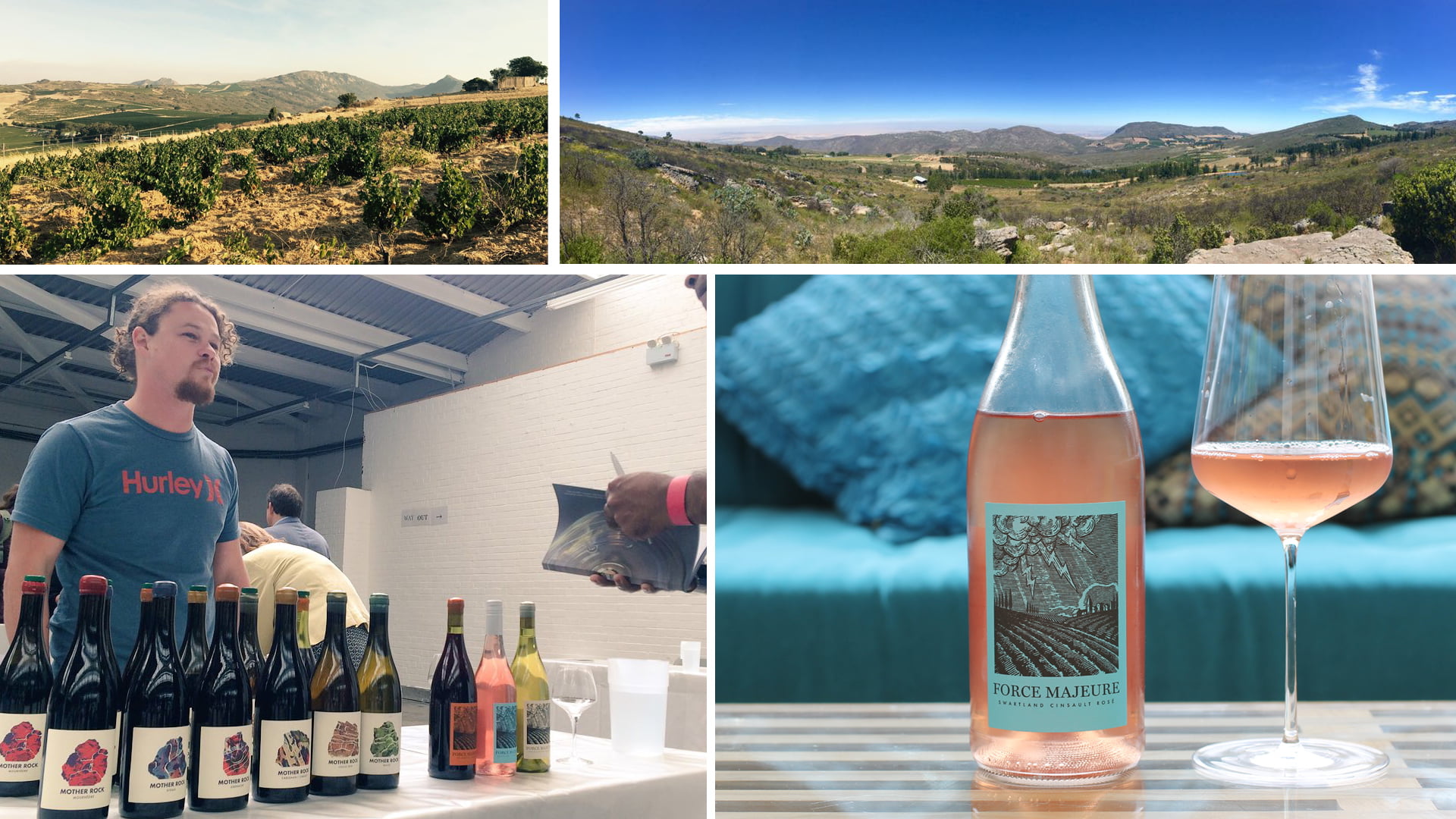 Clockwise from top left: Genache vines; The site of Johan’s new farm up North in Picketberg; Johan at the RAW fair last year; The fresh and pure, food-friendly Cinsault Rosé from the Force Majeure range
The Mother Rock Range – Johan’s partnership with Ben – has gone from strength to strength. The new wines released in the UK for the first time last year: a white blend, a skin contact Chenin and site specific reds have been very well received and he will keep making those in partnership with his Swartland growers.
JM “I’ve put in too much effort to let them go!”
Looking ahead to the first harvests up in Picketberg, how might the Mother Rock range develop? We’ll keep the existing cuvees, but the farm will give him healthy young vines, farmed in the correct way from the start, and the potential to make serious wines from terroir specific sites.
Johan will be in London next week for the Real Wine Fair and a host of other activities. You can catch up with him on Wednesday 10 May at The Larder Deli, where he’ll be pouring the Mother Rock wine between 15:00 and 17:00 [Trade only]. If you’d like to find out more about the range and his plans please drop us a line.
Hip hops… refresh your list with some food friendly craft beers
You’d have to have been living in a remote Siberian cave not to notice how popular craft beer has become over the last five years. But what exactly is craft beer – is it a style, is it about the intensity of flavour, or is it simply any beer with an eye-catching label that isn’t brewed by one of the mega brewing corporations?
The style emerged in the US in the late 70’s as a response to the banal lager-beers dominating the market. Micro-brewers were searching for an intensity of flavour, which they found by using fruity American hops. American hops can bring grapefruit, resin, fresh lemon peel, orange and tangerine notes to beers. In Europe, similar to natural wine, there isn’t an official definition for craft beer. Maybe that’s part of the excitement as it leaves the brewers – around 1,700 in the UK – free to constantly evolve and come up with myriad tempting options.
All this choice can be a bit confusing though. This is why Indigo formed a partnership with Nick Trower, founder of Biercraft. Nick has gathered together a collection of the most exciting small craft breweries from the railway arches of Hackney, to Brighton, Bavaria and Barcelona, via Adelaide Hills and a few other places in-between. Biercraft focuses on quality, searching out exhilarating brews to complement your drinks list.
“Biercraft now works with 20 of the best London breweries. From the originators the Kernel in Bermondsey, through to the exciting new brews coming out of Redchurch’s Urban Farmhouse brewery in Bethnal Green, there has never been such a diverse array of well made, delicious beers being made just a few miles from the capital’s best restaurants.”
At the back of our portfolio you’ll find a concise, curated list of these breweries, and if you order through us we’ll put your wines and beers together for one convenient delivery.
Not sure what the difference is between a Pale Ale and an IPA, skeptical about Saison…? Don’t panic, Nick has put together a concise list of options to get you started…

Every beer list needs… Mahrs Bräu – Pils : 4.9% : 330ml
This Pilsner has a golden hue and seems to glow warmly in the glass. A distinctive aroma of hops, lightly carbonated and dry with a dash of bitterness. It is the perfect thirst quencher, but also pairs with fish dishes and grilled meats.
Founded in 1670 Mahrs Bräu vies for the coveted award of best brewery in Bamberg, arguably Germany’s greatest beer town. All the beers are batch brewed and unpasteurised, using hops, barley and wheat from local farmers, and of course conform to the German Reinheitsgebot (purity laws).
Refreshing as a rainstorm on the South Downs… Burning Sky – Saison Provision : 6.5% abv : 330ml
Saisons were traditionally summer ales made by farmers for their seasonal workers (saisonniers). Provision has a primary fermentation with a saison yeast, then undergoes a long slow secondary fermentation in large oak foudres. The result is tart, crisp, slightly sour and incredibly refreshing.
Burning Sky HQ is nestled at the base of the South Downs in an old Sussex Barn, where they let their imaginations run wild. The crux of the brewery is to brew without compromise in terms of ingredients and time – slow-working yeasts bring complexities and depths of flavour to their beers.
An agile match for hearty dishes… Lost & Grounded – No Rest for Dancers : 6.2% : 330ml
Probably the world’s oldest drink, mead is essentially fermented honey and water, and is referenced in the ancient cultures of China, Greece and Egypt. Like traditional meads, Gosnells is made from honey and water, but is much lighter, drier, and bubblier to the tongue. This is a refreshing, thirst-quenching mead with delicate floral and citrus notes and a slight spritz: lovely as an aperitif or matched with summer fruit tarts and desserts.
Gosnells was founded by Tom Gosnell in 2013, with the aim of bringing mead back to the masses. They employ traditional brewing methods and blend carefully sourced citrus blossom honey with water to create new styles that are very different from typical meads.
If you would like to see our beer list, chat through the range, or would like some samples with your next wine order drop us a line.
The Colours of Priorat
We’ve always been particularly proud of our small stable of Priorat producers, which includes Daphne Glorian of the legendary Clos Erasmus, Família Nin-Ortiz and a recent addition, the game-changing winemaker Dominik Huber of Terroir al Límit. Last month the Indigo team drove through the wild, winding roads of this remote part of Catalunya to join other winemakers, importers, and locals at an unforgettable harvest party organised by Dominik. We wanted to share a bit of this truly special experience with you, as told below by Magali, a member of our Sales Team.
And while we’re not usually the type of tout scores, we thought the recent reviews of our Priorat wines by Luis Gutiérrez of the Wine Advocate needed to be celebrated. You can find them at the bottom of this post!

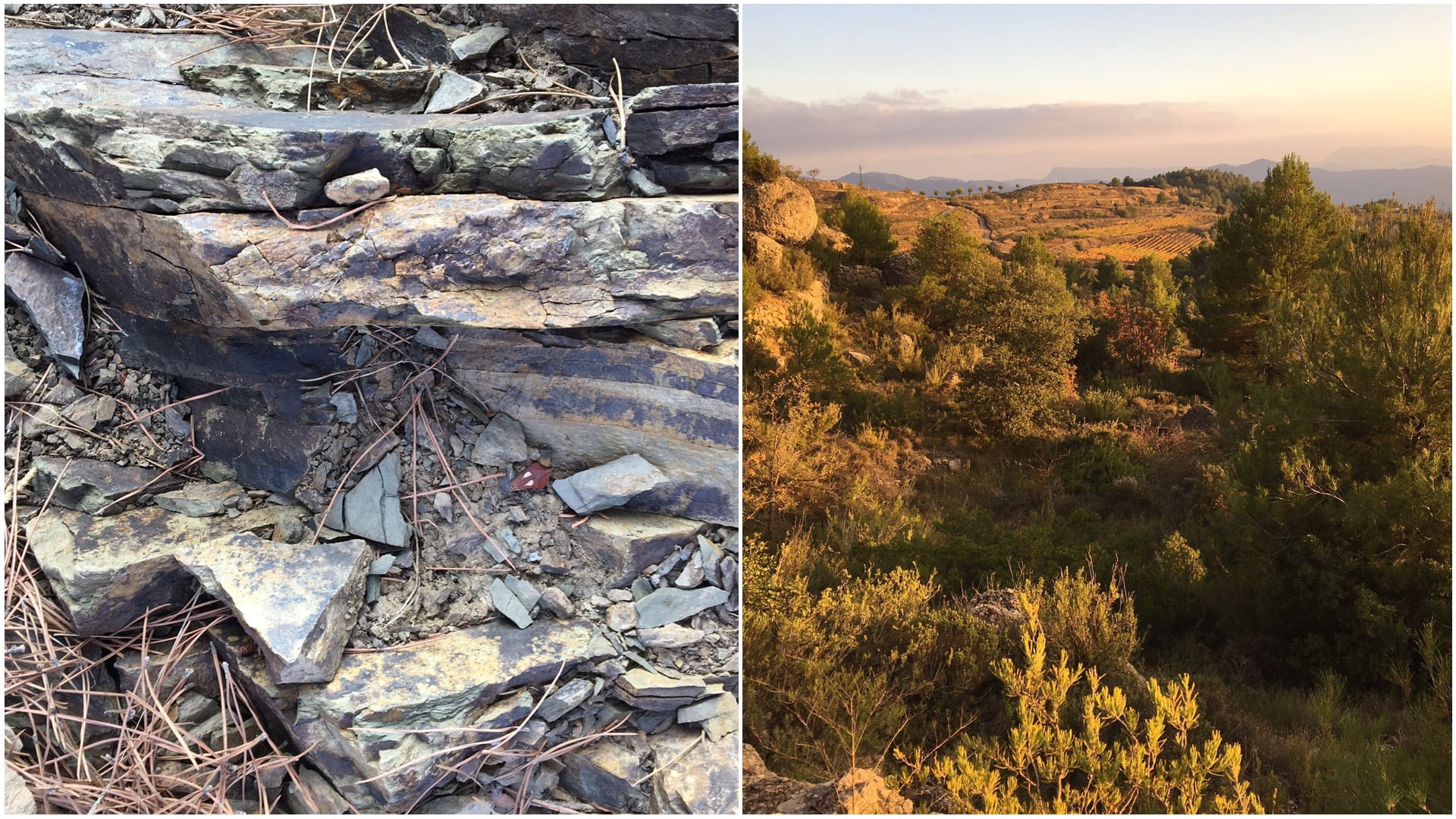
As we drove up the hills into Priorat for the first time, it occurred to me that this looked like no other region I had ever visited. Perhaps the most appropriate way to describe it would be as a wild, unruly place. It’s remote and difficult to access, with vertiginously steep slopes and old vines throughout. And if we’re going to get technical, I might as well point out that it has a hot and dry Continental climate and low rainfall. But it’s the characteristic llicorella (a red slate) soils that lend Priorat its most striking feature: an orange-tinged, magical light that stretches over the hills and vineyards– and is not easily captured in photos.
A bit of background for those of you who are unfamiliar with the region: Priorat’s winemaking history began with the creation of the Priorato dei Scala Dei monastery back in the 12th century, founded by Carthusian monks. The region was already quite well known for winemaking when it was devastated by phylloxera in the 19th century. It then slowly recovered but remained dominated by cooperatives until 1989 when René Barbier and some friends – including José Luis Perez, Carlos Pastrana, (our very own) Daphne Glorian and Álvaro Palacios put Priorat back on the map by focusing on site-specific bottlings (mostly preceded by the word ‘Clos’) and fine winemaking techniques.
Although they were wildly successful and raised the region’s international profile, newer players like Terroir Al Límit are taking a different approach to high quality winemaking by tapping into the historic culture of the region and producing lighter, less extracted wines that are nonetheless extremely elegant and age-worthy.

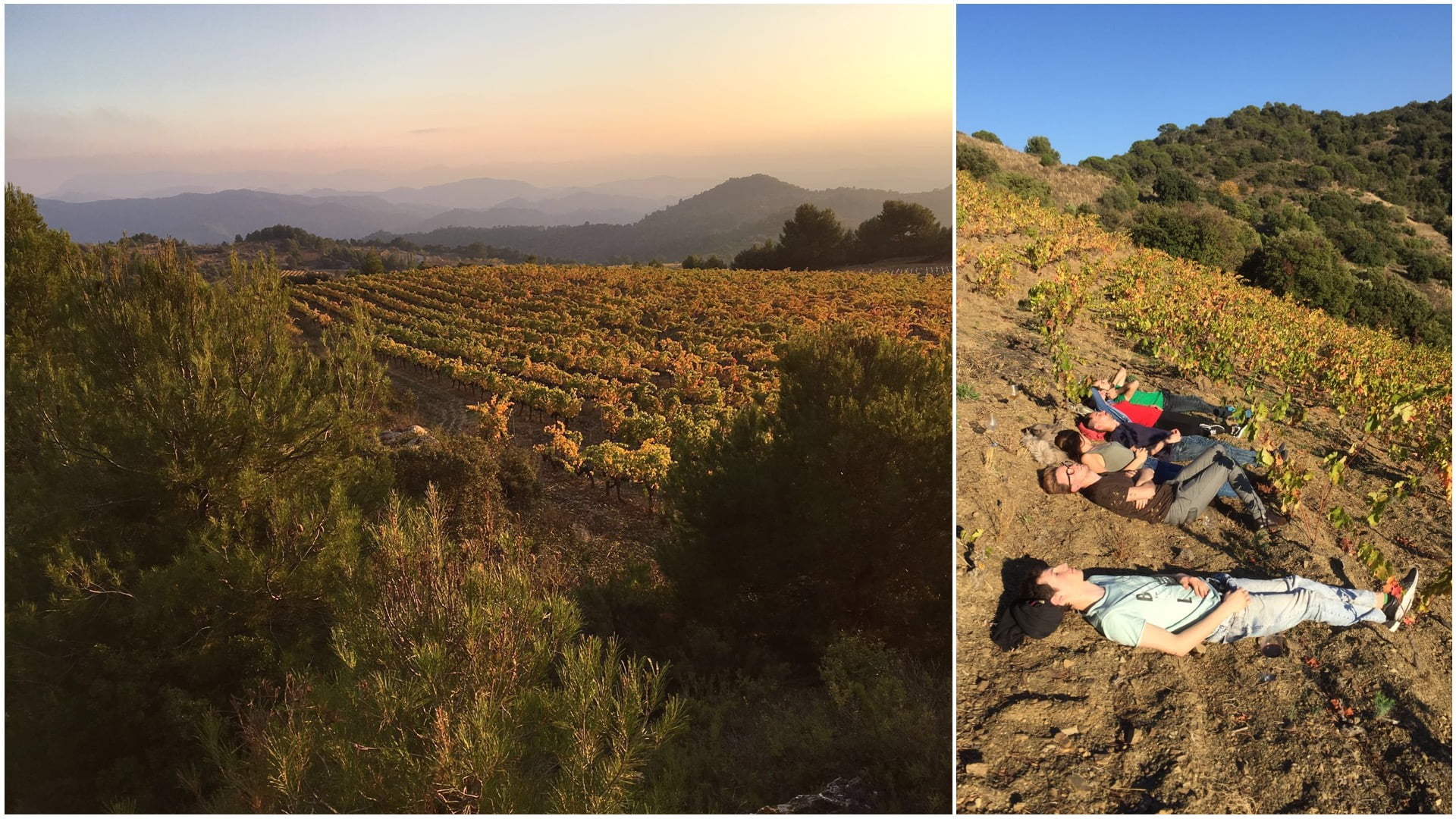
Anyhow, back to our trip! As we arrived in the village of Torroja, where Dominik Huber lives, we were driven in pick-up trucks to the ‘Les Tosses’ vineyard, where we had our first lunch and drank the unfinished and unblended wines from the recent harvest; Xarel-lo, Garnacha Blanca, Garnacha, Cariñena, all stored in rustic glass jars. When you see these steep slopes planted with old Cariñena on slate soils at 650 metres altitude, you think it must take someone really determined (or a little bit crazy) to decide to make wine here.

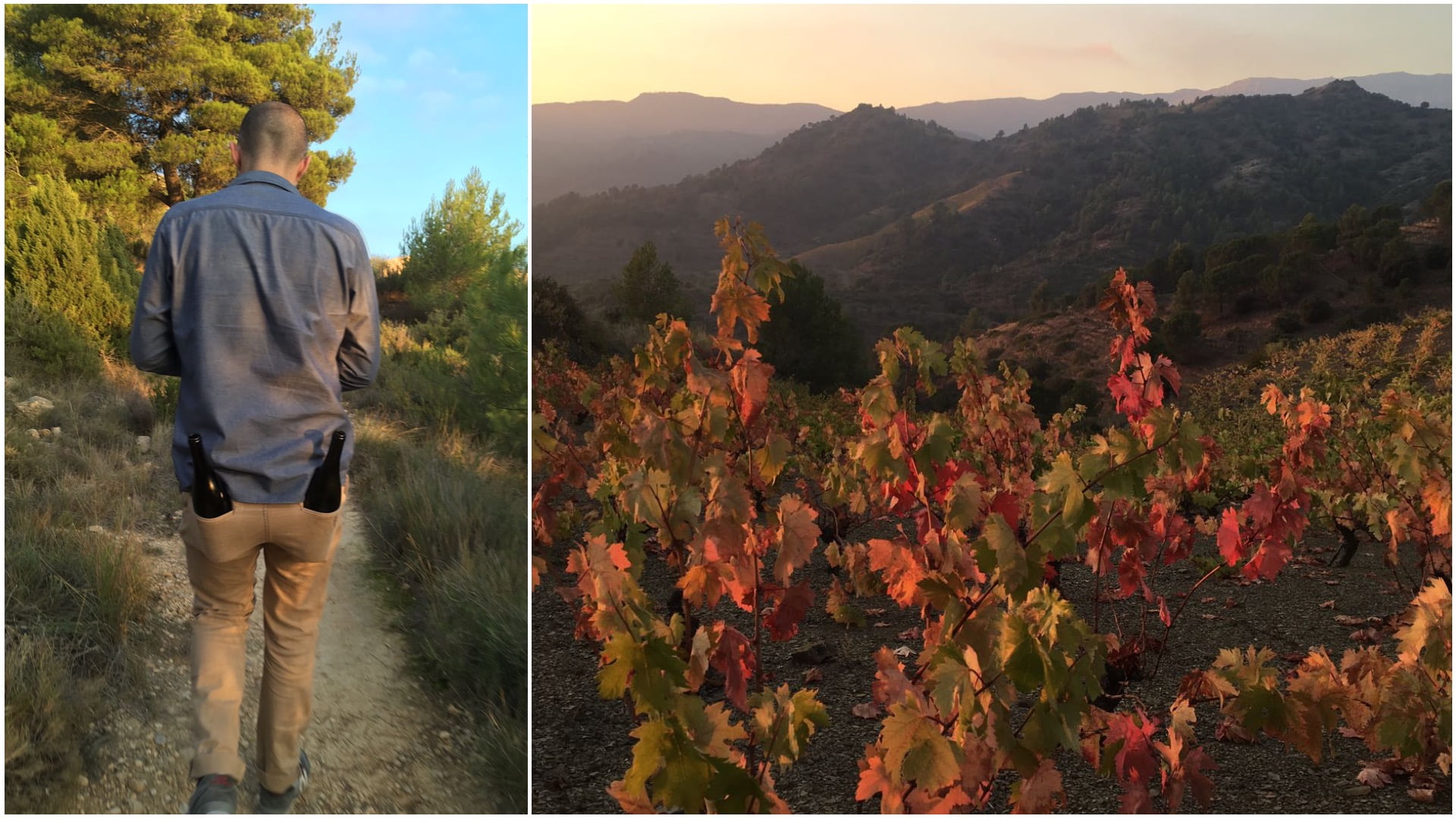
We walked back for almost one hour, rambling along with glasses of wine in our hands and bottles in our back pockets.
In the evening a ‘Magnum Party’ was held at the wonderful Cal Compte Hotel in Torroja. We joined other importers, friends (both wine-related and not), winemakers, and locals who each supplied their own magnums. Among them our fellow Indigo winemaker Theresa of Georg Breuer, so we had the pleasure of drinking some of her Rieslings, including the stunning Nonennberg ’13. Our contribution to the party included magnums from Suertes del Marqués, Ochota Barrrels and Muhr-van der Niepoort.
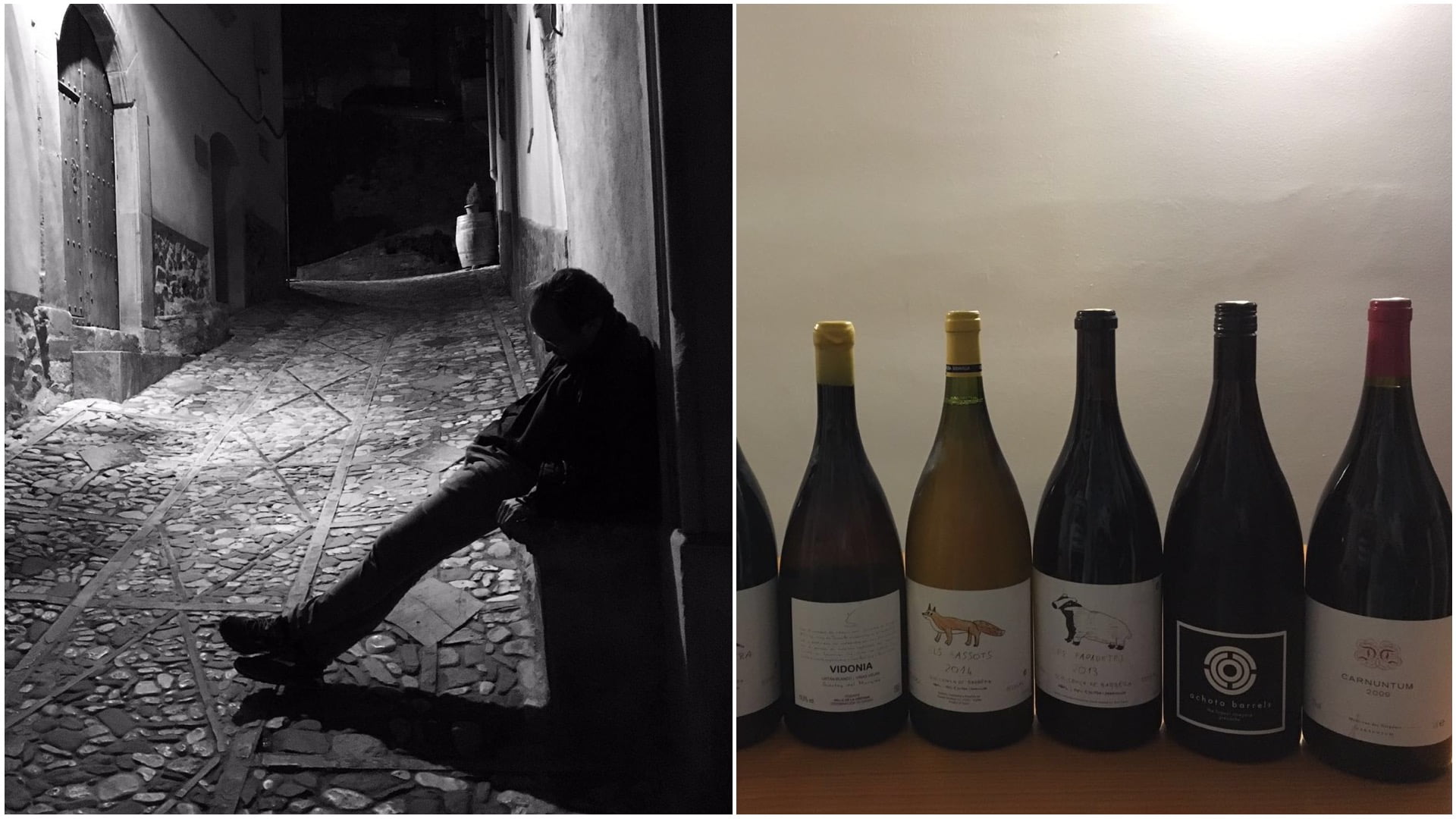
The next day we soaked up hangovers with a traditional Paella and tripe, but not before Dominik brought out the new Terroir al Límit releases for us to taste. Everything was tasting great, but Les Manyes and Les Tosses 2014 were particularly captivating. It’s clearly a vintage Dominik is very proud of.
We then headed to the beautiful “La Planeta” vineyard owned by another Priorat favourite, Celler Pasanau. The traditional licorella soils are covered by a gravelly soil where Ricard Pasanau planted Cabernet Sauvignon nearly 20 years ago for his classic ‘Finca La Planeta’ cuvee. More tasting, rambling, and vineyard gazing ensued before a final dinner back in Torroja. A perfect ending to an epic trip.
Recent Scores by Luis Gutiérrez from The Wine Advocate (Robert Parker)
Below you will find a list of wines we currently stock that received exceptional scores from wine critic Luis Gutiérrez. We really admire Luis’ work and the recognition he has given to small, artisanal growers in Spain. We’re also very proud to work with these growers, so we thought we might as well shout it from the rooftops.
Note that the incredible Clos I Terrasses ‘Clos Erasmus‘ was awarded 100 points, but I’ve left it off the table because we are unfortunately (but understandably) out of stock. For more information on the wines you can contact us directly, or visit the producer pages for Clos I Terrasses, Familia Nin-Ortiz and La Conreria d’Scala Dei. Terroir al Lítmit and Celler Pasanau will be uploaded soon!
| Producer | Wine | Vintage | Score |
| Clos I Terrasses | Laurel | 2013 | 93 |
| Familia Nin-Ortiz | Nit de Nin | 2013 | 96+ |
| Familia Nin-Ortiz | Planetes | 2013 | 93+ |
| Familia Nin-Ortiz | Planetes White | 2014 | 93 |
| Conreria d’Scala Dei | Black Slate | 2014 | 92 |
| Terroir al Límit | Terroir Historic Red | 2015 | 90+ |
| Terroir al Límit | Terroir Historic White | 2015 | 91 |
| Terroir al Límit | Arbossar | 2013 | 95+ |
| Terroir al Límit | Dits del Terra | 2013 | 94 |
| Terroir al Límit | Les Manyes | 2013 | 97 |
| Terroir al Límit | Les Tosses | 2013 | 96 |
| Terroir al Límit | Pedra de Guix | 2013 | 94 |
| Terroir al Límit | Terra de Cuques | 2013 | 92 |
| Terroir al Límit | Torroja Vi de Vila | 2014 | 92+ |
Indigo and Biercraft on tour
Those of you who have been to our portfolio tastings will already be aware about our partnership with Biercraft – purveyor of the world’s most exciting boutique craft brews. Their philosophy of searching out small, quality-minded producers with delicious, compelling products chimes perfectly with Indigo’s.
There has been a worldwide burgeoning of craft breweries over the last few years, and the London scene in particular is thriving. Craft beer is now firmly front-of-mind for consumers, not just in bars and at festivals but in restaurants too. The diversity of styles and flavours can work really well with food, but it’s a whole new ballgame to pairing food with wine. With this in mind we asked Nick Trower, Bier-meister and general font of knowledge on all things hoppy, to take us to a few of East London’s brewing hotspots. And this is what we learned…
We started out at Redchurch Brewery, cosily tucked under a couple of arches in Bethnal Green. Set up by former lawyer Gary Ward in 2011, they expanded and moved to larger premises in 2014, where they make excellently crafted hoppy beers with a real sense of East London provenance. As well as the brewery they have a tap room where we gathered around the bar for a taste through their range.
 Taproom bar at Redchurch. Sofia giving us a bit of background on the range.
  Meditating on the type of malo in Tartelette – so geeky!
  Some of the range at Redchurch. Downstairs in the brewery where the magic happens.
I particularly enjoyed Tartelette from the ‘Wild Series’ so named because they are brewed with wild yeasts, mixed and bacterial fermentation and foraged and cultivated ingredients. Tartelette is a sour beer, but don’t let that put you off, it has a gentle tartness with a refreshing citrus finish. Quirkiest beer of the tasting was Pillar of Salt, a German gose style beer which actually tastes of salt – there has to be a great food pairing for this somewhere…
Next stop was Square Root Sodas, winner of last year’s Radio 4 Food and Farming awards for best drinks producer. Set up by former Howling Hops head brewer Ed and his partner Robyn, they moved to a small but perfectly formed site under a railway arch in Hackney last year. They produce seasonal fruit sodas and distinctive tonic waters. They don’t use additives or preservatives, this is all about quality ingredients.
They are devoted to using the freshest, tastiest raw materials, and spoke about a trip to Sicily from where they now buy nobbly, un-waxed and gloriously tasty lemons. And an expedition to the Yorkshire rhubarb triangle where they were spooked to hear the rhubarb growing!
 Squeezing organic, un-waxed Sicilian lemons by hand at Square Root. Ed explaining the production process.
  Tasting some of the Square Root summer flavours with Robyn.
Square Root was a revelation. From a space not much bigger than my kitchen Ed, Robyn and a small team produce the most startlingly expressive soft drinks I’ve ever tasted. Ed said how exciting it was that soft drinks were finally being recognised– I say when they’re this good it’s no surprise.
Just around the corner in a railway arch (surprise, surprise…) three friends Graham, Ben and Sam aka Pressure Drop make an exciting range with a focus on wheat beers and foraged ingredients. The trio started out in 2012 in Graham’s shed, but soon pinned down some winning recipes and needed to move to more spacious premises.
I was excited to try the intriguingly named Wu Gang Chops the Tree, a wheat beer with a host of other flavours and foraged herbs, including bay leaf. The result apparently pairs wonderfully with curry and tandoori dishes, definitely one to try at home kids… And the name? That originates from a Chinese proverb about Wu Gang who tried to cut down a self-healing sweet olive tree, the Eastern version of our Sisyphus myth.
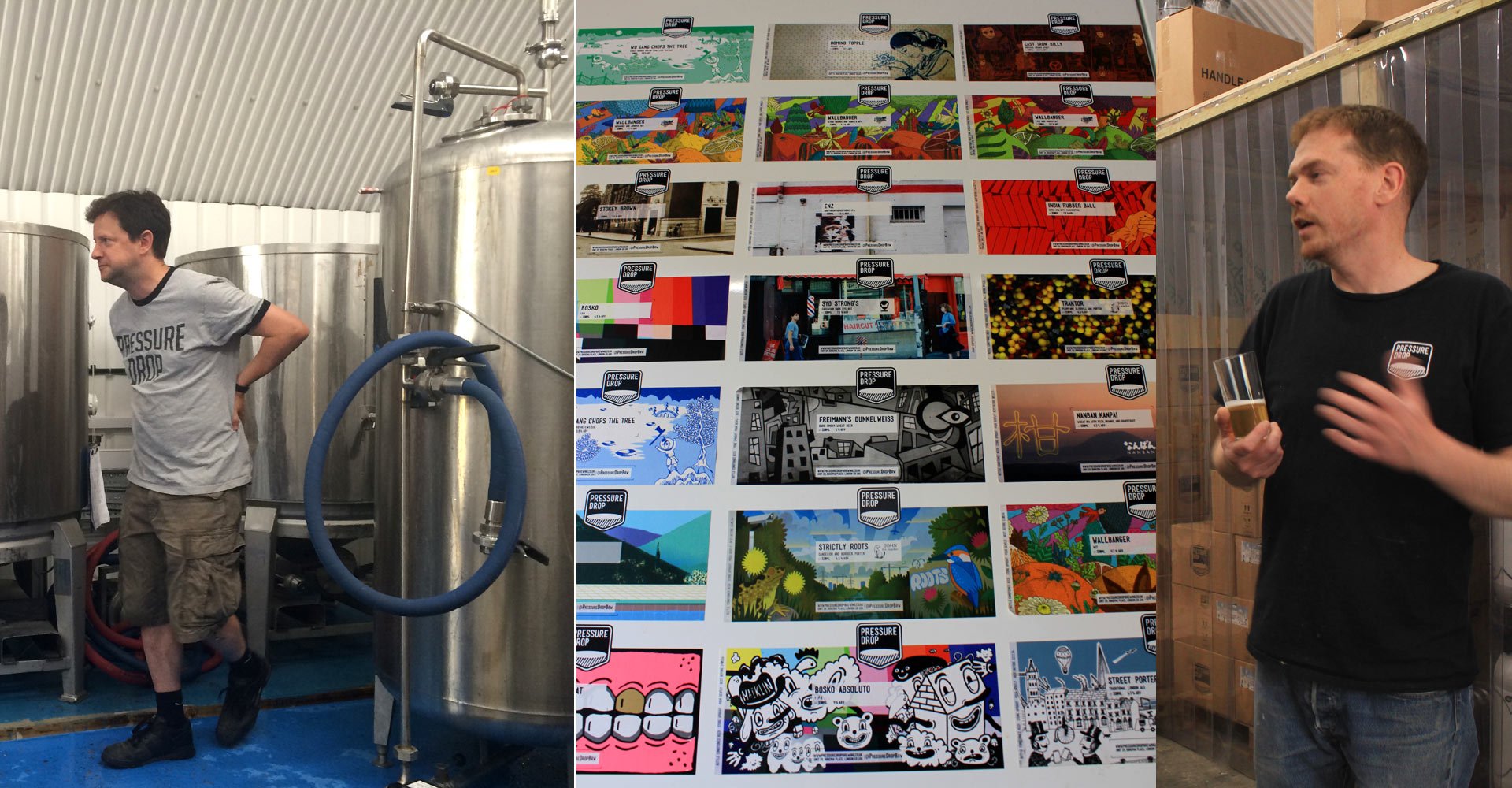 Graham and Sam talk us through the kit. Some of the colourful labels, mostly designed by local artists.
 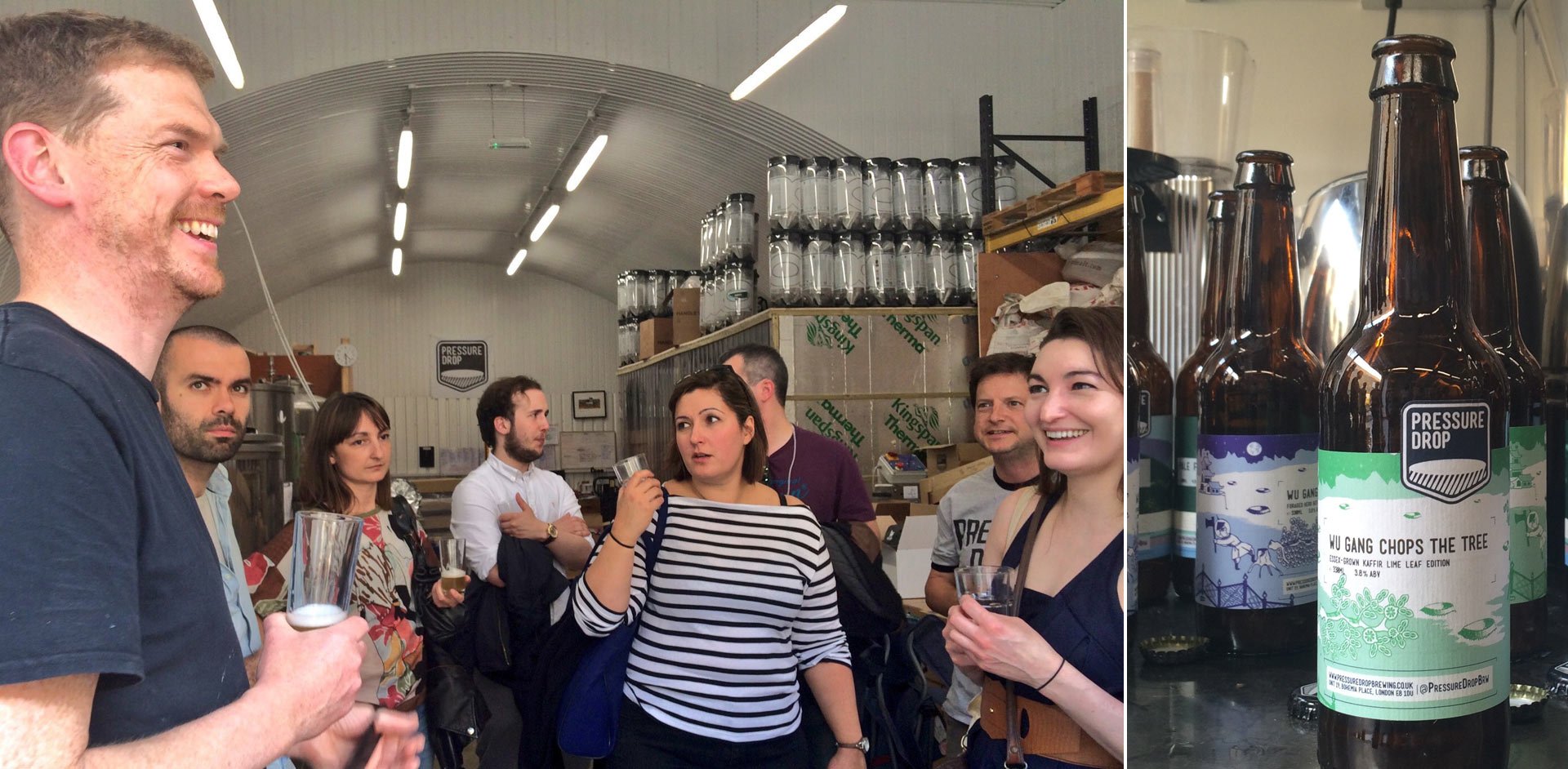 The famous Wu Gang!
A couple of stops along the Overground brought us to our last brewery of the tour, Howling Hops. They recently moved to a brand new site with a bar attached in Hackney Wick. Scaling up production – and this was certainly a bigger more technical looking affair – means they are able to have better control over quality and consistency. The move wasn’t all plain sailing though, installing their tanks in the relatively low ceiling warehouse was a feat of ingenuity. I bet they needed a beer or two after that one… As luck would have it next door is UK’s first tank bar – ten serving tanks directly dispense ten Howling Hops beers from behind a ten metre long bar, it doesn’t get much fresher than that.
Hard work over, we settled down onto one of the long bierkeller style bench tables to sample some of the grog, my vote went to the floral/citrusy Farmhouse Saison, Nico preferred the East End Hefeweize, there’s something for everyone – prost!
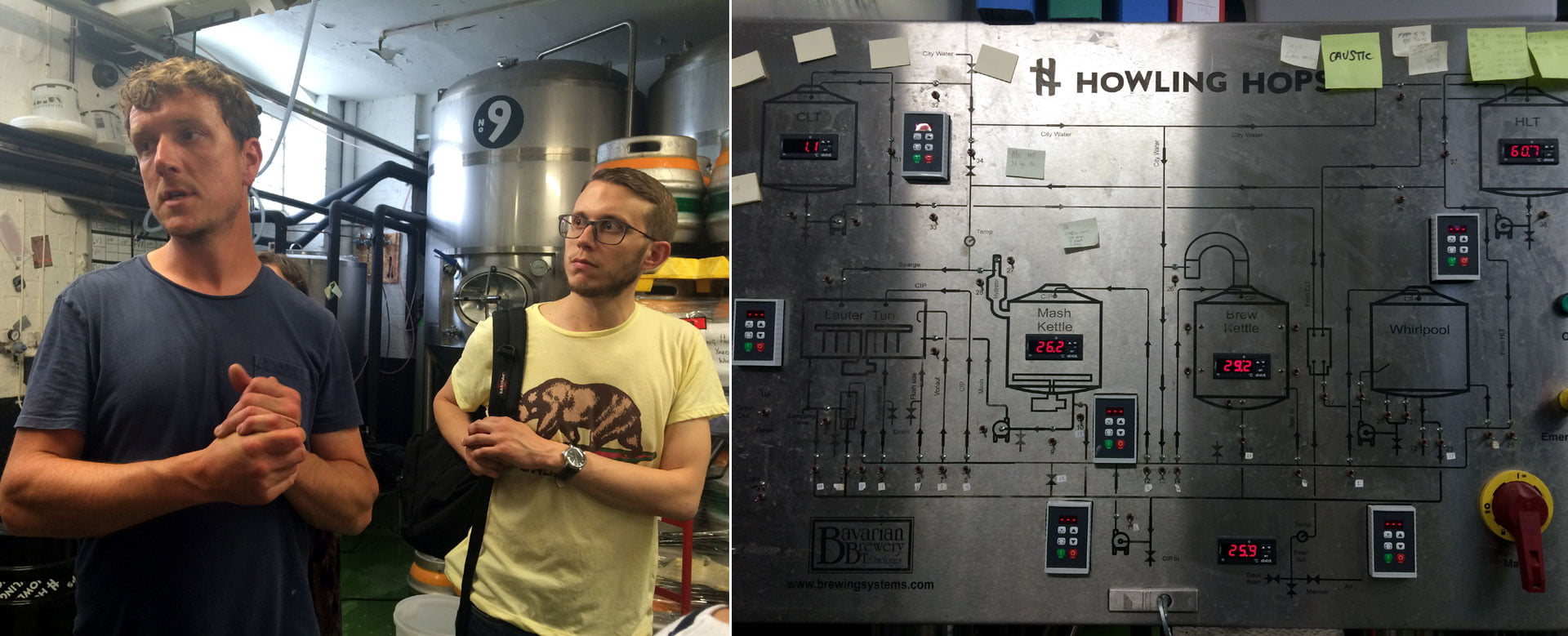 Hmmm it’s all looking quite technical in Howling Hops brand spanking new brewing site
 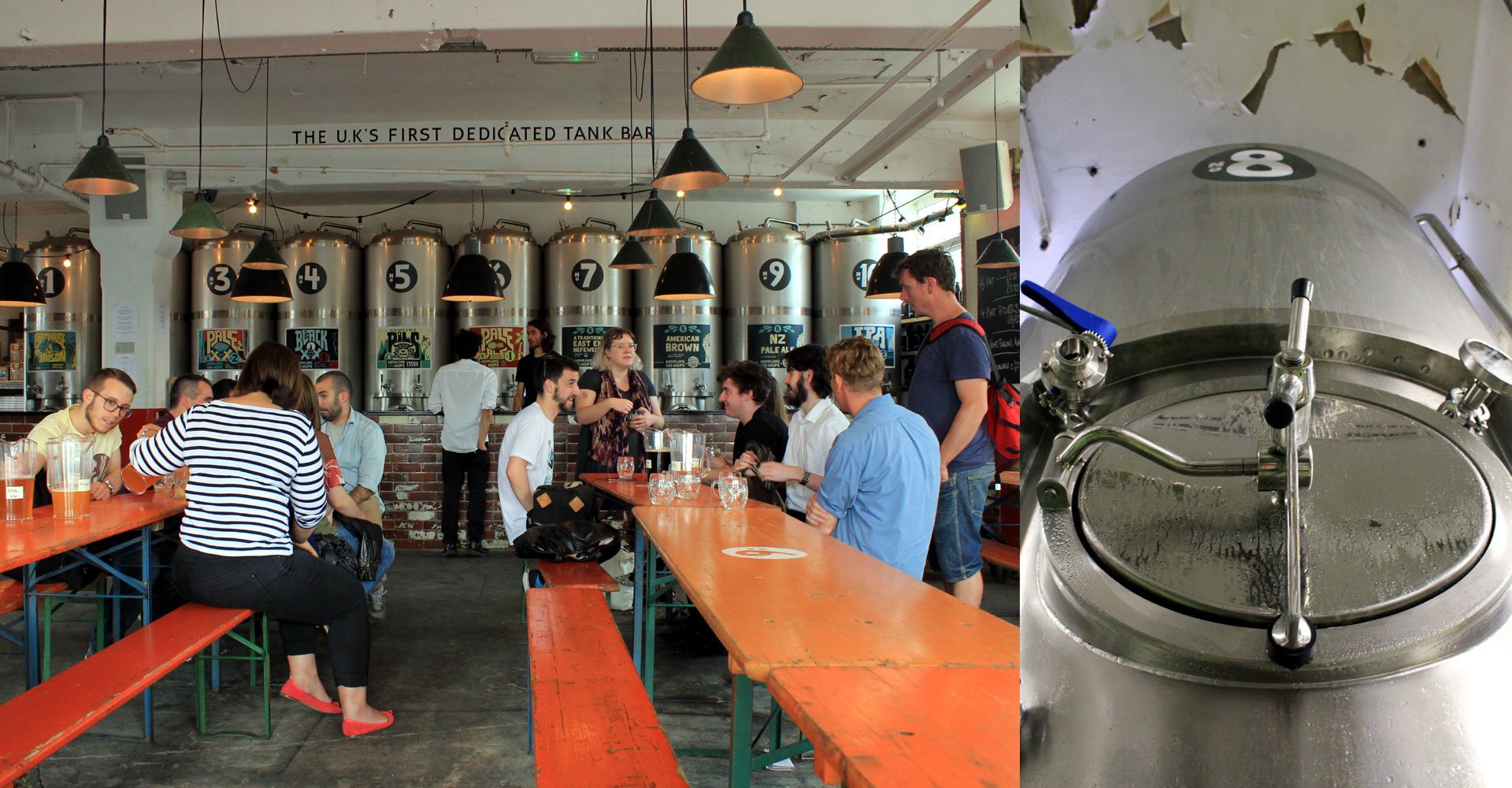 Howling Hops Tank Bar
A huge thanks to Nick Trower at Biercraft for setting the visits up, if you would like to see our beer list, chat through the range, or would like some samples with your next wine order drop us a line.
Restaurant Spotlight: A Visit to Wilks, in Bristol
Husband and wife team James Wilkins and Christine Vayssade own and run award winning Wilks Restaurant in Bristol, with Christine at the front of house and James in the kitchen. Chef James arrived in Bristol with an accomplished CV that has seen him work in some of the best kitchens in Britain and France, including three-Michelin-star restaurant Michel Bras in Laguiole. When Michel asked James if he would move to Japan as Head Chef and Director of his restaurant Toya in Hokkaido, James jumped at the chance. There then followed a two-year stint in Istanbul, which required a very different vision and culinary approach.
Christine characterises James’ cooking as modern European with a strong French influence, but the diverse cuisines, produce, cooking styles and cultures he experienced during his travels are a huge influence and source of inspiration. The team has a strong French influence: sommelier Ludovic Lidon grew up in Sancerre and has worked in a number of fine dining restaurants in France including Le Jardin des Sens in Montpellier, Michel Sarran in Toulouse and Le Jules Verne in Paris.
Christine and Ludovic were kind enough to spare some time to talk to us ahead of a busy Bank Holiday weekend. We spoke about the multicultural roots of Wilks, their enthusiasm to work with small local producers, and the arrival of young chefs and gastro-businesses who have set up in and around Bristol and are turbo charging the food scene in the city.
Jo: Christine, tell me about the journey to Wilks – what places and culinary experiences inspired you and James to set up the restaurant?
Christine: James is English and although he has been abroad a lot, had always wanted to set up his own restaurant in the UK. When we returned from Istanbul it took time to find a property we liked in the south of England. The Wilks site became available – we didn’t know the city or have any contacts here, but we liked it, saw it had potential and we took our chance!
Jo: You were awarded a Michelin star only a year after opening and entered the Good Food Guide as the highest rated in Bristol – what did this recognition do for the business?
Christine: It changed everything overnight. We got really busy, the diary was booked for lunch and dinner every day – it was fantastic. We had been open for such a short period of time we weren’t expecting it. It was very sudden and if you’re not prepared it can be a bit of a shock, but James has very strong experience in Michelin environments, you have to keep doing what you’re doing and try to improve. We have a strong team. Ludovic has brought really good experience from his background and we try to improve every day.
Jo: What is the dynamic between the kitchen and the wines? Does the menu drive the wine list or do delicious wines you try inspire the kitchen to create dishes to match them?
Ludovic: The point is to emphasise the chef’s cooking. James has his style and it is up to us to find different wine styles and pairings to complement his menu. We choose wines with James to match with his cuisine, not the other way round. It is important to us to experiment, not to always choose wines from the same country or in the same profile. James’ cooking is multicultural and it’s interesting to explore possibilities that are close to the spirit of the cooking; we like to try this with our customers.
Jo: What is the essence of your wine list and what do your customers respond to the most? Do they opt for classic wines or do they ask for advice?
Ludovic: We have a range of customers, most are very open minded about wine, they are really receptive to suggestions and look to us to recommend good matches. Our menu is always changing depending on the best produce available. I find it important to have fresh wines on the list to keep customers excited and to match the daily menus. It also gives me the chance to road test a wine to see if it works well before adding it to the main list.
Christine: Sometimes we have a young couple that has come for a romantic dinner; they perhaps don’t visit fine dining restaurants regularly and are treating themselves. It is fantastic for us to see people coming to us like this because it means we are approachable. We never wanted to be stuck up – we aim to offer good service in a nice atmosphere. If they order the tasting menu and you give them the wine list they are sometimes overwhelmed, so that’s where Ludovic steps in. It’s an important part of the job to read the customer, and offer something that will satisfy them, and that they will enjoy. It usually works really well.
We used to have a very French wine list, but since working with Indigo we are diversifying, and we enjoy the selection of different wines that we can offer by the glass. We have ‘wines of the week’ – two whites and two reds. Ludovic does a lot of work to choose these. Some places have the same menu for a season or for a whole year. We have a lot of regular guests – people that come once a week, or monthly – so we have to offer different things. Some regular customers don’t even want to see the wine list – they just ask for Ludovic
Jo: I know Ludo is partial to Riesling – are any other styles or regions close to his heart?
Ludovic: Quite a lot! I’m a big fan of wine from Spain, especially from Galicia. I really started to learn about it when I started working at Wilks, including wines from Rafael Palacios and Eulogio Pomares. I like Ribera del Duero, we used to have Cometa from Quinta Milú— it’s a beautiful wine. I was born near Sancerre, but I’m not a big fan of that style of very classic wine. It’s popular here in England – Sauvignon Blanc, Chardonnay, lots of people ask for them – but we want to offer something different that you don’t find everywhere. We like to find small production wines, to support small domaines and introduce them to people.
Jo: The 64 thousand dollar question… what about English wine? You don’t have to say flattering things!
Christine: I think there is great potential, but they aren’t there quite yet, that’s my opinion. We used to have a white English wine on the list, but none of the English customers would choose it, and I wasn’t crazy about it myself so we didn’t continue with it. In a few years I’m sure they will be producing some very good sparkling wines.
Jo: Bristol has a thriving restaurant and bar scene, tell me more about it.
Christine: Yes it has changed dramatically in the four years we have been here. There were good restaurants when we arrived but now there are a lot of young chefs opening up businesses. London is expensive and Bristol has a lot to offer, it’s a vibrant city. There are many restaurants opening and very talented chefs in the city.
Jo: Where do you go to eat/drink/socialise on your days off?
Christine: We both have a favourite at the moment: Bulrush (open since November). A young couple runs it. Like James and I they started from nothing but now they are establishing themselves.
Ludovic: They have a beautiful tasting menu, really nice. Also the Kensington Arms is superb, it’s just around the corner from here.
Christine: Also Bravas Tapas. And *hot tip alert* our friends are about to open a restaurant called Wilsons, just down the road – we’re very much looking forward to that!
Jo: In this part of the West Country you have some fantastic local produce.
Christine: Yes at the moment we’re using asparagus from the Wye Valley, Cheddar strawberries – we try to use as much local produce as possible. Our butcher is two streets away, and his sister has a farm just outside Bristol – that’s how local it is. Even our gin is local. There is a lot of interesting produce around Bristol, people setting up small companies, they start from nothing and step by step they succeed which is fantastic and we try to support them. That said, we do also bring produce from France. We look for the best, that’s our priority over locality.
[Side note: Wilks source their gin from Psychopomp, a micro-distillery in Bristol. Coincidentally I visited their bar the evening before talking to Christine and Ludo, and I can absolutely attest to the deliciousness of their bespoke botanical blends! Their sipping gins are almost close to whisky]
Jo: Finally… If you had a “desert island” meal and matching wine(s)
Christine: That’s such a tricky question, what is the best meal? I remember having a fantastic meal in a three-Michelin-star place in France, it was stunning, but I also remember being on holiday in Cinque Terre in Italy with two friends, and going into the local shop, buying some Gorgonzola, some fresh tomatoes, a bottle of red, and having a picnic by the sea. It was absolutely fantastic. It’s all about good company, good produce. The list would be endless if I had to tell you my favourite ingredients – a bit of foie gras, pigeon, asparagus, sweetbreads…
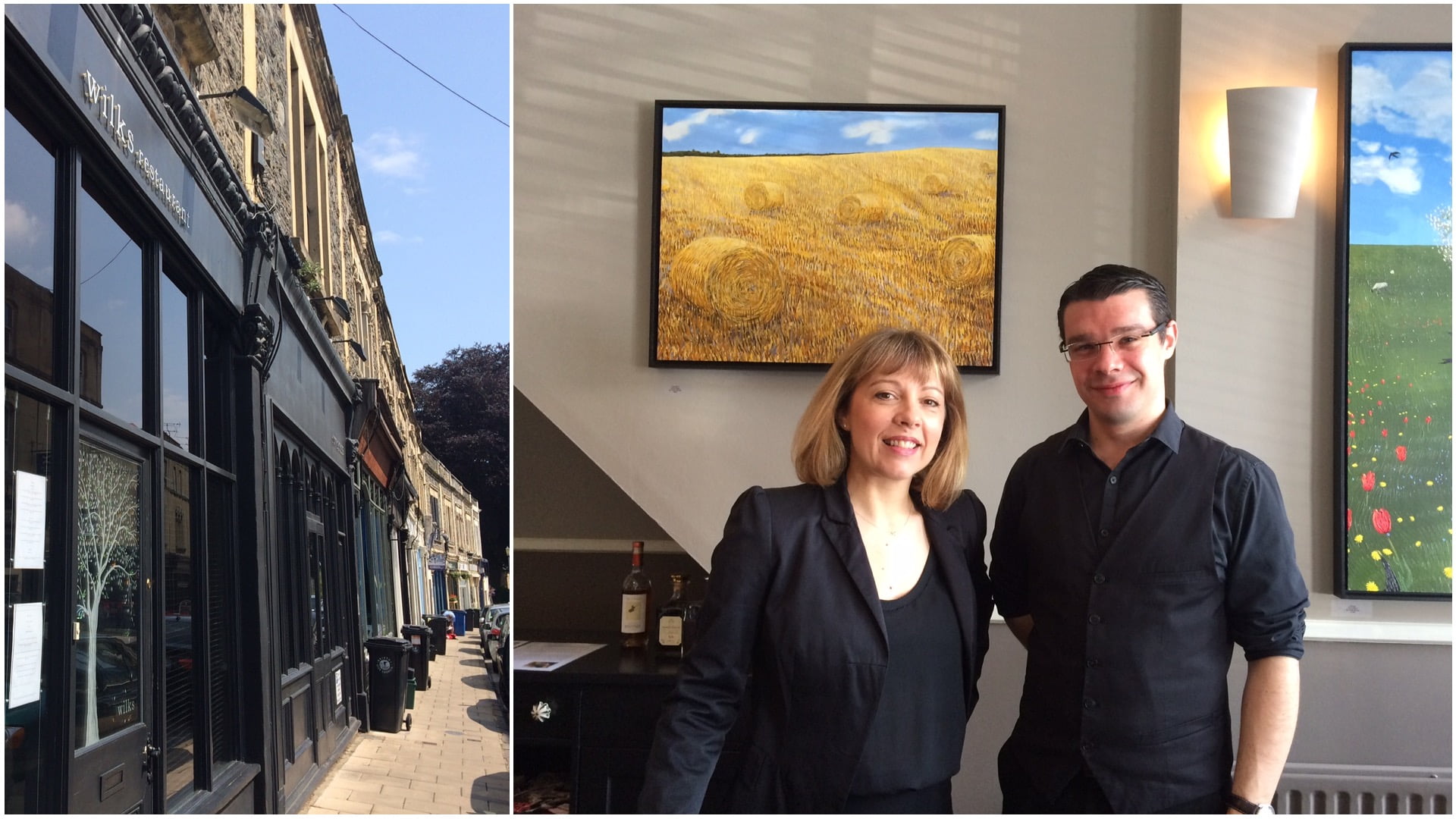
And that concludes our interview. A huge thank you to Christine and Ludovic for talking to us. Their passion for rooting out the best ingredients on offer, their continual quest to explore and improve, and most of all their joy at bringing all of this together to delight their customers really shines though. We could have continued the discussions for much longer but lunch service called. Here are the details for Wilks and for some of the other fantastic local eateries mentioned in the article.
Wilks Restaurant
1B Chandos Road, Bristol BS6 6PG
http://www.wilksrestaurant.co.uk/
Bulrush – 21 Cotham Road South, Bristol, BS6 5TZ
http://www.bulrushrestaurant.co.uk/contact
Kensington Arms – 35-37 Stanley Road Redland Bristol BS6 6NP
http://thekensingtonarms.co.uk/
Psychopomp – 145 St Michaels Hill, Bristol
http://www.microdistillery.co.uk/
Wilsons Restaurant – opening soon
http://wilsonsrestaurant.co.uk/
A Tour of Northwest Spain, Issue 1: Visiting Bierzo’s Legendary Winemaker, Raul Perez
When we arrived in Bierzo the vineyards could only be seen through a curtain of incessant rain. A fog hung above the rolling hills and old vines dotted the landscape as far as the eye could see, lending whole scene a sort of ancient, haunting beauty.

We were here to visit the region’s most talented and prolific winemaker, Raul Perez. An exceptionally kind and generous man, Raul is also a genuine encyclopaedia on his native Bierzo. As he took us into the first of three wineries we would visit that day—Bodegas Castro Ventosa– he gave us a history lesson on the Perez family and its centuries-old connection to this land.
Bierzo has about 5.000 hectares under vine and 6.000 viticulturists. This is a region where a 1-hectare parcel is considered a big vineyard, and is often owned by 50 to 60 different people. Naturally, this high fragmentation has made it difficult for big companies to purchase vast amounts of land in Bierzo. On the other hand, in the last 40 years Bierzo has lost around 60% of its land under vine, most of it abandoned by people seeking better lives in cities or more profitable forms of agriculture. In the 1950s large portions were replanted with the high-yielding Palomino, usually sold to Galicia.

So it is easy to see why for Raul, working in Bierzo is more than a job or family legacy– it is a necessary effort preserve the region’s tradition and defend its reputation. The Perez family has been involved in wine there since at least 1750. That’s the date of a will, which contains a few parcels that are still in the family today. Originally grape growers, they began to make wine in the last century. Today Bodegas Castro Ventosa, which Raul owns with his two brothers, is the biggest privately-owned bodega in Bierzo. They own 75 hectares, from which almost all of their grapes are sourced.
The Castro Ventosa bodega is split into two parts: one for the young wines (or ‘Jovenes’), fermented in stainless steel and 100% destemmed, and another for the top wines which are fermented in foudres, where he uses 50-100% whole bunches. All wines are fermented with indigenous yeasts and aged in used barrels, but the most neutral ones are kept for the top wines. The reds are mostly Mencía blended with varying amounts of Alicante Bouschet (used to add acidity), and a bit of Merenzao (aka Bastarda). In fact Raul pointed out that a defining characteristic of Bierzo is that there are no single-variety vineyards—all are planted with at least 5 or 6 different grapes, including white varieties such as Palomino, Dona Blanca and Godello.

According to Raul there is no other region in the world with a higher proportion of old vines– about 80% the vineyards were planted shortly after phyloxera, from about 1880 to 1936, and old vineyards tend to be cheaper. Raul’s own vines average 80 to 90 years of age (Cepas Centenarias for example, is made with 100-year-old plus vines).
As the afternoon darkened, we moved on to the next two wineries to taste a dizzying amount of cuvees from barrel, mostly from his personal project: Bodegas y Viñedos Raul Perez. These ranged from very personal projects such as the La Vizcaina single vineyard wines, to village wines such as Ultreia de Valtuille. Even though Raul makes wines in many different styles, a common thread is that they tend to be perfumed, powerful and structured, while also extremely elegant.
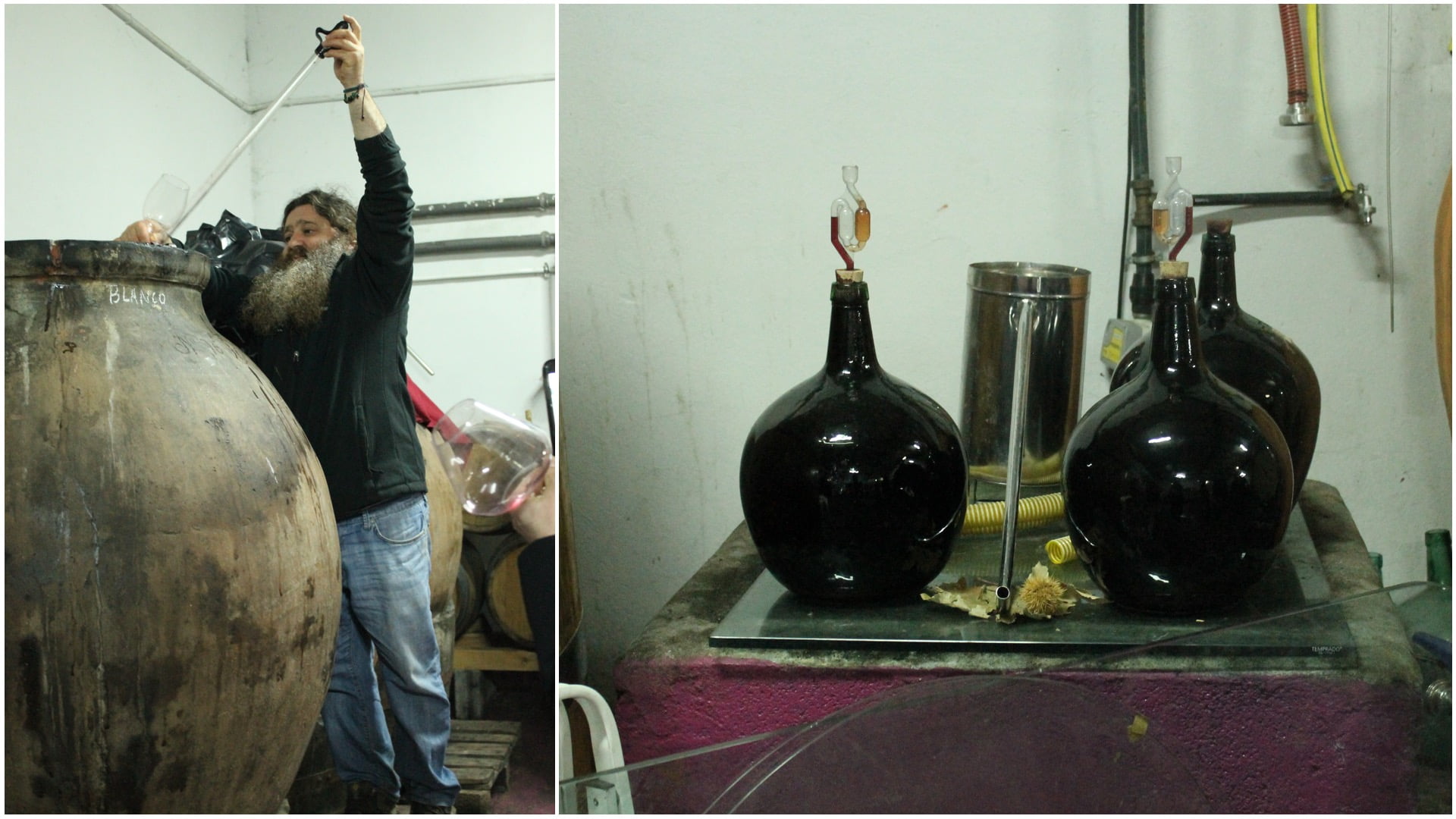
In the last winery we tasted wines he makes in other appellations and some ongoing experiments. There was a 100% Palomino, skin-contact Dona Blanca fermenting in amphora, barrels of red wines that had developed flor, others without sulphur, and the same wines at different stages of maturation. While some of us occasionally lost track, Raul kept guiding us through them with equal parts child-like enthusiasm and thoughtful insight.
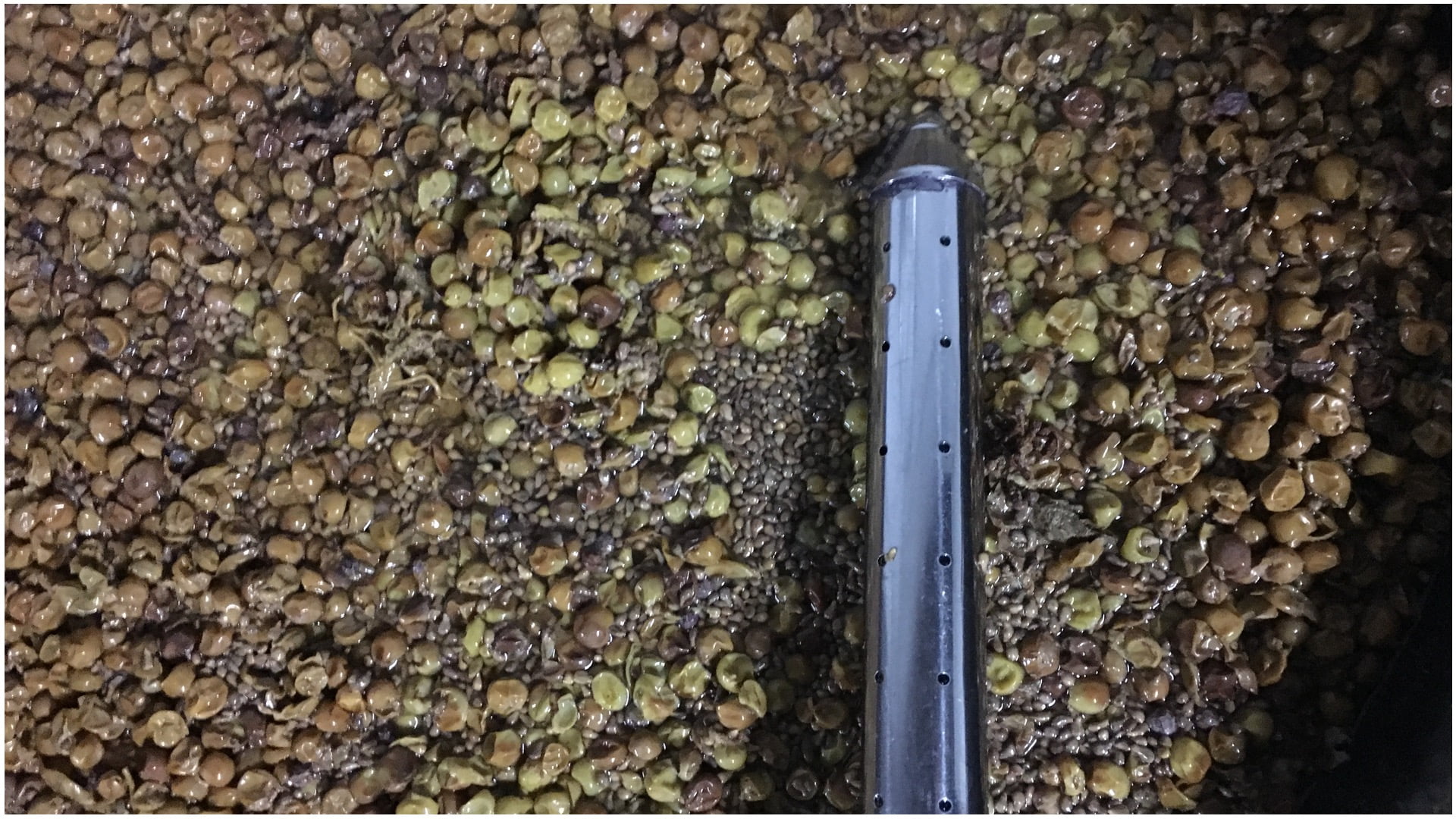
We finished the night in the best possible way: raiding Raul’s cellar before sitting down for a delicious dinner at his home, cooked by his own mother.
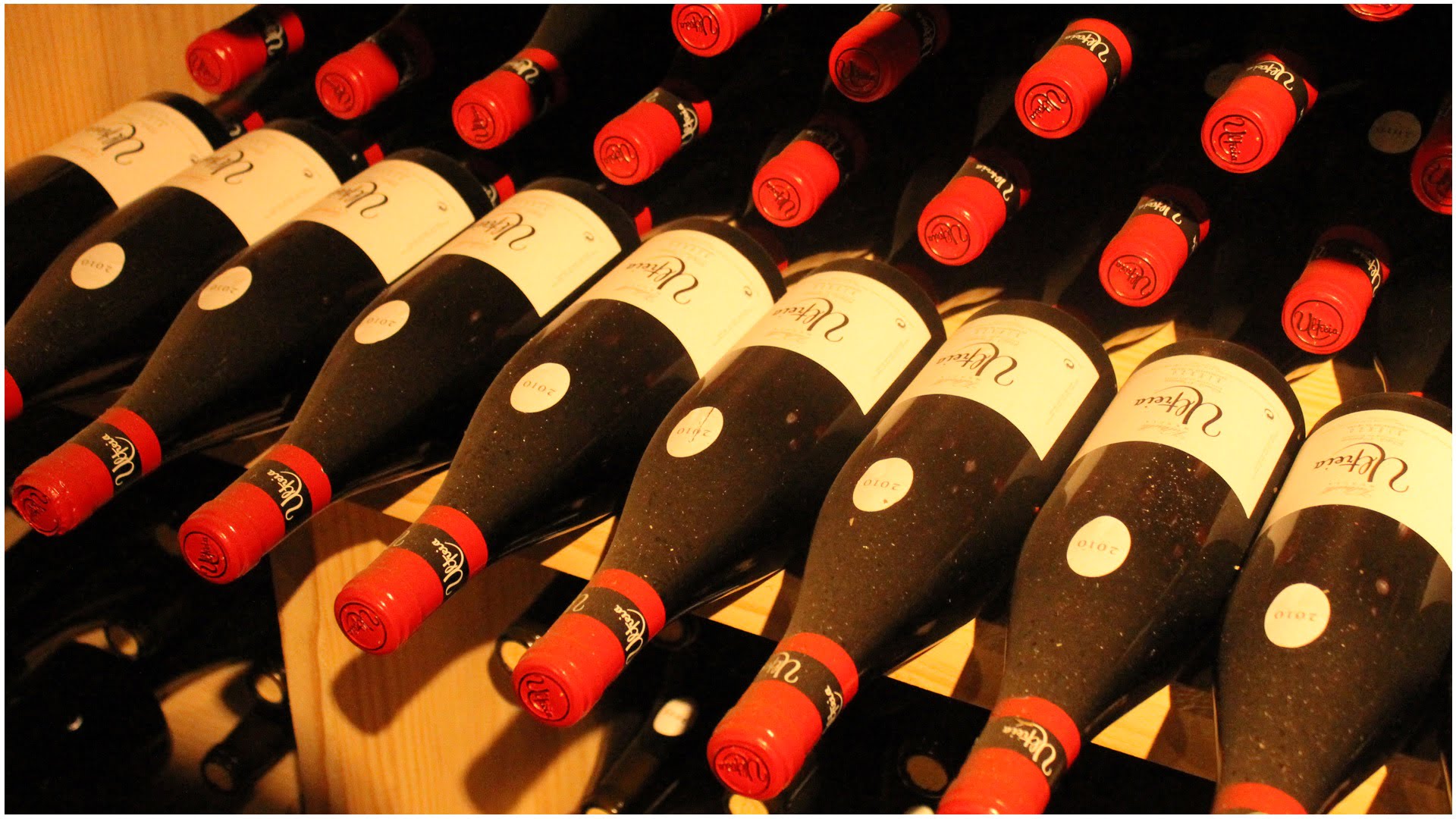
We left Bierzo for Galicia the next morning to continue our trip. But every time we mentioned Raul to other winemakers, the general reaction was the same as our own: enthusiastic remarks the quality of his wines, his endless energy, and how incredible that someone so talented and well-regarded was also such a humble, genuinely good person.

Read more about Raul’s wines on our producer pages here and here. More posts on our Northwest Spain tour coming soon!
Postcard from Tenerife
Our Buyer Ben just came back from a (working) holiday in Tenerife. Here he shares his visual diary, with a few notes about the island’s spectacular old vineyards, and the beginnings of an exciting new project for Indigo.
I spent a week in Tenerife with my family this Easter holiday. This marks my second visit to the island, a place that fascinates me with its mix of wild, rugged natural beauty, and ancient winemaking history. It’s also home to two of Indigo’s most celebrated producers, who are largely credited with the restoring the island’s reputation for producing high-quality wine, while recuperating old vineyards and working with indigenous varieties: Suertes del Marqués and Envínate.
(For a brief summary of the fascinating history, appellations, and indigenous varieties the island holds, check out this short article by Jancis Robinson.)

The first part of my trip was spent with Jonatan from Suertes del Marques, who was also generous enough to host my family for the trip. After waking to a view of the vineyards, and the sounds of the bottling line (we were sleeping right above the cellar), we took a little tour of the Suertes property, located in the Valle de La Orotava DO.
![IMG_5194[1]](https://www.indigowine.com/wp-content/uploads/2016/04/IMG_51941.jpg)
Vines trained in the Valle de la Orotava’s traditional system, cordon trenzado, where the vines are literally braided together.
Possibly the most memorable part of this visit were the El Ciruelo, La Solana, Los Pasitos and El Esquilón vineyards—the names behind some of Suertes’ single-vineyard cuvees. What hits you as soon as you get out of the car is the sheer steepness, but the old vines are equally impressive.
![IMG_5191[1]](https://www.indigowine.com/wp-content/uploads/2016/04/IMG_51911-e1460973185496.jpg)
Vines are ungrafted and many are over 100 years old
We capped off the evening with a dinner and tasting with Roberto Santana of Envínate and Robert Parker’s man for Spain, the charming Luis Gutierrez. Plenty of great wine and conversation, but by 10:30 pm I was ready for some food. Of course my Spanish friends thought it was the perfect time to taste the 2015’s down in the cellar (looking amazing by the way). It was after midnight by the time we sat down to eat with my kids asleep on the sofa in the next room, and my increasingly famished wife…
On the next day Roberto and I drove to the stunning Anaga Hills, on the northeast side of the island, to see the Envínate vineyards. This area is lush and green with sandy soils, a significant contrast to Orotava’s more arid, Mediterranean-like vegetation and volcanic soils. I’m always impressed by the diversity of terroir across the island.
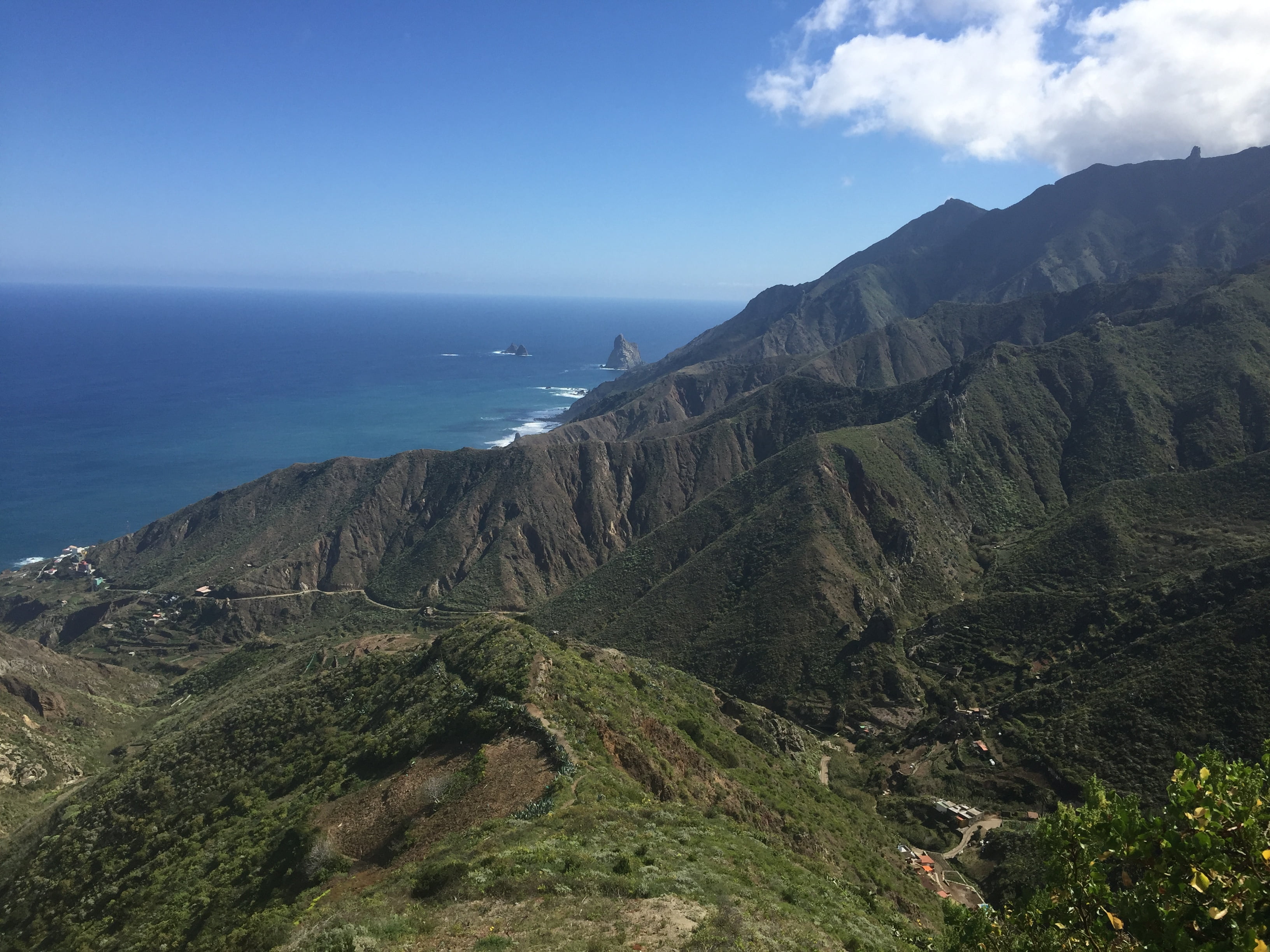
We drove up the narrow winding roads leading to a big rock commonly referred to as the Lion Head, which sits at the very top. The tiny Amogoje vineyard is planted on the “lion’s” throat. The area is so popular with hikers that Roberto has to place a sign to keep them from eating his grapes!

Envíante’s Amogoge vineyard is planted with a mix of white varieties including Gual, Listán Blanco, Marmajuelo, Albillo Criollo, and Malvasia, untrained and at least 100-years old.
We then drove through the village of Taganana to see where the red varieties are planted, perched right above the Atlantic Ocean. The vines here grow directly on the ground as a means of protection from the cold wind, and are lifted onto small wooden “stilts” shortly before harvest. These are some of the few remaining vineyards planted within such short distance of the sea—as the tourism industry grew, most of the land this close was sold off for development. They are Atlantic wines in the truest sense of the expression.
![IMG_5174[2]](https://www.indigowine.com/wp-content/uploads/2016/04/IMG_51742-e1460928546634.jpg)
Back at the Suertes del Marqués property, Jonatan took me to see an empty field he wanted to use for another project. Looking at this fertile landscape got us thinking about the possibility of planting some botanicals, so who knows– some interesting Tenerife spirits might be hitting these shores in the future. It’s just a dream for now, but at the very least it gives me a good excuse to go back soon.
For more information on the wines of Suertes del Marques and Envínate, please visit their producer pages here and here.