
Our Blog
A flying visit from Barco del Corneta
Beatriz describes her wines as ‘swimming against the current’, and she certainly seems to be making waves in her hometown of La Seca in northwest Spain.
Ten years ago Beatriz returned to her family’s land in La Seca, Valladolid, to plant 5 hectares of vines with the help of her mother. This is where the grapes for her Barco del Corneta Verdejo come from. Beatriz has a special fondness for this wine that is clearly a labour of love, and the wines are only getting better each year. She explains that 2015 was a hot year, so was 2017, yet when we taste the 15 the balance and acidity is striking, with a wonderful waxy texture.
Her newer project is from 100 year old, untrained vines. These are about 30 km outside of La Seca, as old vines are hard to find in her town. Sadly many vineyards in the area have been ripped up to replant, as there is a lot of bulk wine that comes out of the region. ‘People here think that 30 years is old for vines! They do not realise.’ Her ethos of small production, organically farmed, small hand-worked plots is unusual in a land of large, conventional producers. ‘There are maybe 4 or 5 other artisan producers in my area, quite spread out, but we all know each other.’
Her Grandfather’s plot of old vines that provides the grapes for Judas (Viura) also gives its name to the wine. The other two wines in this trio – Casio and Bruto – are named after characters from Dante’s Divine Comedy. Casio is a deeply complex and intense expression of Verdejo, one that just grows in the glass (best to decant before serving). Bruto is made from Palomino, a grape traditionally found in the south of Spain; ‘it is unusual to see it up here, and very hard to find.’
‘People here think that 30 years is old for vines! They do not realise.’
With the recent trend of focusing on female winemakers, it would be easy to remark on Beatriz’s status as a solo young female winemaker making waves in a region dominated by bulk wineries. Yet she finds it unremarkable: she planted her vineyard with the help of just her mother, she has a clear vision of what her wines should be and is unfazed by being the lone artisan producer in her area. ‘Maybe it gives me a point of difference here, which can be helpful. Otherwise, I don’t think it matters, it is about the wines.’
She and her boyfriend are moving to La Seca (her hometown) from Valladolid, so she can be closer to her winery. He works with her to design the labels, some of which they are changing this year.
You can find more information on the Barco del Corneta wines on our website, or email emily@indigowine.com or contact your sales rep.
Viñedos de Alcohuaz: True mountain wines from Chile’s Elqui Valley
The Elqui Valley, a link between the cool Pacific of northern Chile and the towering Andes, can take your breath away. This is where Viñedos de Alcohuaz are growing Syrah, Garnacha, Malbec and Petit Verdot, at almost 2,200 metres above sea level, where the mountains seem to touch the stars. A combination of extreme day and night temperatures, mineral soils, perpetual sunshine and low rainfall contribute to the spicy mineral characters and fresh vibrant acidity that underlines all their wines. These are unique wines from a unique place – true mountain wines.
Indigo caught up with Fernando Vargas, their marketing manager to hear how the recently completed 2018 vintage is looking.
After a series of unpredictable years influenced by El Nino, how was the 2017-18 growing season?
We’re very happy with what we harvested in 2018. The growing year was mild, with low rain, so the fruit was healthy and phenolically ripe. This was a relief as 2016 was a very short growing season – we had snow in October, a disaster for the Malbec and Garnacha, the young shoots were devastated. The quality of what we harvested was good but we had 10% of the normal yield. In 2017 the vines were still recovering, and our yield was around 60% of what we’d normally expect.
It’s a risk you take when you’re work with ‘extreme terroir’. We knew this when we started the project, it just hasn’t been this extreme for 30 years!
It’s still a relatively young project, is anything changing as you progress?
We don’t have a recipe, everything depends on the year. Reta (Marcelo Retamal the winemaker) has a lot of experience in Chile, he’s learning this new terroir and the conditions. Over the last two vintages we’ve changed the way we work with the Garnacha. We used to vinify it in open lagares, but as the grape is sensitive to oxidation, and we now use closed conical concrete tanks so the style is more reductive.
We’ve also started adding stems – 20-30% – to Grus and the single vineyard Garnachas which gives greater freshness.
How are things changing in Chile, there’s a lot of talk about a move towards quality, and exploring different regions with more terroir driven wines?
There’s a business focused core to Chile’s wine industry that focus on volume not terroir. Wines of Chile has around 400 members and less than 1% are small producers, so the WoC budget is directed by the big wineries. Small producers have different aims, over the last 5 years we’ve started to join together in groups such as MOVI (Movement of Independent Vintners), to present ourselves to the trade and explain what we’re doing differently. Not everyone is riding the same wave with a priority of quality. Argentina is better organised in this respect.
What’s most exciting about winemaking in Chile at the moment?
There isn’t just one thing! We have great assets: a diversity of terroir, from high altitude sites in the Andes to coastal micro-climates. Small producers are energised, they’re experimenting, matching the best varietals to the most suitable sites. The central part of Chile is good for ‘Coca-Cola’ wines, but outside this area the most diverse areas are being explored, producers are dry farming to get more character from their vines.
The central part of Chile is good for ‘Coca-Cola’ wine, but outside this area the most diverse areas are being explored, producers are dry farming to get more character from their vines.
What next?
There is very little legal framework around winemaking in Chile, no DOCs. We need to develop a framework, for example ‘Reserva’ on a bottle means little, you can buy very cheap Reserva wines. Consumers aren’t stupid, they will realise it means nothing if a Reserva wine costs £5. We need to generate trust with consumers, so they know what they’re buying and will feel comfortable to spend more.
Many wineries keep growing. This is not the spirit or vision at Alcohuaz, we want to remain truly boutique.
You can find out more about the project and individual wines on our website.
If you’d like to taste them or enquire about volumes please contact your sales rep or orders@indigowine.com
Future classics: Suertes del Marqués doesn’t just want to be labelled as volcanic wine
Jonatan Garçia Lima of Suertes del Marqués wasn’t born into winemaking, his family bought vineyards in their native Tenerife the 90’s. Initially they sold their grapes, but in 2006 they started to make their own wines. Obviously some things have changed since those initial vintages. They have reduced yields and stopped using herbicides and systemic treatments, but they remain committed to working with the wealth of native varietals and traditional cordon trenzado training system that you find in the Orotava Valley. In the winery they also respect traditions, working by hand, using native yeasts and only minimal sulphur additions.
Volcanic wines have become ‘a thing’ recently, which is obviously beneficial to Suertes del Marqués. Do you worry about a loss of interest when consumers (and wine writers) move to the next hot topic?
Jonatan – Actually I worry more that people are pulling up our historic vines to plant avocados! 10% in Orotava have been pulled out, they get 3 Euros per kilo and they’re not as labour intensive as grapes.
For the last 6 years we’ve been popular, I want to sustain that momentum, I’d like to be a classic name, an integral part of wine lists in the future. I would like to get to a point where people don’t think “I’m ordering a volcanic wine”, but “I want to drink a Suertes del Marqués wine”.
I’m taking a long term view with Suertes, looking at the bigger picture. I don’t just want to be a cellar of fashion, I want to be a classic, I want people to say, “This is a great wine”.
Will anything need to change in order for that to happen?
JGL – We’re learning as time goes by, each vintage improves. We started making the wines in a extractive way, but gradually we have moved away from wood towards fresher wines, with lower alcohol, aiming for a longer finish and greater ageing potential.
There isn’t much precedent on how these smoky volcanic wines will age, how do you see them tasting as they mature?
JGL – Being a young project it is hard to tell. 7 Fuentes from 2008, despite being our entry level wine, has aged really well, it’s still incredibly alive. This made me think about the importance of alcohol levels and acidity.
Jonatan is particularly pleased with the 2016s, it was a warm vintage, but the wines are fresher than the 2015s as they took the decision to harvest earlier.
JGL – Early picking makes Listan Negro a completely new grape, it has a fresher style. Also previous to 2016 we de-stemed and added some stems back. This didn’t make sense, sometimes we were adding green tannins and the grapes get damaged by de-stemming. Since 2016 we’ve been using a percentage of whole bunch, higher for the single vineyards, and the tannins are better integrated. Generally we’re ‘working’ the wines less, and using longer macerations, and the result is a longer finish.
At this moment I’m very happy with the wines from the latest vintages. I think the single vineyard wines such as El Esquilon, El Chibirique, El Ciruelo and Los Pasitos will be tasting great in 10 years time. I think we are going to continue working in this way, but maybe in 10 years I could see that I was wrong!

Any new wines on the horizon?
JGL – I have a few projects. I’m working on some fortified wines and experimenting with Listan Blanco under flor, in a barrel from Ramiro Ibáñez who makes Cota 45 in Jerez. I’m aiming for a Jura style.
Also I read in an old book about the history of Tenerife that there are historical plantings of Souson,* I’m going to look for them!
We have a good range of the 2016s in stock with more 7 Fuentes and El Lance on the way, contact orders@indigowine.com or your sales rep if you’d like to discuss availability of specific wines. You can find out more information about Suertes del Marqués and the wines on our website.
*Souson can also be found in Galicia. Try Coto de Gomariz’s Flower and the Bee red.
Smell something fishy? Clarifying the vegan wine debate.
Indigo takes a moment to consider the hot topic of vegan wine, starting with what makes a grape-based product non-vegan in the first place?
With the success of ‘Veganuary’ this year and a rise in vegan restaurant openings, it seems the tide is turning as consumers are increasingly thinking about what’s on their plate. And, so it seems, in their glass. No longer to be dismissed as a ‘fad’, veganism is an indication of a new way of thinking around the integrity of the food and drink we consume. Wine is no exception. But how can a wine actually be vegan? Or not vegan? It’s just grapes, right? With multiple views and an increasing number of voices joining the conversation surrounding vegan wines, we’re here to set our vinous record straight.
The vegan status of a wine is all to do with the process called ‘fining’.* This is done to remove the naturally occurring haze of tiny particles in newly made wine. These particles are harmless, consisting of bits of grape skin, spent yeast, etc. However, many consumers don’t like or trust hazy wine (reminiscent of the ‘wonky veg’ debate perhaps?) and so some winemakers take steps to remove these particles.
Fining agents that can make a wine non-vegan include gelatin (protein from pig skins or animal bones), casein (milk protein), egg albumen (chicken egg whites) or isinglass (fish bladders). Yes, you read that right – fish bladders contain collagen fibres that clump together when put in contact with wine. They bind with all the small suspended particles and sink to the bottom of the vat, so the clear wine can then be drained off. Agents like isinglass are more commonly used for whites and rosés, while egg whites are better suited for reds. Winemakers have come a long way since the days of using bull’s blood (a traditional fining agent, banned in the EU since 1997), yet animal products are still widely used.
While technically the fining agent is entirely removed from the wine by filtration afterwards, it’s possible miniscule traces could remain in the finished bottle. Winemakers are split on the need for fining: some think it strips the wine of some of its natural texture and character; for others it’s an important part of ensuring the stability of the finished wine. Regardless of what side of this fence you happen to sit on, some consumers will always value the clear and faultless appearance of a product.
Remember, organic doesn’t necessarily mean vegan (although often a sustainable approach in the vineyard goes hand in hand with low intervention in the winery). It’s a complex topic, and to the curious outsider it can add to the often seemingly opaque world of wine. At Indigo we search out producers whose philosophy is to work sustainably, with minimal intervention in the vineyard and the cellar. Almost all our wines are suitable for vegans, mostly being unfined and unfiltered, with some using a little bentonite or vegetable proteins.
Our price lists have now been updated to include vegan information for each wine. Please contact your rep for a copy of the list, or if you have any queries please contact orders@indigowine.com
*Some people argue that using animals or animal products when farming the vineyard negates a wine’s vegan status. This view rules out most biodynamically farmed wines, due to their use of preparations such as horn or silica manure, and any vineyards that traditionally use horses for ploughing. At Indigo we focus our vegan information solely on the winemaking process, but our list notes where winemakers work biodynamically.

What about beer? Our partners at Biercraft give us the lowdown on beer and veganism.
Thankfully, the vegan status of a beer is simpler than for wine! The most used fining agent is Isinglass, yet this is used less and less and is mainly found in cask ales. Many breweries are moving away from using Isinglass and consider not fining their beers at all – like Moor Beer Company from Bristol, proud to not be using any fining agents and are therefore serving naturally hazy beer – or are using synthetic agents like PVP instead. Most beers that are bottle conditioned are unfined and vegan-friendly. Like the Indigo wine selection, nearly all Biercraft’s delicious beers are vegan-friendly. Exceptions are the Hammerton Oyster Stout (oysters and their shells are infused in a mash before fermentation), Hiver Honey Beer or any beers with an addition of lactose, though there are currently none on the list.
If you’d like to hear more about any of these beers, or if you have any queries please contact theresa@biercraft.co.uk
Harvest 2018: a view from the Swartland
Luis from our sales team was over in South Africa recently and spent a couple of weeks with Johan Meyer. It’s a stressful time for South African winemakers, the country is experiencing the worst drought for over a century, and rainfall for the last three years has been way below normal.
Johan works with farmers across the Swartland region. They don’t irrigate, but the vines need a certain amount of water to photosynthesise. At a certain point, even older bush vines with their deeply established root systems struggle to tap into any groundwater. Without water, grape development stops, so somewhat counterintuitively, grapes can take longer to ripen during periods of extreme hot, dry weather.
When Luis arrived, harvest in the Swartland was running a few weeks later than average, so, rather than sorting grapes and filling presses he had to busy himself with other tasks.

Day 1 – No harvest yet. Instead, we labelled around 1,000 bottles of Force Majeure Chenin Blanc by hand. The price may need to go up!
Day 2 – More work in the winery – disgorging and hand-labelling two new Pet Nats, The Love Child Pinotage and Otome Chenin Blanc.
Day 3 – Rain at last! Niklaas, the cellar hand, said the last time he saw rain in the area was almost a year ago. Cause for celebration with a bottle of Johan’s new Pinot from Elgin. Made with whole clusters and carbonic maceration to give a light strawberry-coloured brew, it had vibrant red fruit aromas and a fresh palate with touch of amaro. Perfect thirst quencher.
Day 4 – There’s always something to do in the winery. Today we were topping up barrels of the 2017. This is sometimes referred to as paying the angels share, 2-5% of wine in a barrel can be lost to evaporation in a year. Plus, we were treated to a lesson from Niklaas, the Jedi Master waxer. I think he may have done a few of these before. Luis, the young Padawan waxer seems to be getting the hang of it, just 500 more to go Luis…

Day 5 – Finally some vines…
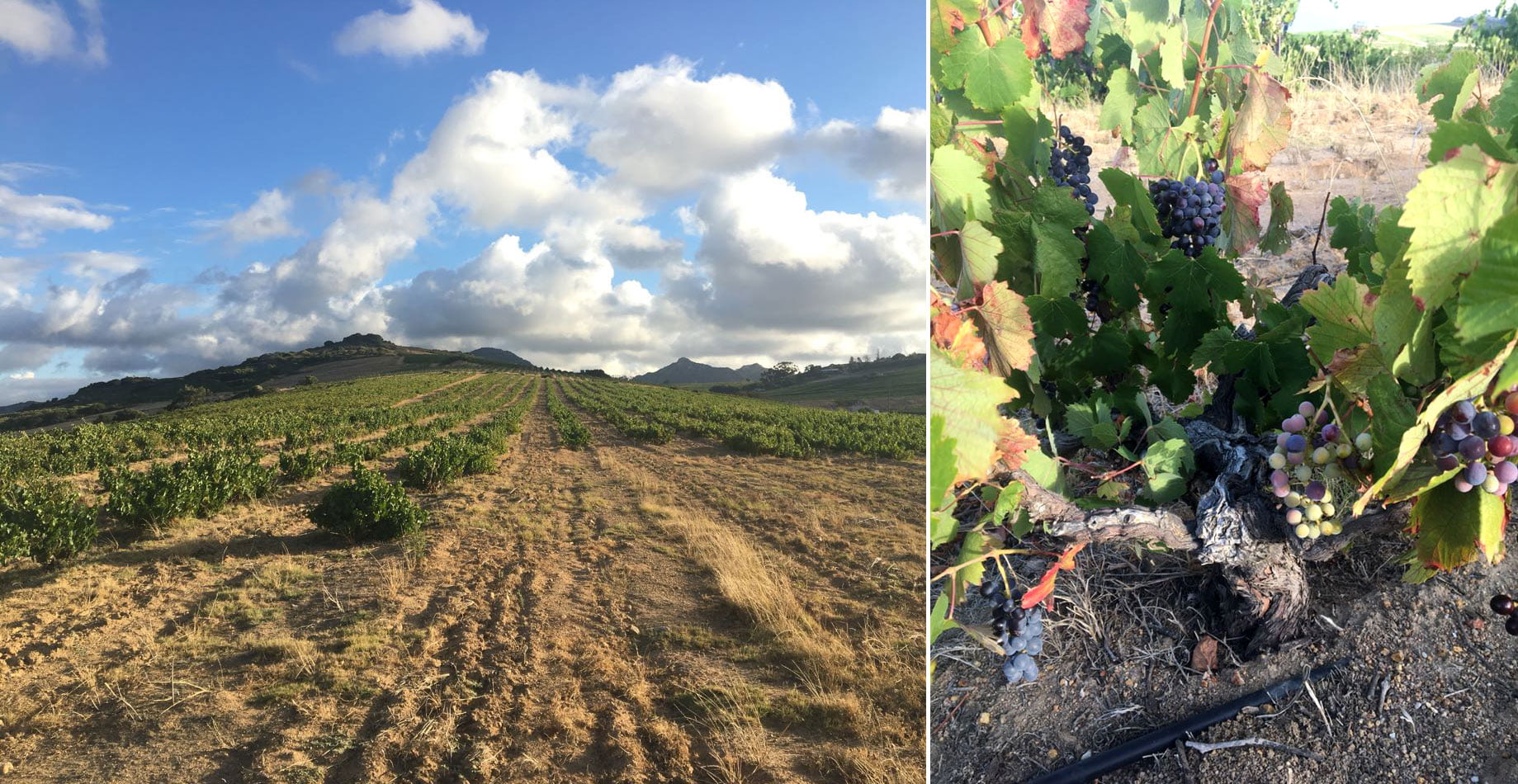 This east-facing vineyard at Scholes Farm in Paardeberg, with sandstone soil, was planted in 1967 with Pinotage and some Tinta Barroca. Pinotage is one of the earliest varieties to harvest, even before Chenin Blanc.

Day 6 – It’s happening HAAAARVEST!!
Today we start picking at Kweperfontein Farm in Joubertskloof. Four tonnes were harvested by hand, not a bad start. The 15-year-old Chenin Blanc vines you can see in the picture below go into Johan’s Force Majeure White and Mother Rock Liquid Skin (skin contact Chenin from Paardeberg granite). This year Johan is also making a zero sulphur Chenin under Joan Ramon Escoda’s ‘Brutal’ label.
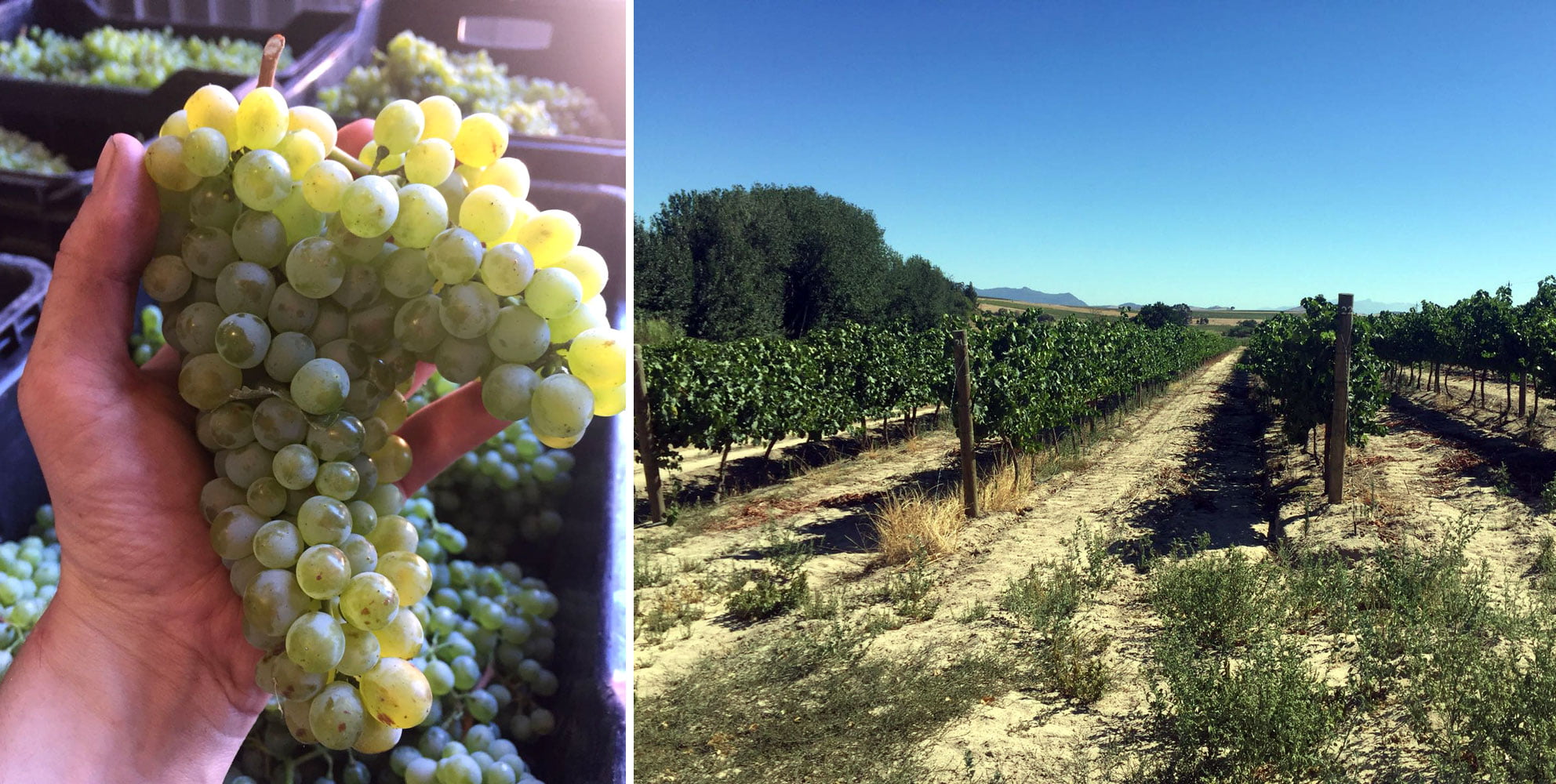
 First pressing of the Chenin Blanc. The small basket presses take longer to load and clean, but they’re perfect for small batches of grapes and are gentle on the fruit.
Due to the late start to the harvest, Luis only saw the Chenin Blanc come in. I caught up with Johan this week, he has some Mourvèdre in Swartland, and Pinot Noir from the Western Cape which goes into his Cradock Peak site remaining to harvest. He’s happy with the quality of the grapes, but said ripening was uneven, and some vineyards struggled with sun burn so rigorous selection was needed, and yields are down 50% on average.
Johan will be coming to London in early May, the perfect opportunity to ask him how the 2018s are looking, and to try new Kleinrivier Chardonnay and Pinot Noir from Hemel en Aarde Ridge. Email us if you’d like to arrange meet Johan and taste.
The pirate winemaker: Frederick Stevenson
Wines of incredible energy and character are coming out of a warehouse in the middle of Adelaide, proof that you don’t need a chateau or high-tech equipment to make good juice. With their attention-grabbing artwork and focused freshness, they’re truly expressive of the guy behind the label. Frederick Stevenson, the winemaking alias of Steve Crawford, appeared in 2011, and has been defying vinous norms ever since. Steve/Fred’s frank charisma and enthusiasm make it a challenge to keep up with him, but we managed to pin him down when he was in London recently to get the full story.
With hindsight it seems inevitable that Steve would end up making wine. Originally, he hoped to be a chef, but while working in a garden store he realised he wanted to do something that involved travel and being outside. He studied viticulture and worked in cellars and vineyards across South Australia. He talks about the difference between the traditionally European path into winemaking – being born into wine from living in a certain region – versus the Aussie way: ‘I was surrounded by wine but not involved in it; the whole thing is more industrialised, you go to study wine and then decide to do it, it’s not so much “in the blood”’.
 Steve in his Montepulciano vineyard
His interest in the European winemaking culture led him to work in Rheinhessen. It was Steve’s first encounter working with a natural and biodynamic producer, and with Riesling. ‘It was a more intuitive form of winemaking, built up over years, compared to the clinical way I’d studied and learnt.’ Here was winemaking with a simple approach, with a focus on slow, oxidative processing, that produced a wide variety of styles of wine. This, says Steve, hugely influenced and still frames his own handling of Riesling.
‘Texture and interest’ became the focus of what he looked for in a wine, and he spent the next four to five months travelling around France, northern Spain, northern Italy, Austria and Germany considering this idea. Steve’s curiosity led him to explore constantly; when in Italy, at harvest he would buy bottles from various producers in the region to drink over dinner each night, to see what was being done nearby and to gain a deeper understanding of that place’s character and potential.
For a time Steve worked in the Southern Rhone in Costières de Nîme, and it was here that he became fixated on Cinsault, as well as Marsanne and Rousanne. ‘I think I gravitated towards Cinsault… it provides nuance to Grenache and Shiraz, it gives that rose petal or Turkish delight thing as well as something savoury.’ This is the blend he ended up using in his Dry Red – bright, crunchy and loaded with personality. In Steve’s words, ‘this is the wine you just drink – smash against the wall – and walk out.’ He also talks about how Marsanne/Rousanne blends ‘aren’t really done in Australia’, again something he ended up working with himself. Nor does he feel dry styles of rose are very widely explored back home ‘they’re usually very sweet; I only really encountered dry rose in France.’

In 2011 he moved back to Australia with a head full of ideas and a fresh approach to winemaking. ‘I actually felt weirdly anxious about recipe winemaking in Australia.’ 2011 was a wet vintage – ‘It got terrible press, restaurants wouldn’t touch it, even though we praise wet years in Burgundy. It was a first chance to explore elegance in wines this year but the opportunity wasn’t grasped. People still pushed high yields, and it didn’t work.’ That year there was too much Grenache in a vineyard he liked so he bought a tonne of grapes to make his own wine. ‘It’s very susceptible to botrytis… in the end it was fine, a bit spicier than usual, but restaurants still wouldn’t buy it because of the vintage.’
‘I actually felt weirdly anxious about recipe winemaking in Australia.’
This first venture into winemaking came about while he was still working for a large winery. His desire for a platform to experiment with his own ideas pushed him to create his underground label, and in 2012 he made his first Montepulciano in his garage. The fruit came from an old vineyard with sand over clay soils: ‘I find clay brings a savoury aspect to the wine. Montepulciano has that great sausage skin savouriness.’
 ‘Bloke Art’: hand marbled paper by Steve for his Montepulciano label
He reflects on the shift that’s taken place in the Australian food scene over the past few years: ‘big Barossa Shiraz isn’t valid anymore in top restaurants’. With the rise of Nordic cooking, pairing menus and Asia-Pacific influences, a need has arisen for a different style of wine more akin to the lighter styles he admired and enjoyed in Europe. These are food friendly wines, and it’s this social aspect that is at the heart of his ethos. A sense of collaboration and community is central to his project; the striking artwork on all the labels are done by friends and local artists, with each artist being responsible for their particular bottle each year.
‘big Barossa Shiraz isn’t valid anymore in top restaurants’. With the rise of Nordic cooking, pairing menus and Asia-Pacific influences, a need has arisen for a different style of wine more akin to the lighter styles he admired and enjoyed in Europe.
Steve still has his reservations about the industrialised wine scene surrounding him. He muses – ‘A younger person can only get so far’ – and yet he’s able to live out that intuitive winemaking he so admired in Europe. He works with the biodynamic Vine Vale property in Barossa, and his organic Hongell vineyard. It’s still early days – ‘I work with simple equipment, I’m getting to know my vineyards’ – but it seems the pirate winemaker of Adelaide is now very much the captain of his own ship.
We currently stock three of Steve’s wines: The Dry Red, a bright perky blend of Cinsault, Shiraz and Grenache, a little untamed and loaded with personality, the perfect entry into the world of Frederick Stevenson; the Montepulciano, bursting with cooked plums and mulberry, fine dusty tannins, fresh acidity and alpine herbs on the finish; and the plush Hongell Grenache, with a fine tannin backbone and juicy acidity.
Portfolio Tasting 2018 – Meet the brilliant people behind the wines
Our Portfolio Tasting is back, on Wednesday 21st February at The Vinyl Factory in Soho.
Nobody knows or speaks more passionately about our wines than the producers themselves, so we’re very excited over 40 of them coming to London for the tasting this year, including new members of the Indigo family: Mosel biodynamic pioneer Clemens Busch; engineer turned winemaker Antonio Madeira who is revitalising ancient vineyards in the Dão highlands; Jorge Monzón is doing a similar job at Domino del Águila and is presenting Ribera del Duero wines in a whole new light; Raj Parr will be pouring this terroir focused Evening Land wines from Oregon; Pax Mahle, one of the driving forces behind the much written about ‘New Wave’ wine scene in California; and from closer to home our first English vineyard, Hoffmann & Rathbone in Sussex. They will be joined by familiar faces including 4 Kilos, Casa Castillo, Daniel Landi, Envínate, Fedellos do Couto, Eulogio Pomares, and many more. You can find a full list at the bottom of the article.
As in previous years we’re joining forces with our friends Biercraft, who work with the most exciting small craft breweries from London and beyond. You’ll be able to taste new additions to the Biercraft portfolio: Ronald Mengerink from Dochter van der Korenaar who is making some of the most highly regarded beers in Belgium right now; vying for the title of England’s most bucolic brewery, Mark Tranter and team from Burning Sky in Sussex; Moor Beer‘s can conditioned ales, traditional enough for CAMRA purists whilst pushing a modern hop forward agenda; Dry & Bitter from Denmark, arguably Europe’s finest exponents of the modern IPA. Plus Biercraft stalwarts and London’s best breweries: The Kernel, Five Points, Beavertown, Brew by Numbers, Pressure Drop, Partizan et al.
Come and meet the brilliant people behind the wine and brews – the buzz will be unmistakable!
Indigo Wine & Biercraft Portfolio Tasting
Wednesday 21 February, 2018
10:00 – 17:30
The Vinyl Factory, 51 Poland Street, London, W1F 7LZ
Hoffmann & Rathbone | Sussex
Hure Fréres | Montagne de Reims
Sorelle Bronca | Valdobiaddene
Evening Land | Willamette Valley | Oregon
Pax | California
Birgit Braunstein | Burgenland | Austria
Andreas Bender | Mosel | Germany
Clemens Busch | Mosel | Germany
Georg Breuer | Rheingau | Germany
Peter Wetzer | Sopron | Hungary
4 Kilos | Mallorca
Bodegas Bentomiz | Málaga
Bodegas las Orcas | Rioja
Bodegas Marañones | Vinos de Madrid
Casa Castillo | Jumilla
Castro Ventosa | Bierzo
Celler Pardas | Penedès
César Márquez | Bierzo
Coto de Gomariz | Ribeiro
Daniel Landi | Méntrida and Cebreros
Dominio del Águila | Ribera del Duero
Envínate | Ribeira Sacra
Familia Nin-Ortiz | Priorat
Fedellos do Couto | Ribeira Sacra
Fento | Rías Baixas
Javier Revert |Valencia
Luis Anxo Rodríguez | Ribeiro
Pamela Geddes – Lobban Wines | Penedès / Jumilla
Terroir al Límit | Priorat
Zárate | Rías Baixas
Antonio Madeira | Dão
Marcio Lopes | Vinho Verde
Muxagat | Douro
Quinta Pellada – Alvaro Castro | Dão
Tiago Teles | Bairrada
Vitor Claro | Alentejano
Adalia | Valpolicella
Colombera & Garella | Piedmont
Eduardo Torres Acosta | Sicily
Fattoria di Sammontana | Chianti
Vina Čotar | Kras | Slovenia
Markovitis Winery | Naoussa | Greece
Historic Rioja Wines
Over the last few years we’ve been working with Johnny Hartwright, who is based in Barcelona and has a passion for sniffing out consignments of old vintage Rioja. The wines have typically been cellared in the same place ever since they were released and sold, and have aged into elegant, ethereal wines which match beautifully with food.
I caught up with Johnny recently to find out more about his vinous treasure hunts and why he thinks Rioja wines age so well.
When did you realise there was a market for these wines?
“Since moving to Spain I had tried and enjoyed mature wines from Rioja. Someone tipped me off about a huge collection of over 100,000 bottles which had been stored in a basement car-park – near perfect cellaring conditions! I sold the whole lot – seven lorry loads, the largest single parcel of old wines sold – to a UK indy wine retailer. Seeing the demand was there I saw the potential, and started to look for other stashes!”
Johnny never buys large collections of wines without first checking out the storage conditions and tasting some of the bottles. Spain can get hot and unfortunately some wines have not been well stored. He was understandably tight-lipped about how he sources the wines, many of which have been stored in their original cellars since release, however he has some unusual anecdotes about their discoveries which he’ll share with us when he comes over.
What is behind these Rioja’s longevity and ageing ability?
“There are two factors, grapes were picked earlier and at lower sugar levels in the 70s and 80s – the pH of the juice produced is lower and the acidity of the wines was higher which gives them freshness and good aging potential. Secondly it was common in the 70s to keep Crianza wines in barrel for at least two years, the requirement is a year, the Reseva and Gran Reserva wines were often kept in barrique for much longer. This longer aging in wood is only practiced today by a few producers such as Lopez de Heredia, it helps to stabilise the wine as well as concentrating the aromas and flavours giving them the concentration for a long life.”
This tradition for oak aging was born in the late 19th century when Bordeaux producers, fleeing from the twin plagues of mildew and phylloxera brought their barriques over the Pyranees to Rioja. This is when many of the grand old bodegas such as La Rioja Alta, CVNE, López de Heredia, Muga, Marqués de Murrieta and Marqués de Riscal were founded.
And what of Riojas today will they go the distance like the examples from the early 20th century?
“I’m not sure, wines today are often picked riper and therefore have lower acidity. There is also a shift away from long oak aging as consumers seem to prefer more fruit driven styles. I don’t think modern day wines will go the same distance as those produced in the 70s, 80s and early 90s, I guess only time will tell.”
So it seems we should enjoy these graceful old Riojas while we can.
We’ll be opening a selection at a tasting at The Larder on Wednesday 18th October – if you’d like to join us for a glimpse into Rioja’s history or would like a list of the wines we have available contact us.
Seeing beyond Malbec – Edy del Popolo on the growing diversity in Argentine wines
Indigo has recently started importing wines from PerSe, a personal project from Edgardo (Edy) del Popolo and David Bonomi, who are pioneering terroir driven wines in Argentina. I caught up with co-founder Edy del Popolo to learn more about the project and his thoughts on the outlook for Argentine wines.
Edy and David are trailblazers on the Argentine wine scene. They met in 1995, when they were working together at a local winery – David in the winemaking team and Edy as a viticulturalist. Today David is considered one of the most knowledgeable oenologists in the Uco Valley, with on-the-ground experience from Altamira in the south to Gualtallary in the north. He was recently named young winemaker of the year by Gaucho Restaurants, which his friends like to tease him about joking he is very well preserved for 48, and after over 30 harvests! Edy was practically born under a grapevine: his parents owned vineyards in north Mendoza, all his aunts and uncles worked at wineries, vineyards and barns were his and his cousins’ playground. “Vines and wine are part of people’s lives in Argentina, not just a job”. With this background it was almost inevitable he would go on to study oenology and agronomy at UNC in Mendoza. In 1998, when the winery he was working at was sold to the Santa Rita Estates, he became Doña Paula’s first Argentine employee, going on to oversee planting of over 1,500 hectares for them across Argentina. This allowed him to explore from north to south and to really get to know the main wine growing zones. Throughout this time he was trying piece together a puzzle of site, climate and vine, to understand how natural and man-made factors affected the finished wines, and searching for the perfect combination. “I like to discover new places and raise the bar. I like to fix new parameters, to build the next level”.
Despite all the knowledge they were gaining, they were both mainly making a commercial style of wines aimed at certain markets, not the type of wines they really enjoyed. So in 2012 Edy left Doña Paula to start an independent project with David. PerSe is a boutique project based in the Uco Valley making fine wines which express their origins as transparently as possible, wines which spontaneously express the sites they come from rather than the winemaking. Tim Atkin in his 2017 Argentina report cites terroir as being increasingly important in Argentina – In this respect Argentina is becoming more Burgundian. Greater understanding of the influence of calcium carbonate is bringing freshness to top wines.
The terroir they have chosen is Gualtallary, a subregion to the south-west of the town of Tupungato. Although terroir is a word Edy prefers not to use – “I prefer site or location, if you understand and respect a place you can enhance the character and reveal its potential and only then make fantastic wines” – Gualtallary is a zone they both know extremely well, and one with a wide range of sites and conditions. The temperatures are cool to very cool, so Edy explained they have to choose their sites carefully as only certain sites can produce grapes that fulfill their potential. They work with small plots of 0.2-0.5 hectares, often with very stony and calcareous alluvial soils. At these altitudes of around 1,500 metres, with the intensity of sunlight Edy says it is important to restrict vegetative growth, contain the vine roots and make them work hard. They prune in the goblet style with low canopies, and work with yields that are 30-40% lower than the average in the region. Conventional wisdom might say that deep roots help vines produce the most concentrated fruit, but Edy argues this doesn’t always apply. “In the end the best wine is produced through the accumulation of observations and details. Science and study are useful tools but you can’t explain wine quality only through science, you need local knowledge to be able to interpret the best potential of sites”.

In their opinion, Gualtallary is the most interesting area within the Uco Valley and possibly in all of South America, as the combination of a cool climate with the complex soils is capable of producing extraordinary wines of unmistakable personality. “The Uco Valley hasn’t always been what we know today, it has undergone almost a revolution of new vineyards, new sites, new producers, new altitudes and mostly a lot of new learning for all of us”.
There are currently two sides to PerSe: some of their grapes are purchased from growers, but they always have a personal connection – perhaps one of them originally planted the vines or provided the clone material – or they work closely with the grower. I can hear the enthusiasm in Edy’s voice when he talks about their newest development, a site they have planted themselves next to an old monastery. The land is owned by the monks but leased to Edy and David for 9,999 years so they can think of it as their own. Edy described it as a spectacular place, in his opinion unique in South America – the grapes from here will go into their La Craie cuvee and eventually into new projects.

And what of the wines? Ben describes them as ‘serious’, and perhaps not a style you’d expect from Indigo, with amazing quality for such a young project and showing balance and drinkability even at a young age. They are already gaining plaudits – Tim Atkin has rated PerSe as an Argentine ‘First Growth’ in his 2017 report. Volare del Camino and Lubileus 2014 were awarded 96 points in Wine Advocate and La Craie 2014 98 points – elegant as very few wines in Argentina are. Harmony and elegance, fine minerality, length and persistence define this amazing wine. Simply amazing!
La Craie is a field blend of Malbec and Cabernet Franc, vinified reductively and with a long maceration. David believes skins and stalks give structure to the wine but if you macerate them long enough they can also act like sponges and take back some tannins. He has achieved a refined and elegant style with balanced tannins and silky texture. Iubileus, which is mostly Malbec co-fermented with some Cabernet Franc bunches, is also from a high-altitude vineyard with very poor soils. It is more extrovert than La Craie, with flowers and red fruit plus the subtle presence of Cabernet Franc. The tannins are silky and there’s great freshness. Volare del Camino is 100% Malbec from a very small parcel with lots of limestone and some granite patches. Fermented in bins, with daily punch downs and a 30-day maceration period, David and Edy call it their “essential wine”, fresh as a mist of chalk and lilies and with an unmistakable Gualtallary perfume.

I asked Edy about their winemaking influences and while his reply was not what I was expecting it makes perfect sense in the light of their vast accumulated experiences.“We are self-made! We are inspired by other regions – he mentioned Burgundy and the Northern Rhone – but mainly we identify with winemakers who think in the same way as us. Our wines won’t be the same as theirs, but we share common approaches and find inspiring connections when we spend time with such people”.
The literal translation of PerSe is ‘by or of itself’, Edy translates it as “just because”, meaning they can follow their intuition, and draw on their experience to make wines they like to drink. “Our philosophy is to be of service to the site, make wines with little intervention, which express the site without our fingerprints.”
We’ve barely mentioned the M word. Malbec has been hailed as Argentina’s signature grape, and in the context of the other quality improvements in Argentine wine since the 90s it has really put the country on consumers’ wine drinking map, but like Marlborough Sauvignon Blanc there’s a risk of stereotyping Argentine wine as easy drinking and rich with ripe fruit and oak. Where does Edy see the future of Argentine wine? “This is a great moment for Argentine wine, there is a huge amount of diversity: the concentration of big wineries doesn’t worry me; it is what you expect from a thriving business. There is also a beautiful bunch of smaller growers going in a different direction, trying to reveal authenticity and putting individual Argentine regions on the map. The whole community is friendly and enjoys sharing wines and ideas.”
“In a sense we are leaving Malbec the brand behind, discovering regions in detail and working towards a set of new wine appellations. In Gualtallary for example I can recognise five subregions which produce different wines and styles. Diversity is growing and in a few years we won’t just be talking about Malbec but specific subregions such as Gualtallary-Monasterio. We’re starting to see beyond Malbec – today Argentina is making wines that are on a level with the best in the world. That didn’t happen ten years ago”.
There is a palpable enthusiasm in his words and it seems that wine journalists and critics are starting to agree. Indigo have recently taken on a number of exciting Argentine agencies which give a snapshot of this energy and diversity. If you’d like to try the PerSe wines and our other new agencies including the Altar Uco solo project by Juampi, the youngest of the Michelini brothers; Escala Humana natural wines that reflect their home region of Gualtallary; and Triangle Wines a collaboration between our very own Ben and Alvaro and Gerardo Michelini – join us at a tasting at 67 Pall Mall on Tuesday 26th September – email us for more details.
A visit to Hoffmann & Rathbone
When did English wine stop being something people joked about? When Nyetimber and Camel Valley beat Champagnes such as Bollinger and Roederer in the World Sparkling Wine Championships in Verona in 2010? When Taittinger announced it was buying land in Kent? Perhaps the proof is in the numbers – around £132 million was sold in the last 12 months from English vineyards, a figure that has trebled in the last five years albeit from a small base. At Indigo we’ve had our eyes open looking for an English sparkler which really floats our boat for a while and with Hoffmann & Rathbone we think we’ve found it! They make distinctive wines with real finesse, delicious to drink now but with clear ageing potential.
We took a trip down to Sussex last week to meet Ulrich the winemaker at Hoffmann & Rathbone, to get the full story and try his wines in situ. Their small winery it located just outside the lush village of Mountfield a stone’s throw from Battle (of Hastings fame). We received a warm welcome from Uli, marketing manager Mel and Pepper the vineyard dog, plus a glass of Uli’s zesty Bacchus while he gave us a bit of background about the project. The winery was founded in 2009 by Ulrich Hoffmann and his wife Birgit Rathbone – Ulrich has been a winemaker and consultant for over 15 years, previously working in top estates in Baden-Württemberg, Bordeaux, Navarra, and Napa, and he might have continued on his travels had he not fallen in love with both the Sussex countryside and Birgit! Together they have created a boutique business that is exclusively focused on quality. Their ethos is that the perfect sparkling wine cannot be rushed, all their wines spend at least three years maturing in bottle on lees, some longer, and nothing is released until it is ready.
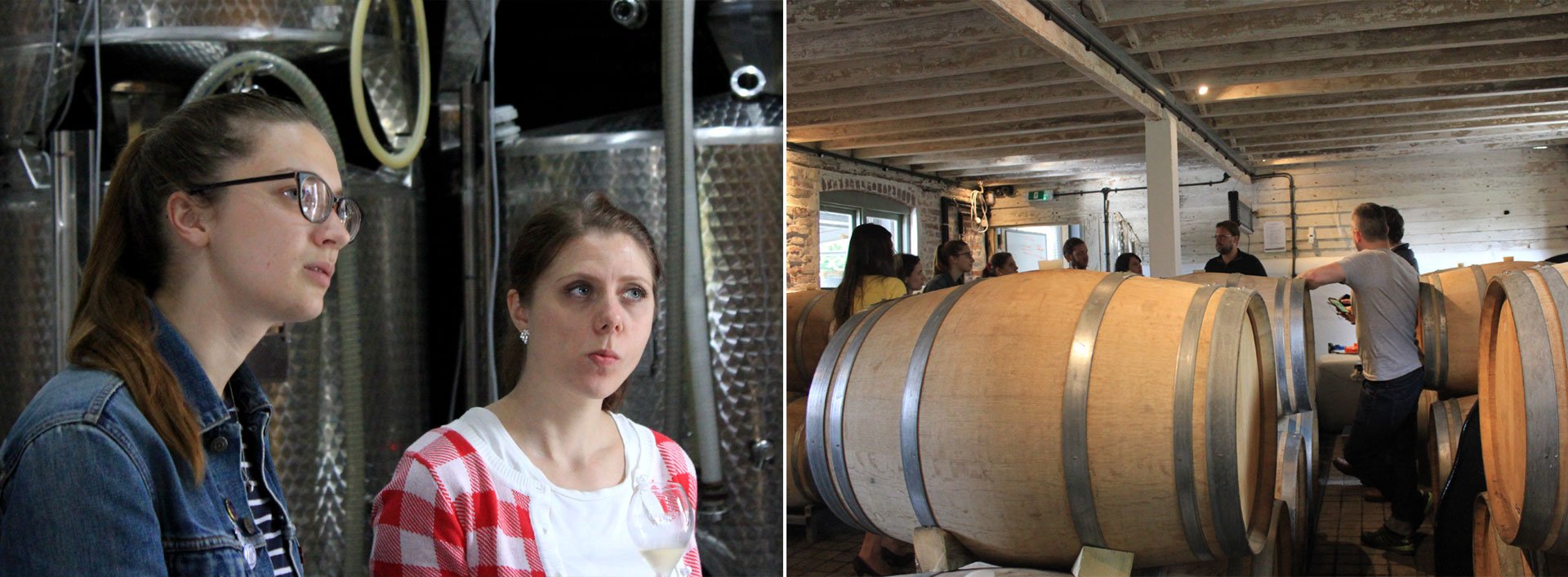 Tasting the 2013 Classic Cuvée in the tank room. Barriques are used to ferment a proportion of the Chardonnay.
First stop was the tank room, as with most quality sparkling winemakers they press gently in stages using a pneumatic press. They keep all the pressings and parcels separate during fermentation to give them the maximum flexibility when it comes to blending. Fermentation is at a relatively cool 15 degrees, using yeast strains suited to sparkling wines and aromatic yeasts for the Pinot Noir. He doesn’t use wild yeasts which he feels are too much of a risk for sparkling wine. Some of the tanks undergo malo, this is on a case by case basis, depending on the freshness of the year and balance of each tank. Wines are bottled for the second fermentation in January or February.
We tasted the 2013 Classic Cuvée a blend of 60% Pinot Noir, 30% Chardonnay and 10% Pinot Meunier. It has a rich honeysuckle nose and a mouthwatering elderflower freshness with ripe fresh pineapple in the mouth. The dosage is just 7-8g/l and the wine has a beautiful balance of acidity and texture. It spends three years on lees. Ulrich says “Long aging is key to managing the acidity in English wines.” Time on lees softens and changes the character of the acidity.
We then moved into the barrel room, a small percentage of the Chardonnay is fermented in barriques. Here we had a sneak peek on the 2011 Blanc de Blanc, which hasn’t been disgorged yet. It already has a lovely stone fruit richness and some florals on the nose. In the mouth you get wonderful balance of honey and citrus and a touch of chalkiness. Talking of chalk we asked Uli his thoughts on the importance of soils and terroir for English wines, and the oft quoted continuation of Champagne’s famous chalk ridge. “The micro-climates are crazy in the UK” Uli looks at vineyard positioning, slopes and aspect as much as he looks at terroir, as this can make a real difference in Sussex.

After a quick stop into the bottling room we headed out into the fresh air and across the fields to see how the vines were getting on. Hoffmann & Rathbone don’t own their own vineyards at the moment, but work with four sites in the area, one of which is handily right next to the winery. At the top of the east facing slopes you can find Chardonnay, and towards the bottom and on the flat some Pinot Noir. A lot of local vineyards, as with many across Europe, were badly hit by the late frosts this spring, luckily this site had only lost around 20% of the potential crop. The grapes were looking healthy and the Pinot was just beginning veraison. Pests and disease are a constant challenge in the UK, the vineyard is surrounded by a high fence – not to keep people out but hungry local deer. They also plant between rows to soak up some of the plentiful rain. In this bucolic setting Uli cracked open the Rosé Réserve 2011 – a soft salmon pink with a gentle mousse. The rosé is 85% Pinot Noir and 15% Chardonnay and shows all the strawberry and red berry fruit you’d expect from a Pinot dominated blend. On the palate it is bright with a fresh finish, this is a serious food wine with the stuffing to stand up to all sorts of dishes, but more on this later.
After all these delicious aperitifs we were starting to feel a bit peckish. So it was time to head to stylish local gastro-pub The Curlew. What better to match with English fizz than their inventive modern British cuisine. The freshness of the Rosé Réserve was the perfect partner to an elegant starter of ballotine ham hock with compressed apple, soft boiled quails egg and lovage mayo. The Classic Cuvée paired wonderfully with a rich main course of halibut, charred leek, sweetcorn puree and clams. And the discovery of the meal was how amazingly well the Rosé paired with dessert of chocolate brownie, hazelnuts and pickled blackberries – a truly surprising match and proof of the versatility and palette of flavours in the wine.
 Veraison starting in the Pinot Noir vines. Chocolate brownie with pickled blackberries, yummy! The Curlew in Bodiam.
One last question for Uli – why had he settled in the UK to make wine? “It’s a young industry here and you really have room to make your mark. The energy and excitement is almost akin to the craft beer scene”. We for one are certain Hoffmann & Rathbone – rising stars in the English wine scene are destined to make a very big impression indeed. The Classic Cuvee 2011 and Rose Reserve 2013 are now in stock, they’ll be on our table at Dirty Dozen on 19th September – click here for details.