
Our Blog
Holass: Thoroughly Modern Winemakers
Meet Imre Halász and Ellie Bauwens, the dynamic couple behind Indigo’s newest additions: Holass. We recently caught up with them to learn about their project that aims to bring the great terroirs of Hungary and Austria to the attention of the world.
Like many artisan winemakers, Holass is a project with strong connections to the land, translating the unique character of the vineyards they work with. What makes them different is how they do it.
Holass has no winery. Nor do they own vineyards. They aren’t tied to a single site or region. Instead, their production is based on collaboration with like-minded wineries and growers who practice traditional winemaking techniques. Holass work with a small vineyard or parcel provided by different winemakers across Hungary and Austria to make their own wine. Each one uniquely expressive; but together, the wines explores the terroirs of this area more broadly.
“In reality, they are a new breed of winemaker”
On paper Holass are negociants. They describe themselves as a collective, emphasising the strong sense of community central to their work. In reality, they are a new breed of winemaker, offering an alternative approach to viewing, making and selling wine.
But how did they get come up with this alternative winemaking model? Well, like all good stories, it starts with romance.
Ellie and Imre met at Prowein in 2014. Ellie was working for a Belgian wine distributor; Imre for an Austrian winery. Neither knew that this chance connection would eventually lead to both a personal and professional partnership.
Inspired by a shared love for wine, making their own seemed like a natural next step: ‘we wanted to do something with wine. It’s what we love most’. So, during a trip to Imre’s native Hungary, that they seized the opportunity to work with an abandoned vineyard in Sumeg. The outcome was their first HOLASS wine, a rosé blend of Kékfrankos and Olaszrisling that they sold through Ellie’s contacts in Belgium over the summer of 2016.
Their fun foray into winemaking was a huge success, and the buzz it generated brought them to the attention of other producers. This paved the way for Holass’ collaborative model of winemaking.
“Capturing this history and sense of origin is important for Imre and Ellie – they want to tell the story of where these wines come from.”

Since then, their portfolio has grown. Today Ellie and Imre work with five producers across Hungary and Austria. They work exclusively with local varieties from historically important Hungarian wine regions: Sopron and Tokaj. They also produce wine from Burgenland, which sits on the Austrian-Hungarian border. Although officially a part of Austria since 1921, its widely viewed as a significant area in Hungary’s wine heritage. Other producers, such as Peter Wetzer, also work across this historically permeable border. Capturing this history and sense of origin is important for Imre and Ellie – they want to tell the story of where these wines come from.
Their wines are mostly single vineyard bottlings made in small batches. Each winery they collaborate with has a vineyard or parcel specially reserved for Holass. Imre describe this arrangement as being “a winery in the wineries”. He visits each site he works with almost every month, paying careful attention to each stage of the grape growing and winemaking process. Even after the wines are in barrel, he and Ellie are directly involved and constantly check in on the wine – “they can change dramatically over a short period of time”. However, Ellie says that this nomadic lifestyle suits Imre; “he loves it. He has gypsy blood”.
“There’s no cookie-cutter winemaking in the winery either; Imre brings what he considers the optimal approach to each vineyard and variety.”
In the vineyard, the focus is on healthy, high-quality grapes. According to Imre, this is critical for producing wines with minimal sulphur. For this reason, they choose to work organically with little to no machinery in the vineyards and winery, often bottling directly from the barrel by hand. There’s no cookie-cutter winemaking in the winery either; Imre brings what he considers the optimal approach to each vineyard and variety.
One of the most interesting examples of this is the Balf and the Sopron. These two Kékfrankos come from the same vineyard, separated only by 500m in elevation. However, this seemingly trivial shift in altitude offers startling juxtapositions in character, with small changes in the soils and fruit from each site yielding two very distinct wines, both complex expressions of the region’s native variety.
This connection to the land is powerful theme recurrent Holass’ wines, which take their names from geographical indications of their origin – a region, a town, a river. Their aim is to show the kind of wines these places can produce.
Click here to learn more about Holass and their range of terroir-driven wines. Drop us a line of you’d like to try them.
What a difference a year makes – new wines from Luis Perez
A big takeaway from a recent visit to Jerez was the existence of vintage variation in wines from the region. And nowhere was that more clearly illustrated than tasting La Barajuela 2017’s with Willy Perez, which have just arrived in the UK.
If proof was ever needed that Sherry can be a product of the vineyard and the season, as much as any other wine, the contrast between the 2016 and 2017 La Barajuela wines was it. Grapes for La Barajuela wines come from El Corregidor in Pago Carrascal Alto, and are named after the chalky laminar Tosca de Barajuelas albariza soils in the vineyard. The estate was owned by Sandeman, but was abandoned when the company moved to Portugal. Willy is recovering the vineyards at the top of the site, and planting new vines. Carrascal is the most inland of the historical pagos, and therefore less subject to the cooling Atlantic wind, it was traditionally the source of Oloroso.


2016 vs. the 2017 vintage
2016 had relatively fresh and even weather, with just a couple of warmer weeks completing ripening before harvest began. 2017 on the other hand was hot throughout, good rainfall in winter and spring caused the vines to forge ahead, and the harvest was the earliest on record. In Jerez vintage variation isn’t just about sunshine or rainfall, it also relates to two winds which blow across the region: the cool humid Poniente comes from the Atlantic; and the Levante, a hot dry wind from inland. And according to Juan Moreno, viticulturalist for Alejandro Muchada, one wind or the other can have a marked influence on a year. At Luis Perez it went as far as changing the type of wines which they produced in 2016 versus 2017. In 2016 they made a Fino La Barajuela, but from warmer 2017 they have bottled a Palma Cortada and a Palo Cortado. To understand why it’s worth taking a look at where the wine names and classifications originated from.
What’s in a name
The names Palma, Cortado and Raya were created in the 18th Century, at a time when the fruit was classified from a viticultural perspective – based on ripeness of the grapes when they came to the bodega and reassessed by taste after fermentation. Palmas were the least ripe, slightly green grapes with the lowest potential alcohol. As flor yeast cannot abide alcohol over 16%, these are most likely to age biologically to become a fino or amontillado style wine. Cortados were ripe grapes with higher potential alcohol, so biological ageing was unlikely, corresponding to an oloroso style. Rayas were over-ripe or later harvested grapes used for making wines traditionally called Jerezanos. The sugar concentration was such that they didn’t ferment to dry. This touch of residual sugar in the wines can lead to further reactions as the wine ages, giving lifted aromas and a savoury power to the wines. There is an element of chance here, as if the fermentation does complete these wines will become olorosos.


We’re familiar with winemakers harvesting at specific times to get particular aromas or flavours from their grapes. At Luis Perez they take this to another level – making repeated pickings across the same vineyard at different times and ripeness levels, so the fresher citrus fruit of the Palmas and the richer tones of the Rayas come not just from the same vineyard, but the same vines!
Exceptions to the rules
A Palma Cortada is a wine that although made from the greener grapes, was from a warmer year and would only age under flor for a couple of years. 2017, with elevated temperatures throughout the growing season, was a year that resulted in more concentrated saline Palma Cortadas. Palma Cortada La Barajuela 2017 is smoky and salty, complex with some fresh citrus pith, spice, dried fruit and a very long finish.
A Palo Cortado resulted from an assessment made by the almacenista (cellar master). Two to four years into the biological ageing of a wine they would identify a cask with more body and an oxidised character. These were marked – a chalk mark was placed across the palo linear mark – the palma was ‘cortado’ or cut in Spanish. Often grapes from certain warmer plots which were more mature at harvest had a tendency to become Palo Cortados. Cortado La Barrajuela 2017 is salty with roasted nuts and a very fine, ripe fruit finish. It’s fresh and drinkable and you don’t note the 16.5% alcohol.
When Willy Perez did a tasting with us in London last autumn he said “Sherry seems complicated but there are two important things: if you are near the ocean of not; if you pick your grapes green or riper”. I would say sherry can be quite complex, but don’t let that put you off. When you have a guide as skilled and animated as Willy Perez the journey is sure to be delicious and rewarding.
The Palma Cortada and Cortado La Barajuela 2017 has just landed, along with new wines: La Escribana a salty flor aged Vino de Pasto and Tintilla Carrascal a dark earthy Tintilla de Rota (aka Graciano). There’s more information on the producer page or drop us a line if you’d like to taste the wines.
Priorat reclassified
We caught up with Daphne Glorian to talk about the new vineyard classification system in Priorat, and the 2018 vintage arriving in late November.
Daphne is a force of nature, she started Clos i Terrasses in 1989 when Alvaro Palacios and René Barbier persuaded her to join them in a project in Priorat, before its reputation as a region for fine wines had been established. The five of them all still had day jobs – only René was based there full time – but they pooled their experience and resources across their vineyards. Daphne travelled from Paris every six weeks: “Each of us had our own vineyard, and we shared a winery, but we had separate vats”
Fast forward 30 years and the wines are some of the most sought after in Spain.
The names of the land.
Many Spanish wine regions are divided by administrative boundaries, rather than by soil types or quality. But there’s a growing momentum – often led by quality minded producers – to change this.
There’s a new classification that you will see on Priorat wine labels. It’s called Els noms de la terra – The names of the land – and follows a Burgundy-style pyramid model. With regional wines at the base; moving up through Vi de Vila (from 12 village zones); then Vi de Paratage (equivalent to a single location or Lieu-dit); and finally single vineyard Vinya and Gran Vinya classificada (equivalent to premier and grand cru).
Daphne won’t use these classifications as her two wines – top bottling Clos Erasmus, and second wine Laurel, from barrels which don’t make the Grand Vin cut – are easily understood. I asked her if she thought the new definitions would help drinkers understand the region.
“It might be complicated for the consumer… but it gives them an idea that Priorat isn’t a monolithic place that everyone thinks of, with one wine”.
It’s also good for growers: “it’ll give them competition; they will want to go up in the hierarchy”.
And does she think the villages have unique characters? “I keep saying to them let’s not forget Burgundy has been doing this for a thousand years, before they can differentiate… it’s [more] complicated, Burgundy is one red variety, here there is Grenache and Carignan and international varietals in the mix. It’s not that simple”.

How has her winemaking changed over the years?
“Our taste evolves like our taste in music… It sounds like a cliché but I’ve learned to be patient”. Moved to away from heavy extraction, you don’t need to push for it in Priorat, you get hard tannins and massive wines. “I now move in a very soft way, gentle pumping over, and no stepping on the grapes”.
It’s not just Daphne, increasingly producers in Priorat are using a lighter touch. Dominik Huber at Terroir al Limit also moved away from the heavily extracted and oaked style and adopted gentler extraction, or infusion as he refers to it. Which he believes showcases the region’s unique vineyard sites better.
2017 vs 2018 vintages.
And finally, what about the 2018s which will be coming to Indigo in spring?
“They’re fresher wines [than the 2017s], we had plenty of rain in spring, they’re not as opaque and dense. You could drink the 2018 earlier, it’s more open”.
“2017 is a great vintage, it is dense, but it does have a fine texture – I love it – I don’t mind drinking young wines. You could drink the 2018 earlier, it’s more open”.
We still have a small amount of Laurel 2017 in stock including some magnums. Luis Gutiérrez in his Wine Advocate report described it as: aromatic, open, expressive, tender and juicy and surprisingly fresh for a dry, warm year that resulted in a very early harvest. There is a peachy, soft, approachable quality here that I like very much. 95 points.
If you’d like to taste the 2018s let us know, the Clos Erasmus is sold by allocation.
Delinquente Wine Co: Reflections on the 2020 Vintage
The quirky characters of the Delinquente Wine Co. crew have returned! Betty, Roxanne, Bullet Dodger and Tuff Nutt are back and serving up the fresh, smashable Riverland wines we know and love. To celebrate their arrival, we checked in with DLQ winemaker Con-Greg Grigoriou and got his view of the 2020 vintage.
Vintage in the southern hemisphere typically takes place between February and April. It can seem strange to think that the fruit for the 2020 vintage was picked and fermented just 8 months ago. But this is the incredible gift of wine from the antipodes: the opportunity to reflect on and taste a year before it is over. With the arrival of the 2020 Delinquente wines, we look back on the season that shaped these wines in this unusual year.
The 2019-2020 growing season and harvest in Australia was particularly challenging. The country experienced one of the worst bushfire seasons in its history, with several wine regions severely affected. Fortunately, the Riverland was spared from the worst, but Con-Greg still describes it as a difficult season: ‘All in all, 2020 vintage was crazy. We had hail hit the vineyard in October, then crazy heat waves in November and December.’
Despite a rough start to the year, by late February and early March the conditions ‘were perfect – besides the pandemic hitting’. The outbreak of Covid-19 brought with it a new set of obstacles and concerns. But vintage stops for no-one, not even a pandemic, and Australian winemakers were forced to navigate lockdowns and new physical distancing restrictions. Despite these unprecedented challenges, Con-Greg is pleased with how the 2020 vintage turned out: ‘whilst we lost a little volume, the quality is fantastic.’
‘All in all, 2020 vintage was crazy. We had hail hit the vineyard in October, then crazy heat waves in November and December […] whilst we lost a little volume, the quality is fantastic.’
The start of 2020 was tough in a lot of ways. But for many it served as a reminder to practice gratitude and when possible, savour the simple things in life. When taking stock, Con-Greg says ‘[t]he vineyard is a pretty good place to think – open expanse, blue sky and endless green of the vines can put you into a bit of a meditative state […] Things always seem to make a bit more sense and seem simpler after getting some fresh air.’
It also brought positive and moments worth celebrating. A pioneer of the young Australian winemaking scene, Con-Greg was recognised as one of the Top 50 Winemakers 2020 by Young Guns of Wine earlier this year. He was ‘stoked’ by the honour and acknowledge the nomination with good humour and humility – qualities that are reflected in his vision for his wines.
Delinquente grew out of Con-Greg’s desire to make the type of wine that he hadn’t previously imagined possible in his region. His idea was to take advantage of the Riverland’s small vineyards planted with Southern Italian varieties, which are well-suited to the region’s dry Mediterranean climate, and produce small batch, handmade wines with bright fruit and intriguing but uncomplicated drinkability – or as he would put it, “smashable”. To complete his vision, he recruited local Adelaide street artist Ankles to design the edgy, eye-catching labels. Amid a sea of Big Wine, Delinquente conveys a unique aesthetic and clear point of view: fun, approachable and terroir-driven wines that will challenge people’s perception of the Riverland.
Click here to learn more about Delinquente Wine Co. and Con-Greg’s wines. Drop us a line of you’d like to try them.
Introducing Abel: A fresh face for New Zealand Chardonnay
We caught up with Sophie and Mark McGill, who after gathering extensive experience in the world of hospitality and wine, have returned to their native New Zealand to set up their own winemaking project. Meet Abel, the newest addition to the Indigo portfolio.
Sophie and Mark say they were destined to make their own wine. They both grew up in the heart of the New Zealand wine industry – Sophie’s parents, James and Wendy Healy worked with Cloudy Bay before setting up Dog Point Vineyard in Marlborough; Mark’s father Linton worked as a viticulturist throughout New Zealand before establishing his own vineyard in the Wairarapa. In 2015 they set up Abel in Nelson. They take inspiration from the wines of Chablis, choosing to move away from oak rich styles in favour of Chardonnay with texture, energy, and brightness.
But why Nelson? Given Sophie and Mark’s connection to Marlborough and its growing reputation for Chardonnay, we were particularly curious to learn more about the Nelson-Tasman region and how it makes Abel Chardonnay unique.
Sophie and Mark were drawn to Nelson for its strong agricultural potential.
In addition to its family-friendly ‘hippie’ vibes, Sophie and Mark were drawn to Nelson for its strong agricultural potential. Perched on the north-western tip of New Zealand’s southern island, the region enjoys long sunshine hours, and a moderating maritime climate, making it one of the best areas in New Zealand for Chardonnay production. Apples, hops, and other fruits also thrive in these distinctly seasonal conditions and can be found growing in valley flats below the sloping vineyards.
Unlike more established neighbour Marlborough, Nelson’s wine industry is less commercial. The focus is on smaller sites, with more hands-on production and a push towards organic viticulture, all of which align with Abel’s ethos. However, this presents challenges too; many sites are what Sophie alludes to as ‘lifestyle’ vineyards, where the emphasis isn’t always on quality farming practices. As a result, Mark and Sophie are highly selective about the fruit they use for Abel. They only work with carefully chosen, sustainable sites in the Upper Moutere, where Chardonnay thrives in rich orange clay and gravel soils. They are directly involved in the viticulture wherever possible, often pruning and harvesting themselves to ensure low yields and high fruit quality.
In Spring 2019 they planted their own vineyard and orchard in the Moutere Valley. They wanted a place of their own – in part to secure fruit for the future, but more importantly, to personally manage what they grow and make. Their new vineyard, planted on 5 hectares of crumbly Moutere clay, is a mix of three Chardonnay clones. The intention is to convert to organic viticulture once the vineyard is better established; according to Mark, this is more viable than starting organically, as the fertile volcanic soils result in ferocious weeds that compete with the young vines.

Compared to their focused efforts in the vineyard, Mark and Sophie’s approach in winery is hands-off: handpicked fruit ferments in 3000 litre barrels at high temperatures (often 35ºC+ with no cooling), which avoids stuck ferments and helps stabilise flavour as the wine ages. The wine undergoes full malolactic fermentation over winter along with some gentle lees work and is bottled with minimal sulphur, unfined and only coarsely filtered.
Nelson vs. Malborough. When asked how Nelson Chardonnays compare stylistically with those from Marlborough, Mark and Sophie say the difference is rooted in the soil. The two regions share similar climates, though Nelson gets around a third more rainfall each year. Marlborough broadly features two main soils types; loamy clay on the hills, which produces leaner, more citrusy wines; and free-draining alluvial soils on the plains that give distinct flavours of apple and nectarine. In contrast, Nelson Chardonnays are stylistically defined by greater breadth of character and a pronounced flavour profile of fragrant white peach and bright grapefruit, which Sophie’s father James attributes to the region’s unique Moutere clay (Moutere is not French as I originally presumed – it’s a Maori word, pronounced MOH-TEH-REH and means ‘island’).
Ultimately, Mark and Sophie aren’t aiming to produce a specific style. Their vision for Abel is to create wines with purity and drinkability; that speak to the place they are made; and complement the food they’re being enjoyed with.
Mark says: For us, it’s about showcasing the fruit, that’s the key ingredient after all and I think that’s quite evident in both our cider and our Chardonnay.
The Tasman Chardonnay 2018 is zesty with intense aromas of peach, citrus and flinty minerality; time on lees gives the wine a gentle nuttiness and a beautiful textural quality that rounds out its naturally bright acidity. Click here for more details on the Tasman Chardonnay. Drop us a line of you’d like to try it.
4 Eléments: Change and Innovation in Champagne
In his influential book Champagne Peter Liem speaks of a transformation in the region: a new wave of family growers and young winemakers who are paying closer attention to the farming; vinifying their own grapes rather than selling to the big houses; exploring and working with individual vineyards and parcels like their near neighbours in Burgundy. In short: “the acknowledgement of Champagne as a wine like any other”.
A key influence is the climate. While virtually all wine regions are experiencing warmer summers, this is particularly significant in Champagne where cool growing seasons and high acidity levels have long underpinned its signature style. This is not necessarily viewed a bad thing. For the moment, the impact has had many positive effects – fruit with higher levels of maturity and concentration, as well as reduced concerns about damage from frost and rain. However, the potential long-term consequences of rising temperatures are forcing many producers to rethink how they want to make their wines.
These changing conditions are expanding the parameters of what is possible and there are signs of real evolution and experimentation in a region historically ruled by tradition. This has translated most notably in a move away from multi-vintage blends towards more terroir-specific wines and single-vintage expressions. We are also seeing more and more varietal champagnes, a trend that goes against the traditional champagne mantra that blending is all important.
Brothers François and Pierre Huré, the third generation of Huré Frères in Ludes, have embraced this potential for change through their 4 Eléments project – a collection of three wines that provide a “precise, faithful and uncompromising view of our ‘lieux-dits'”. The wines are created according to four criteria:
1. Produced from a single vineyard or ‘lieu-dit‘ : grapes are sourced from select single-variety sites with the aim of presenting a unique expression of its terroir.
2. A pure expression of a single vintage : all fruit must be grown in a single year, providing a faithful manifestation of the vintage, regardless of the highs and lows.
3. Made from a single variety : flying in the face of the traditional champagne mantra that blending is all-important. The Cuvée consist of just one of the classic Champagne grapes, Pinot Noir, Pinot Meunier or Chardonnay.
4. Produced using the same style of vinification : wines are fermented and aged in a 600L barrel. No malolactic fermentation. 3g/L – dosage. Bottled on cork.
The brothers began this project five years ago, with the hope that vintage after vintage, their wines will show the strong identities of these vineyards. These wines represent an important element of this new wave in champagne production – one that respects the classic winemaking frameworks of the region while embracing the potential for innovation. On average 1,500 bottles of each 4 Eléments cuvée are produced each vintage: each wine displays an immense vinous quality and are totally unique in style, with distinct terroir-driven focus and concentration of flavour.
A selection of Champagnes from Huré Frères, including the 4 Eléments Chardonnay and Pinot Noir, are available to purchase through our online store: Indi-to-Go. To learn more about Huré Frères and their wines you can find more information on their producer page.
The changing faces of Sangiovese
Sangiovese is Italy’s most planted grape making up around 10% of vineyards. It’s thought to have originated in the south – a cross between the ancient ciliegiolo grape and Calabrese Montenuovo, an obscure variety found in Campania. Sangiovese was first grown in the Apennine monasteries in the between Romagna and Tuscany and eventually made its way into both regions.
Despite being considered a ‘noble’ variety, able to convey a clear message of origin and originality right into the glass, Sangiovese doesn’t have anywhere near the widespread appeal or recognition of Pinot Noir, another grape synonymous with terroir and sublime quality when planted in the right place. To be fair Sangiovese hasn’t always had great PR – the name isn’t mentioned on the label of the best examples. Even in its heartland of Chianti its distinct personality is often blended away or masked by heavy handed use of new oak. Its character diluted in the clones that were much planted in the 70s and 80s, which produce quantity over quality.
Walter Speller and Jane Hunt MW want to change opinions and shine a light on the changing approach to the varietal in Italy over the last 10 years. With this in mind they brought an impressive collection of producers to London at the beginning of March for Sangiovese Reset. This included Giorgio Melandri owner and winemaker at Mutiliana a project focusing on the potential of Sangiovese in Modigliana’s different sites and soils. Giorgio and Walter Speller gave a masterclass: A New Generation Sangiovese from Romagna at the tasting.
In Romagna 15 sub-zones have been identified based on the soil types which run in broad bands as you move inland from the coast: sand near the sea; a layer of clay as you start to go up the hills; chalk; and finally marl and sandstone. With more meticulous farming we’re just starting to see how these soils and microclimates influence certain characters in the wines. According to Walter and Giogrio the sand sometimes gives salty characters, the chalk more floral wines and the marl and sandstone a citrus elegance and a savoury longevity.
Walter Speller described Sangiovese as being in a “Post-modernist phase”. In the recent past there was an overzealous use of new oak barriques, along with the use of selected yeasts and filtration, and this led to a “sterilisation of wine”. In addition, high yielding clones have been grown on trellises giving poor quality material to work with. Walter feels that producers need to look back pre WW1, before phylloxera, to rediscover original winemaking techniques.
We tasted two of Giorgio’s wines in the class both from the outstanding 2016 vintage. Modigliana has three valleys – Ibola, Tramazzo and Acereta – that climb up the Apennines from the town and give their names to three distinctive wines. Woodland around some of the vineyards keep the summer days cooler and regulates the water supply. Some of his vines are above the fog line so grapes ripen later into the autumn.
Ibbola from Mutiliana comes from a plot of mostly sandstone with a small amount of marl at 500 metres above sea level. The site is surrounded by woodland which cools the microclimate, typically resulting in long hang times and later ripening. All his wines are fermented and aged in concrete vats which allow the character of the grapes to shine through. The wine is fresh and quite shy initially on the nose with a herbal streak which Giorgio says he finds typical of the area. It tastes of fresh currants and blood orange, with very fine tannins – this wine has the bones to last.
Tramazo comes from a higher plot at 600 metres, soils are also marl and sandstone but with a percentage of clay. The wine has a fresh sappy nose, with a bit of bell pepper and sage. It’s juicy with a slight vermouth quality.
You can find out more about the Mutiliana project on our website.
Vigna Barbischio, a Chianti Classico Riserva was also on taste at the event. This textbook Chianti made by Maurizio Alongi has a spicy nose, vibrant cherry fruit on the palate and crunchy tannins. Drop us a line if you’d like to taste this or any of Giorgio’s wines.
‘Live Joy’ – Biodynamic lessons in life and winemaking from Birgit Braunstein
In recent years organic farming has become increasingly popular with both producers and consumers. Furthermore, a rising number of wineries, Romanée-Conti, Latour and Louis Roederer to name a few high-profile examples, are embracing organics more radical cousin biodynamics.
Read our recent blog for an outline of the differences between the two practices.
What’s prompting this conversion?
For many producers, biodynamics represents a return to traditional winegrowing where the focus lies with the health and vitality of the vineyard. However, other biodynamic practitioners view it as a philosophy extending beyond farming and wine production. This was the case for Birgit Braunstein, for whom the conversion to organic and eventually biodynamic practices represented as much a personal evolution as an agricultural one.
Birgit’s family has been producing wine in the Burgenland since 1632. She farms 22 hectares in the Leithaberg DAC, where she grows a mix of Austrian and international varietals. When she encountered biodynamic viticulture for the first time in 1995 in Bordeaux while visiting Château Canon-la-Gaffelière, Birgit knew immediately that this is what she wanted for her own vineyards. After taking over operation of her family vineyard and winery in 1996 she became convinced of the benefits of these practices, and in 2006 began the conversion to organic farming. This was followed by two years of intensive training and learning; to Birgit it was as though “the ideas of Rudolf Steiner…were buzzing around in my head”. During this period, she helped to establish the first Burgenland Waldorf School, which applies the same core principles of biodynamic agriculture to education: everything is related. By 2011 the conversion to biodynamics was complete, and the tenets of biodynamics had extended to her everyday life, informing her personal convictions and attitudes.
“As a winemaker, I see myself as a landscape conservationist. Aware that I have only borrowed the land from the next generation, I am committed to respecting the land entrusted to me. As a farmer, I can make a major contribution to preserving nature and protecting the climate. As a consumer, I can decide what kind of agriculture I support. It is therefore my concern to produce healthy, vivid wines that are digestible and give joyful and enjoyable hours.”
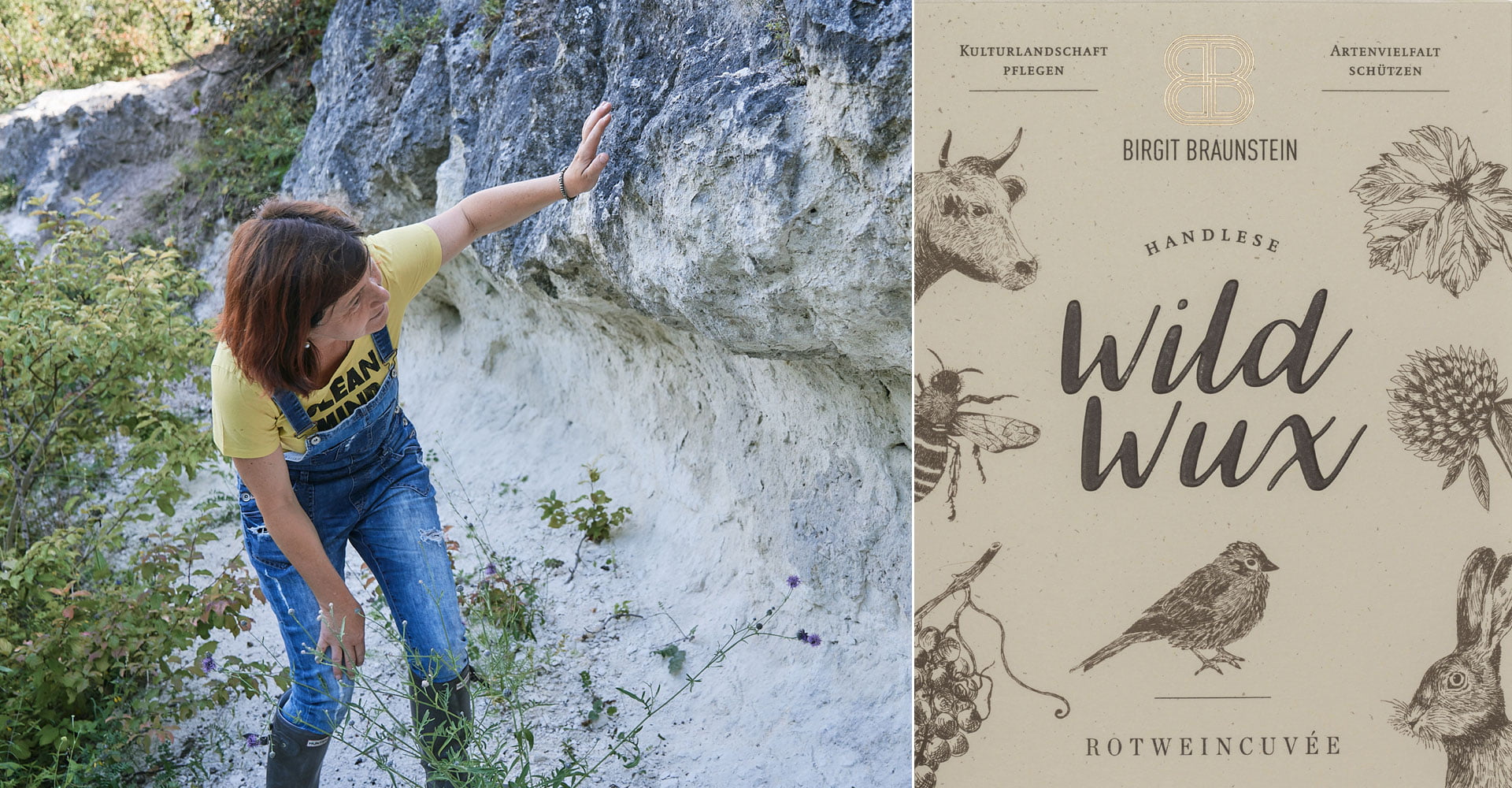
The Wildwux biodiversity project
Birgit’s aspirations for biodynamic winemaking and living resulted in Wildwux, a biodiversity project launched in collaboration with Weingut Geyerhof-Oberfucha. It responds to the unfortunate loss of biodiversity due to the destruction of important landscape elements, often the result agricultural intensification and the profit-driven farming.
The project’s name is a homophone for the German phrase ‘wild wuchs’, which means wild grown. Though this might conjure the image of an overgrown vineyard, it is not about minimal pruning nor does it concern wild-grown vines. Instead, fruit is sourced from 2-hectare vineyard that embraces biodynamic practices alongside mixed agriculture in an effort to restore and preserve valuable habits and endangered plants and animal species through targeted measures. This means a transition from the monoculture typified by most agricultural practice, allowing flora and fauna to co-exist and thrive with equal importance. At a time of growing environmental fragility, when the sustainability of the wine industry is increasingly called into question, Wildwux demonstrates that “BIO [organics-biodynamics] can be much more than a mere omission of chemicals.”
So as a strong believer if wine’s ability to promote positivity and prosperity, Birgit signs the back of each label and sends it into the world with the message ‘Lebe Freude’ – ‘Live Joy’ – a small but important reminder that wine is a celebration of nature and life.
If you would like to learn more about Birgit Braunstein and her wines you can find more information on our website, email maddy@indigowine.com or your sales rep.
Biodynamics – just a load of bull?!
Jancis Robinson presents an open-minded overview of biodynamics in an article for the FT last year, despite the title: “Biodynamic wine and the Hogwarts school of viticulture“. Discussions with people in the wine trade often include a certain amount of scepticism or just a quizzical shrug. Consumers are confused as well, most don’t know how a biodynamic wine differs from an organic or natural wine.
Biodynamics is based on theories described in 1924 by the Austrian philosopher Rudolf Steiner. As a baseline all biodynamic vineyards practice organic viticulture, but with three key differences: the farm should become a closed, self-sustaining system; it should be treated regularly with nine herb and mineral-based biodynamic preparations; and key tasks such as planting, pruning, ploughing, picking and bottling should be timed to harness beneficial forces exerted by earthly and celestial rhythms. The aim is to create healthy self-sufficient ecosystems with an equilibrium between pests that are predators and prey. Practitioners believe that when everything is in balance the vines will produce better quality fruit, which as we all know leads to better wine.
In 2017 around 4.5% of the world’s wine grape vineyards were certified organic or biodynamic, that’s circa 316,000 hectares, and 80% of this is in Europe.
German-based Demeter is the main body overseeing and certifying biodynamic wineries, there is also the French-based Syndicat International des Vignerons en Culture Bio-dynamique (Biodyvin) and the Australian government has its own biodynamic stamp.
Back to the three building blocks of biodynamic farming. The first – building humus or organic matter within the soil – is shared with organic farming and generally thought to be a ‘good thing to do’ by quality minded wine producers. They’re aiming for soils with a rich microbiology, nutrients and insect life, just like the forest floor that vines evolved from.
Where biodynamics goes an extra step is that wineries should create their own soil improvers via composts or manure from the farm, thus working towards the ideal of each farm or vineyard becoming a self-sustaining living organism rather than a commercially efficient monoculture. In addition to providing manure animals are often used to plough creating a lighter impact on the soil than a tractor; sheep or goats, sometimes even ducks keep cover crops under control; and boxes encourage bird predators to eliminate unwanted pests.
The aspect of biodynamics that causes most discussion is the application of homeopathic doses of numbered special preparations that have been ‘dynamised’ (energetically stirred into water) to the soil, compost or to the plants themselves to build strength or counter maladies. There are nine of these: preparation 500 based on fermented cow manure, powdered quartz (501), yarrow (502), chamomile (503), nettles (504), oak bark (505), dandelion (506), valerian (507) and horsetail plant or casuarina (508). When the doubters really start to roll their eyes is on the mention that some of the preps should be buried in cow horns, bladders or intestines for a period of time before use, and all of them are supposed to be applied according to the celestial calendar. This biodynamic growers argue creates ‘formative forces’ capable of transmitting energy and health to the soil, vines and therefore grapes. In his article ‘What is biodynamics’ Jamie Goode starts by saying:
“It is helpful to think of biodynamics not primarily as an agricultural system, but rather as a philosophy or worldview that then impacts on the practice of agriculture in various ways. In other words, to farm biodynamically, first you have to think biodynamically”.
It’s not a decision to be taken lightly, not using chemicals to control weeds or to treat diseases requires winemakers to be very hands on, spending more time in the vineyards, ploughing and cutting or administering preventative doses of various preparations and anticipating problems by an intimate knowledge of each vine. It can also result in lower yields if it’s a tough year pest and disease-wise.
Nine producers in our portfolio are certified biodynamic and many more use some practices. We have spoken to several of them to understand what biodynamics means to them, how they implement it and the difference it has made to their vineyards and their wines. Watch out for a series of interviews with these producers that we’ll be publishing over the next few months.
Find out more about our certified biodynamic producers: Birgit Braunstein, Clemens Busch, Eugenio Bocchino, Familia Nin Ortiz, Frank John, Hirsch, Joan d’Anguera, Jonathan Maunoury, Super Uco (some wines).
Taking a sustainable approach at Gaintza Txakoli
Maybe you’ve done a pintxo crawl around the narrow cobbled streets of San Sebastian or Bilbao. You probably sank a fair few low flat tumblers of the pale, green appley white with a slight spritz along the way, which makes an excellent foil to the local seafood. Txakoli seems like a simple wine at first, and it can be – thirst-quenching, refreshing. If you speak to a passionate local producer like Joseba Lazkano from Gaintza Txakolina you’ll understand how the drink is deeply entwined with local traditions and food culture.
Four generations of the Lazkano family have produced and sold Txakoli. José Antonio, grandfather of the current owners, used to make wine at home for family consumption, and to sell locally, until they set up the Gaintza cellar in 1923. Gaintza isn’t the family name, it’s to do with where their vineyards are – “gain” means high-up site in Basque. Their vineyards are up on the hills above the fishing town of Getaria, where soils are a shallow layer of clay and chalk over deep granite bedrock.
There are three DOs for Txakoli: Arabako, Bizkaiko and Getariako. Gaintza own 25 hectares of vineyards in Getariako, a mix of older plantings on high pergolas, and newer terraced vines. They mainly grow Hondarribi Zuri, the most common and traditional grape for Txakoli production, along with some Chardonnay and Hondarribi Beltz which is a red grape. In their zone a minimum of 80% of the grapes need to be Hondarrbi Zuri, 20% Petit Corbu, Gros Manseng and others varietals are allowed in the blend.
“It’s impossible to be organic in the Basque Country, it’s so cool and damp, mildew is a constant threat”.
Joseba says it’s impossible to be organic in the Basque Country, it’s so cool and damp, mildew is a constant threat. Joseba and his brother practice Viticultura Integrada, they do the best they can in challenging conditions – in a good year they can make 140,000 litres of wine but in a terrible year such as 2013 they produced just 50,000 litres. They believe that they can reduce their vines’ dependence on copper and sulphur and spray less. They work with local fishermen, who know the weather better than anyone else, which means they never spray before rain – a total waste as it all gets washed off and goes into the soil. As a young company with eyes firmly on the future they want to set an example in their area by working sustainably. Their packaging is recycled, they use organic ink for their labels and they are working to produce an ecological Txakoli.
 Looking down over the vineyards to Getaria
Harvest is around the end of September when the grapes are mouthwatering, ripe, with persistent flavour. It takes around 20 days with 25 local workers helping the family. They want the grapes back in the winery quickly to avoid oxidation, the maximum time between the vineyard and the winery is 90 minutes. They do a long slow press in the afternoon and overnight, then cold settle the must at 12 degrees centigrade for 24 hours. Winemakers used to cover their barrels with wet blankets and open winery windows at night bringing the coastal breeze in to cool the wines. But today they ferment in stainless steel at a controlled 15-16 degrees, lasting 25-30 days. In neighbouring DO Bizkaiko they ferment at a higher temperature and allow the wines to undergo malo. Gaintza wines have a very low pH (3.1-2) and can have 13-14 g/l tartaric acid.
“In the past to market their wines before bottling all the local bodegas took part in a “Txotx” in April or May when the wines were ready – this translates to “open the tap” in Basque”.
The wineries would invite the local people in, serve some food and quite literally open the taps on their wine barrels to allow people to taste the wines so they could decide what to buy. That sounds like a lot of fun, I wonder how much wine was left in the barrels by the end? We tasted through the current releases with Joseba in the much more pedestrian environs of our office:
The bright, zesty Gaintza Txakoli, refreshing with a citrus tang, is natural a partner to fried fish or seafood.
Aitako, which they first started making in 2006, is more complex, it’s barrel fermented and aged on lees. A blend of Hondarrabi Zuri, Hondarrabi Beltz and a touch of Chardonnay from a special plot established by their great grandfather, the oldest Hondarrabi vines are 100 years old. It has a beeswax, floral and pollen nose. It’s still mouthwatering with a long finish but the acidity is less pronounced.
They make just one tank of the Gaintza Roses using Hondarribi Beltz a rare cousin of Cabernet Franc from a 1 hectare plot. They ferment the red grapes and blend with a white wine. They bottle at 0 degrees to keep the slight spritz in the wines and leave on lees for three months with no batonnage.
Find out more about the project and the wines on our producer pages.