

Highlight On Homepage – From The Blog
Q&A: Mark Bulman on His Grenache Obsession and the Fight for Australian Fine Wine
Q&A: Mark Bulman on His Grenache Obsession and the Fight for Australian Fine Wine
Few Australian winemakers speak about Grenache with such conviction and precision as Mark Bulman does. Known for his early-picked, tightly structured, site-driven expressions, Mark has become a leading voice in redefining what Australian Grenache can be.
In this conversation with Indigo Marketing Manager, Nancy Green, he speaks candidly about the architectural beauty of tannin, the impact of climate volatility, and why Australian fine wine is still fighting to be taken seriously.
I think of it like a flower unfurling: the earliest stage is the most intricate and unique; full bloom is simpler… I’m trying to bottle that early, delicate, three-dimensional shape of the vineyard.
Part 1: The Passion for Grenache
Q: Grenache has shifted from being seen as a plush and fruit-driven wine to something finer and more architectural. How would you define structure in Grenache today?
Mark: For me, structure in Grenache comes from grape-derived tannin – tannin that reflects the vineyard itself. Because Grenache is grown in warm places, it’s always had this reputation for plush, sun-soaked wines. And this format of Grenache can be very joyful and crowd pleasing. But if you want delicacy, site expression, and real shape, you must focus on tannin as the vehicle for architecture – not ripeness, not generosity, but the vineyard’s own textural bones.
Q: What originally drew you to Grenache?
Mark: My experience was previously in cool-climate Chardonnay and Pinot. When I moved to the Barossa, everyone was obsessed with Shiraz, but Grenache was the variety that I felt was the best translator of site to bottle. Even in rosé ferments, each block told its own clear story. I realised Grenache could translate place with the same nuance I loved in Pinot – so I followed that thread.
Q: How do you approach harvest timing for Grenache? What are the key cues you rely on?
Mark: So this is the method that I’ve developed over the last 15 years. Grenache gives its most intricate tannin early. I pick at the moment the greenness disappears from the berry before flavour kicks in. It’s a tiny window, almost counterintuitive, but it’s when the tannin shape is most distinct to the site. The wines look lean young but they tend to blossom much more brightly than anything that’s a bit riper.
Q: How do soil and sub-region affect the tannin and acid profile?
Mark: Hugely. Grenache is so disease prone that you need a warmer, dryer area to grow properly. Then soil steps in: the richer the soils, the less likely that the tannins will be prominent. The more skeletal the soils are, the harder the vines have to work hardworking sites give the strongest structural identity. The harsher the environment, the clearer the tannin signature.
Q: With climate warming, how has this affected your picking windows and fruit balance?
Mark: Since about 2015 onwards, the swings have become dramatic. Either bone-dry, early vintages with tight windows, or late, wet vintages with extended windows. I prefer the cooler years; they give me more grace to hit that perfect moment before flavour arrives. The picking window is super tight in the hot, dry years because obviously you’ve got a plant that’s trying to produce a fruit with some sweetness, with very limited resources and with a lot of heat bearing down on it. So that compacts very much that sort of zone where I find the best expression is.
Q: I really notice with your wines that they are very distinctive profiles according to either their vintage or their site. They really speak of a time or a place.
Mark: Absolutely. And I think that works into what fine wine should be. I always say, a good wine or a fine wine should speak first of the site, then of the maker and then of the vintage.
Q: Site or winemaking: which matters more for Grenache?
Mark: Site. My winemaking is simple – early pick, antioxidative handling, long soaks. And so that’s actually quite replicable. It’s just that not many other people are doing it that way. Rule #1 is get your site right. A great site made poorly will still look good; the reverse is rarely true.
Q: Grenache can lose shape if over-extracted. How do you balance gentle handling with textual depth?
Mark: Loss of shape comes from ripeness and oxidation. So I pick early and keep oxygen away entirely. Oxidation denatures tannin, it’s not “bad,” but it blurs site. And Grenache is the opposite of Shiraz: where Shiraz thrives on oxygen, Grenache loses detail.
Q: How do you conceptualise tannin as “architecture”? What gives Grenache its scaffolding?
Mark: Tannin is shape, not flavour. It’s a feeling as opposed to a taste. I’ve used this metaphor a few times, but I think of it like a flower unfurling: the earliest stage is the most intricate and unique; full bloom is simpler. At this stage it’s very immediate and bright and it draws you in, but it’s simpler in terms of the layers and the shape. I’m trying to bottle that early, delicate, three-dimensional shape of the vineyard.
Q: Do you see a uniquely Australian style of Grenache emerging?
Mark: Absolutely. We’ve combined old vineyards with a culture of competitive, technically excellent winemaking. Tradition isn’t weighing us down like it does in parts of the Rhône. We’ve pushed forward and found our own dialect, distinct, energetic, and site-specific.
Q: How should sommeliers talk about your wines?
Mark: Don’t lead with the word Grenache. And definitely not “Australian Grenache.” Pour it blind for Pinot and Nebbiolo drinkers — people who appreciate texture, shape, nuance. Let them discover what it is after they’ve fallen in love with it.
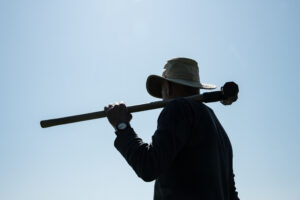
Grower Gary Whaite of Gary’s Vineyard
Part 2: The Challenge of Australian Fine Wine
Q: How do you define “fine wine” in the Australian context?
Mark: Traditionally, Australia has equated price with richness: the more you pay, the bigger the wine. That’s not fine wine to me. Fine wine should tell an accurate story of site — and still be joyful to drink. For decades we prioritised ripeness, clinical winemaking, and clear labelling. It made Australian wine safe, consistent, and very successful – but in this we sacrificed nuance and terroir.
Q: Has the oversupply crisis hurt Australia’s fine-wine ambitions?
Mark: Definitely. Overproduction always cheapens perception. Australia boomed on clean, affordable wine, which cheapened our image and the world still sees us that way. Now we must rebuild the idea that Australia can make wines of site, delicacy, and identity.
Q: What hurdles remain when presenting Australian fine wine to sommeliers and buyers?
Mark: There are plenty of hurdles here. The biggest hurdle is comparison. In blind tastings against European wines, Australian wine often shines really well. But I feel that’s just putting us up someone else’s yardstick.
I think what we need to do, and what Grenache can do, is find an individuality and the uniqueness that only exists in Australia. We’re trying to get out of those hurdles. It’s almost like we don’t want to get too desperate in proving ourselves. We almost want to push the hurdles aside and go don’t worry about the hurdles. Come over here and just see. Just have a taste of this and tell me what’s going through your head and what you’re aligned to.
Q: What would success look like for Australian fine wine in 10 years?
Mark: I noticed in London – where I ate and dined pretty well – so many lists were just absent of Australian wines. Many were totally European centric. I’d love to see Australian wines make up around 5% of great wine lists in the UK. Just a handful of a few really thoughtful and well-chosen bottles.
Q: What message should sommeliers share when pouring your wines?
Mark: I suppose just to relax preconceptions. Try to dismiss what you think Grenache is and then what you think Australian Grenache can be. Let it take you somewhere. If the wine sparks memories or emotions, then great. Then go to the photos and the vineyard descriptions and see why it tastes that way and let that lead you to the place.
Mark’s 2024 release of Gary and Glen’s Vineyard are due to arrive in the UK imminently. Please get in touch with us for more information.
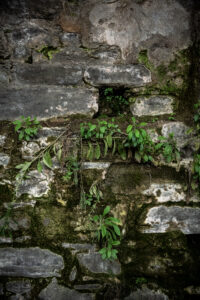
The maidenhair fern found in the stone garden of Glen’s Vineyard
Wines Rooted in the Earth: A Conversation with Alice Anderson of Âmevive
In the heart of Santa Barbara County, Alice Anderson is doing something quietly radical. As the winemaker and farmer behind Âmevive –a name that translates from French as “living soul” – Alice doesn’t just make wine. She cultivates an entire ecosystem.
We sat down with Alice to talk about her path into wine, what it means to nurture a historic vineyard, and how intention, animals, and native plants are part of the soul of her Âmevive project.
From Horses to Harvests
“I didn’t grow up in wine or anything,” Alice admits. “I grew up riding horses and raising animals. Agriculture always interested me, but it wasn’t part of my family background.” That changed when she enrolled at Cal Poly, one of California’s few universities offering a dedicated wine and viticulture degree. There, she met peers like Gina and Mikey of Lady of the Sunshine & Scar of the Sea—fellow Indigo producers, who, like Alice, are shaping the future of California wine. After graduation, Alice set off on a global journey that many young winemakers know well: a kind of “harvest hopping” that exposes them to vineyards around the world.
“It’s one of the beautiful things about wine – every winemaker is shaped by the places and people they’ve worked with. You have this really distinct lineage of people you’ve worked for.”
Her first transformative experience came at Rippon in Wanaka, New Zealand, where she worked a full pruning season. “It was the first time I spent every day in the vines, and it changed my life.” That hands-on farming experience led her to France, where she spent two years working at Domaine Pierre Gaillard. Despite her love of French culture and French wine, something pulled her back to home: “As a mid-twenties single girl living in a stone hut in the middle of nowhere, I wasn’t quite ready for that level of isolation.” So she returned to California – and found her home in Santa Barbara County.
The Soul of Âmevive: Ibarra-Young Vineyard
At the heart of Âmevive is a singular piece of land: the Ibarra-Young Vineyard. Planted in 1971 by Charlotte Young, it remains in her family today – leased and lovingly farmed by Alice and her small team. The vineyard has a storied history. In 1986, Bob Lindquist, one of the pioneering figures of the Santa Barbara wine scene, an original “Rhône Ranger” and founder of Qupé, began leasing and organically farming the land. “He transitioned everything to organic in 1993,” Alice told us. “So this land has been organic since before organic was cool.”
A Regenerative Revolution
Since taking over farming in 2019, Alice has gone far beyond organic. “We’ve become known for a more unconventional farming style,” she explains. “We’re fully no-till, fully regenerative, and fully integrated with animals.” That means rotational grazing with sheep, chickens and ducks. “It’s a full-time job raising animals in the vines,” she laughs, “but their presence plays a vital role.” Chickens and ducks help control pests. Sheep munch the cover crop, reducing the need for tractors. And their manure? Nature’s fertiliser. But the benefits go beyond the practical.
“There’s this energetic benefit [to raising animals]. The more intention you put into a place, the more time you spend walking your vineyard, the more it shows in the final wine. Especially when you’re making wines that are living – unfined, unfiltered.”
Restoring her Native Landscape
Beyond animals, Alice is on a mission to restore native ecology in the vineyards. “We want something blooming 365 days a year,” she explains. That means planting hedgerows and pollinator rows, inviting bees, butterflies, and beneficial insects back into the landscape.
“The hedgerow at Ibarra-Young is about three years old now, and it’s my pride and joy,” she beams. “It’s really well established and just beautiful. And we’ve got annual pollinator rows running the length of the vineyard too. Right now, with all the flowers blooming, it’s just beautiful.”
The Living Soul
Everything Alice does – from grazing sheep to planting wildflowers – is grounded in the belief that great wine is not just made; it’s grown, nurtured, and lived. Âmevive isn’t just a winery. It’s a living, breathing organism rooted in its place, and in the people who care for it.
The wines are a direct reflection of the land she nurtures, and here entire range has a brightness to them – a product of the Californian heat but also Alice’s playful, sunny nature.

Luke Lambert: on new vintages and his Nebbiolo vineyard.
You can tell a lot about a winemaker from their cellar. Luke Lambert’s is a modest brick building housing the large oak foudre he uses to age his wines, a large dining table and a very high end Italian meat slicer. Luke is softly spoken and thoughtful, he travelled around Europe after finishing school, developing a taste for lighter-style wines that were unique to the places they came from, and Italian charcuterie. He was particularly taken by the wines from Barolo, more on his love of Nebbiolo later.
“The Yarra is a pretty good place to grow grapes”, he began, “it’s as warm as Tuscany so there’s low disease pressure, but ripening can happen quickly, so you can get heat shrivel”.
The last few vintages (2021-23) have been relatively cool, influenced by a La Niña weather pattern. Luke says he judges a year by how many days go above 38-40 degrees centigrade and there haven’t been any during the last three vintages.

Luke sources Chardonnay, Syrah and Nebbiolo from a vineyard called Denton, it’s a steep north facing sunny cone on a granite outcrop. The owner has undertaken some improvements to the site over the last five years : he stopped using herbicdes, cultivating under the vines instead; he’s started to add organic compost; and plans to plant more cover crops; and he employed additional staff to manage this extra work.
Luke says the vines are happy and healthy, less stressed, and he can see the farming changes coming through in a darker fruit profile which he can taste in the 2021/22 vintages which he describes as “more serious wines”.
What’s the next step for the project?
Luke has planted a vineyard over the hill in the Yea Valley, between Yarra and Beechworth. We drove up a long track to the top of the site – an east/north-east facing amphitheatre at around 400 metres above sea level, sheltered from the wind and hotter late evening sun. The site had been home to sheep since the 1950s, Luke and his wife Rosalind cleared the trees and brush themselves. He ripped the ground to 1m deep to loosen the compacted ferric-limestone soil, and planted a range of seven different Nebbiolo clones to see which suits the site best. Nebbiolo as a variety is prone to mutations, Luke thinks this might be due to the thin skin which allows strong UV light to reach the seeds.

The vineyard isn’t irrigated, and after three dry years, even having planted on drought resistant rootstocks the vines have been slow to establish. He said he might harvest some fruit next year, the bunshes will be small as the site’s unirrigated, so it will produce a more muscular wine. “If you’re serious in Burgundy or Barolo you wouldn’t touch the fruit for eight years”. He thinks it’ll be 20 years before the wines are where he wants them to be, definitely a project for the next generation.
In the meantime we’ve just received a shipment of the 2022 Syrah and 2021 Nebbiolo. The Syrah, which is 80% whole-bunch, has dark blueberry fruit and a touch of tar, it has a fine but firm tannin structure balanced by fresh acidity. 2021 was a good yielding year for Nebbiolo so we’ve secured a larger than usual allocation of this unicorn! He lets his Neb spend a little less time on skins than would be traditional in Italy, to get the fruit intensity and fine tannin he’s looking for. The wine has a lighter framework than you might expect from Piedmont, similar to the more Alpine style of Valtellina/Gattinara. Luke’s ’22 has the trademark roses, fine structured tannins and dark fruit.
António Maçanita: Electric Wines from the Edge
Energy in wine is intangible, but immediately recognisable. Does it come from the acidity, a bracing, mouth-puckering sharpness that makes a wine feel alive and pulsating with energy? Is it salinity, that salty, sea-spray taste that gives it a sense of liveliness? Some wines just sparkle and demand another sip. When it comes to António Maçanita, however, there’s as much energy in the winemaker as there is in the glass – no mean feat when you taste his electric new Porto Santo project.
António was interested in the natural world from a young age, he loved body-boarding and fishing on family trips to the Azores. He decided to study agriculture at university, enrolling at the University of Algarve; but made a mistake mistake on the course enrolment code, which turned his desired Agronomy into Agricultural and Industrial Engineering. However, this proved to be a happy accident, as the course offered a third-year viticulture module.
Under the tutelage of Rogério de Castro, one of Portugal’s leading viticulturists, he fell in love with the world of wine, and raced into action, planting his own vineyard in the Azores with friends, and heading around the world to get first-hand experience. Stints in California with Charles Thomas, former winemaker at Opus One and Mondavi; McClaren Vale, with Chester Osborn at d’Arenberg; and in Bordeaux at Château Lynch-Bages all followed. Since returning to Portugal Antonio has set up winemaking projects across the country, in the Azores, Douro and beyond; but it was his latest in Porto Santo that intrigued us.
Discovering a new territory
“I only reached Porto Santo in 2020. [During lock-down] a good friend of mine, Nuno Faria (owner of Michelin star 100Maneiras in Lisbon) was on the island of Madeira. We all had a lot of time on our hands, and we were talking about the future, like we all were back then. He showed me the vineyards in Porto Santo and I started to get excited”.
Porto Santo is a tiny island, 43 kilometres north-east of Madeira, with a population of just over 5,000 people. Despite the Atlantic location, it’s the driest place in the whole of Portugal and the climate is semi-arid. While Madeira averages 2,700mm of rain per year, Porto Santo receives less than 400mm.
“It’s tiny and almost in the middle of nowhere- it’s like nowhere I’ve been before,” he said.

So what was it that drew him to this seemingly remote island with a climate most vignerons would run a mile from?
“I started researching the grapes, in the beginning I assumed they were all hybrids, planted post-phylloxera. There was a grape called Cunningham which came from America and was used to make Madeira. And then Nuro said they’re Caracol, and I looked it up: Vitis Vinifera, that had been abandoned and was nearly extinct.
“Then he said Listrão, and I said ‘no, no, no! Don’t tell me it’s Listrão like Listán Blanco? That’s when I started to get really excited. As soon as I could get a flight I said: right, let’s go“!
Porto Santo: a unique environment
There are just 14 hectares of vines on the island, ten of which are Caracol and four of Listrão, called Listán Blanco in Tenerife or Palomino on mainland Spain. The majority of grapes on the island, António explained, are either sent to nearby Madeira to make their eponymous wines. It’s not an island that’s geared towards wine production.
Farming has to be hands-on and well planned. Irrigation is important: there are channels running across the island that guide water down onto the properties to drench them, so the soil can take in as much water as possible. António points to the sponge-like, high pH limestone soils as a key factor here, in contrast to the more volcanic soils of the Canary islands, which have a low pH. The high winds which could batter the vines are dealt with in two different ways: by using protective canes that encircle the vines or with ‘muros de crochet’, a local method in which they train the vines along the ground with dry-stone walls built around them.

What’s in a name?
António began the project without a winery, on Porto Santo at least:
“When the project started we were using a tiny winery in Madeira, we had to ship the grapes over there. We started picking in the morning, put them in a refrigerated truck, on a boat, they would arrive at 1am in Madeira, and we’d start pressing.”
They’ve recently bought a small facility on Porto Santo, a true garage winery in that it was a former car repair shop! But for the first two vintages the wines were produced in Madeira, meaning they had to negotiate both islands complex bottling laws. As they labelled them as Madeira, they had to pass a strict, old-fashioned test from a tasting committee:
“As you can imagine, none of our wines passed the tasting commission of Madeira. They ‘lacked the Madeira character’, so I convinced the head of the chamber to do a tasting with the team, something they had never done before. I bought some wines along from Envínate, Suertes del Marques and Jerez to show Listrão in different forms. I know this is not typical Madeira but nobody had tasted Listrão from Porto Santo before“.
They weren’t allowed to be labelled Porto Santo, so the wines read “P. Santo”, something that will change in future vintages with the introduction of their own winery.

The Wines
They makes four wines in total, two from Caracol, one from Listrão and a red made from Tinta Negra grapes grown on Madeira.
All the whites are whole-bunch pressing and fermented naturally in stainless steel tanks. Caracol dos Profetas spends 3 months on its lees, before bottling. It’s refreshing, with a blistering surge of freshly squeezed citrus and olive brine, tempered by a creamy texture and some salted almond notes:
“It’s almost like a base champagne with the aromatics. Citrus and biscuit with the mineral notes, chalky and broken stone notes.”
Their top Caracol, the Caracol das Areia, comes from “Vineyards that look like they struggle more, with sandier soils, berries are smaller and the fruit felt very concentrated,” António says. It spends 10 months on lees in neutral oak. It has an amazing density in the mouth, weight and concentration combined with steely citrus, some tropical, crystalline notes and a light, almost saffron-like spice note on the finish: “There’re mineral flavours but there’s also a lot of freshness. There’s an iodine sensation, there’s more texture here, more to chew on.”
The Listrão dos Profetas comes from 80 year-old vines and is made the same way as the Caracol das Areia. Despite some similarities with the Canarian interpretations, it feels quite distinct, there’s no smoky reduction, but an avalanche of zippy, fresh citrus fruit, lemon, lime and grapefruit all combining with green olives and a floral streak.
“It’s a wine I’m really proud of. It tastes like rocks breaking against it each other, it has a lot of texture. Compared to the Caracol it’s crunchier. There’s less warmth or spice, more freshness and sharpness”.
His only red is made from Tinta Negra, a light-skinned variety that is generally used in the fortified wines of the island. Made with 30% whole-bunches, it’s a crunchy, juicy, brimming with cranberry and raspberry flavours and a distinctive minerally graphite note.
António’s first releases are stunning, combining concentration with linear precision, they are wines that unfurl in the glass as you spend an evening with them. We can’t wait to see how the project develops as he learns more about the island and with the introduction of his new winery. Get in touch with your sales rep if you’d like to try these remarkable island wines.
The long game: Leo Erazo’s journey towards sustainability. Part 1.
Leo Erazo is a winemaker with a global perspective: after university he travelled for 10 years, studying biodynamic methods in California; soil types in South Africa; and geology in New Zealand before returning to South America. Rogue Vine was his first project in Itata, which he started with Justin Decker, while he was still working at Altos los Hormigas in Mendoza. I spoke to him over Zoom about the uniqueness of Itata, and why he’s committed to organic farming and making wine sustainably.
Four unique factors in Itata: dry farming, ungrafted vines, cool climate, old vines.
Leo explained that they were getting to know Itata at the start: “Which always takes time, you dig a soil pit but you won’t always find the holy grail straight away! It’s part of a learning process, and mapping.
“We’ve been lucky to work in Itata, it has a combination of factors, which can create very special wines. Dry farming, unlike anywhere else in Chile, there’s no irrigation used. This is something the old world and the new world always have a battle about. The second and most important thing, we don’t use rootstocks. All the vines are on their own roots. We all know that rootstocks influence the performance of the vine a lot. Here you get the true expression of the variety because it’s on it’s own roots. The place where we’re working is a fresh cold climate. We have a lot of influence from the Pacific. We don’t need to adjust the acidity, the natural acidity is good enough. The alcohol is moderate, we’re around 11% for the whites and 12.5% for the reds. The wines are very balanced”.
“We have so many old vines, I’ve never seen anywhere else in the world where you have such a high concentration of old vines all together, you probably have about 5,000ha. It’s unique”.

The old vine conundrum.
I asked Leo if there is a limit a vines lifespan.
“This challenges all that we’ve learned at university as viticulturalists. Looking at the differences between how we’ve managed vineyards in the last 30-40 years, where you have to replant because the yields become too low. Here the yields are still OK. It varies, in the lower altitude vineyards with higher soil fertility you have higher yields, and the higher vineyards with lower fertility you have lower yields.
“But we don’t have mechanisation here, the vineyards have been planted and worked in the same way, by hand, since the beginning, since 1551 when vines arrived here. The only change was when herbicides became popular, and some people started using them, to avoid doing it all by hand. So it’s either by hand or by foot, no tractors, no engines, nothing. I don’t know if that makes a difference. I’m working in a vineyard which we bought four years ago, that was planted in 1798. I’m the 6th generation, it’s been in the same family so we have records, normally you don’t know. You suspect they’re over 100 years old, but you don’t have it documented. It still produces a good amount of grapes and makes good quality wine”.

Rebalancing the system
I asked Leo what yields they are getting: There’s a short and a long answer!
“The short answer is that a balanced vineyard can produce 1-1.5kg (per plant). When we initially start to work organically the yields went down to 300-400g. But I’m adamant I want to farm organically/regeneratively”.
“You have the environmental component, we don’t want to keep screwing it up. But also the quality is completely different, the wines are much better”.
“All the vineyards that we’ve bought for the project, were using fertilizer, the fertility was artificially kept up by adding chemicals. When we took those things out, and when we took the herbicides out, the (eco)system is weak. We see a drop in yields for the first three-four years, but then it starts to increase, by the seventh year the yield is going up again to the normal yields. That’s the long answer”!
“When you take the vineyard from this intensive care system, try to recreate the ecosystem, and bring back the fertility of the system itself, it takes seven years”.
“During the process you get less grapes. But once you’re there the quality of the grapes is so much better, in balance, it makes sense. And seven years out of 100, the vines have a long way to go.
“Something nobody talks about is the flavour, like with vegetables, when you mass produce vegetable hydroponically without the trace minerals in soil. The tomato is the best example, intensively farmed tomatoes don’t even smell, unlike a tomato from your garden, you touch the plant and you smell tomato. It’s the same with wine, they might have colour, alcohol, acidity, but they’re tasteless”.
Leo is in this for the long term. In the next part of our conversation he explains about they steps he taking to make his winery more sustainable and reduce his carbon footprint. Leo Erazo’s journey towards sustainability. Part 2.
1000 Small Decisions: Introducing Lady of the Sunshine and Scar of the Sea
There are a lot of synergies between Scar of the Sea and Lady of the Sunshine: owner/ winemakers Mikey and Gina Giugni share a cellar in San Luis Obispo; and as they explained when we spoke recently they share a philosophy on farming and winemaking: “We make real wines, or natural wines if you want to call them that, wines with minimal intervention that are trying to show where they’re from”. But they came to wine via very different places, and work with different terroirs. If winemaking is the sum of myriad small decisions, they make decisions differently, resulting in two exciting but distinct projects.
Mikey: “Winemaking is 100-1000 small decisions; each decision has an impact on how the wine turns out”.
Gina’s story
Gina grew up around vineyards and wine, her parents established Narrow Gate Vineyards in north California, but she found wine on her own: “As a kid you naturally reject what your parents want for you”. Gina worked in a Sonoma tasting room while she studied, and fell in love with wine. She decided to move to Cal Poly and changed her program to Wine and Viticulture. After graduating she travelled, working in Beaujolais, at Burnt Cottage in Central Otago, with Josh Bergstrom in Oregon, and in Napa. She became increasingly interested in biodynamics. While in Napa she saw grapes being meticulously farmed, but picked late when they were super ripe, over-extracted during the winemaking, and manipulated to bring back balance. At this point she decided she should put her theories into practice and make her own wine!
“I thought why don’t we pick the grapes earlier, and use the natural acidity and indigenous yeast”?
Gina started Lady of the Sunshine in 2017, with a few barrels and has been slowly growing to her current production of 1200 cases. The first wine she made under her own rules was Coquelicot Sauvignon Blanc, from a site near Solvang in the Santa Ynez Valley, planted in 90’s on alluvial river soils. “Picking is the most important decision”. Gina is looking at flavour development and picks on the natural acidity of the grapes (not sugar).
We don’t struggle developing flavours or ripeness here, the sunshine here is everlasting. Acid is the limiting factor, it can drop out at the drop of a dime, especially with recent heatwaves.
She calls Coquelicot her breakfast Margarita wine, it’s mouth-watering mix of zesty citrus, tropical fruit with a salty lick and comes in at 12% alcohol, ideal for breakfast!
Finding a home vineyard
Gina moved to the Central coast where she met the owners of Chene vineyard in Edna Valley. The 6.5 acre site is four miles from the ocean. The porous soil looks like limestone, but it’s chalkier, and it breaks apart in layers. Gina took over farming at Chene in 2018, immediately putting her ideas into practice by starting to convert to biodynamics, gaining certification in the summer of 2020.
Gina explained that not many people farm organically in California. She’s redefining what a ‘normal’ vineyard looks like, with the cover crops it looks more like a landscape than a perfectly manicured garden. It’s more work for sure building the compost, but it’s also fun: “We make wine and we also make soil, we collect all our waste and have a giant pile of compost. We put a lot of energy and effort in to, but it’s rewarding, collecting waste, incorporating animals into the farm. Farming this way is really dynamic, a constant challenge, a way of working with nature”.

Both Gina and Mikey are big proponents of certification, they feel it helps to educate consumers and encourages them to ask questions. Mikey: “As the terms organic, biodynamic and sustainable become more popular in the market it’s easy for producers to say what they want, certification is the only thing that upholds authenticity”.
Being just four miles from the Pacific coast the cool microclimate is great for growing Pinot Noir and Chardonnay but the super high humidity from the fogs creates mildew pressure. Gina uses an organic spray made from cinnamon oil which she applies every ten days, more than would be needed for a systemic chemical but it doesn’t kill the good bugs.
“When you strip away artificial fertilisers and sprays, the vineyard becomes more responsive to small changes in climate, you start to notice things, you can really tune into the vineyard”.
The wines
Gina makes two wines from Chene. The beautifully concentrated Chene Vineyard Chardonnay from a one acre block of the California heritage Wente clone. Brought from France in the 60s, Wente has small clusters the size of your fist, with mix of berry sizes. It’s good for biodynamic farming, the loose clusters allow air flow and sunshine to enter the bunches, meaning less chance of botrytis.
Gina foot treads her whites and leaves them to soak overnight: “This give a little kiss of texture and tannin, and adds tension”. The whites are gently pressed into neutral French oak, and ferment outside in a warm environment. She gets bit of reduction from the natural yeast ferment, adding a flinty tone to the wines. Whites are aged on lees until a week before bottling.

There are five and a half acres of high-density (2,000 vines per acre) Pinot Noir planted in Chene, Gina uses about a third of this and sells the rest including some to fellow Indigoer Drake Whitcraft. Gina likes to use the Pinot from the steepest slope of the site which has shallow topsoil. This gives small clusters and concentrated berries. The stems lignify and she now uses 100% wholebunch for her Chene Vineyard Pinot Noir. She describes the tannins in her Pinot as: “More angular, darker than classic Burgundy”. Which she attributes to the hard, shallow topsoil.
Mikey’s story
Mikey also studied at Cal Poly, engineering not winemaking, but he didn’t like working in a cubicle so he got a job in a tasting room, before working on a vineyard and learning on the job. He was interested in sparkling wine and went to Tasmania, and it was here he discovered low-intervention winemaking. When he returned to the US in 2012 he started Scar of the Sea.
While Gina mainly focusses on the terroir within one site Mikey works with vineyards scattered across the region from San Luis Obispo coast down to the Santa Maria Valley, farmed by friends and colleagues he’s made connections with over the years. He’s drawn to older vineyards which are relatively scarce in California. He works closely with three families: The Millers (Bien Nacido and Solomon Hill); the Murphys (Presquile); and Rancho Oniveras farmed by his friend James Oniveros. All are practicing organic as a minimum, given the extra work and costs involved you need a relationship to persuade farmers to work organically. Mikey estimates it costs 800-2000 USD per acre to farm organically, depending on the site, with the biggest cost being weed control.

The wines
Grapes for his Old Vine Chardonnay come from an old section of the iconic Bien Nacido vineyard, Blocks I and O planted in the 70s on own roots.
He splits his Pinots into the classic Burgundian pyramid: ‘Regional’ wine Vino de los Ranchos, a homage to the old ranches like Bien Nacido and Ontiveros which still exist in the Santa Maria Valley. Los Ranchos is a spice driven Burgundian style, light on its feet with refreshing acidity. Seven Leagues is his Appellation wine, from his three favourite vineyards in the Santa Maria Valley – Bien Nacido, Solomon Hills and Presqu’ile. Solomon Hills and Presqu’ile are cooler, more foggy sites with sandy soils. Pinot from there is perfumed and floral, with a lighter texture and structure. In contrast Bien Nacido, with California limestone soils, has more structure and body. He describes Bien Nacido Vineyard Block Q as his Grand Cru, from old old-rooted vines planted 1973. The wine has broader shoulders and more tannin, it’s a classic with restraint and natural acidity, not overblown but with the California sun and vibes.
In his book The New California Wine Jon Bonne noted: The arrival of a mature American wine culture, where producers are confident enough not to mimic the Old World or obscure the nuances of terroir with clever cellar work, but rather seek greatness in a uniquely American context. That is the wonderful reality of the New California.
This is perfectly illustrated in Mikey and Gina’s vibrant, energetic wines, I’ll leave the last word with Mikey.
“We like wines that show the terroir, the flavours of the land. We add a small amount of sulphur to keep the microbe level down, so we’re not showing off bad yeast or microbes, but the purity of the place”.
Find out more about Scar of the Sea and Lady of the Sunshine on the producer pages, or email us if you’d like to taste them.
Bodega Lanzaga – Re-framing the history of Rioja
On the surface Rioja seems steeped in tradition: historic wineries with lofty cellars stacked with barrels that define a well-known classification system based on time spent in oak. In fact this is a tradition that dates back to the 18th century when phylloxera forced Bordeaux négociants to look further afield to supplement their ravaged stocks. As well as barrel ageing the Bordelais encouraged a focus on Tempranillo and Garnacha, and the investment they brought led to large wineries being set up that functioned like cooperatives buying in volume from local growers.
Before this the wines of Rioja were field blends made from co-plantings of dozens of different varieties. Over time growers began to abandon the higher sites and concentrated on growing Tempranillo on the flat, fertile land closer to the river. Farming was less labour intensive here and grapes ripened more reliably. All these factors led to increasingly uniform wines with little sense of regional identity or terroir.
In 1994 Telmo Rodríguez and his partner and friend Pablo Eguzkiza set-up Compañia de Vinos Telmo Rodriguez. In 1998, while working at Telmo’s family estate Remelluri, they noticed and started to buy small parcels of abandoned vineyards around the town of Lanciego. Their aim with Bodega Lanzaga is to rediscover the ‘true’ historic taste of the villages of Rioja that has been camouflaged by oak ageing. They believe these higher altitude sites with a long tradition of viticulture have the potential to produce exceptional wines.
Bodega Lanzaga is located in the village of Lanciego amongst six hills and three valleys. The Sierra Cantabria shields the vineyards from the Atlantic winds and rains from the north, creating a unique microclimate with low rainfall. Soils are stony with a palm-deep layer of iron-rich calcareous clay overlaying the mother rock. The whole estate is dry-farmed and worked organically, it’s the second largest organic certified estate in Rioja – the largest is Remelluri. Production is relatively small: they currently produce between 180-250,000 bottles a year, compared to many of the more well-known estates that produce several million.
Telmo thinks it’s important to talk about the quantity of wine they make, all the cuvées state the number of bottles produced: “Much Rioja is an industrial product, it’s ugly to say we produce 12 million bottles”.
 Lanzaga vineyard. Concrete tanks inside the cellar at Lanciego
Their vineyards are mainly mixed plantings. They have managed to maintain some older vines, especially in the Las Beatas plot, but are in-filling or replanting at most of the sites. They are using massal selection to re-populate the vineyards with cuttings of Garnacha from the El Velado vineyard and Tempranillo from La Estrada vineyard. This enables them to use the more traditional Tinta Fina Tempranillo clone rather than the much more common Tinta de Toro that they could buy from vine nurseries today. Some people think the smaller, tighter bunches of Tinta de Toro produce better quality wine, but Telmo and Pablo think time has made the selection in Lanzaga’s old vineyards: “Generations of growers in Rioja have made a quality selection of the vines through massal selections from the original clones planted in the vineyards close to a century ago”. Juan, the winemaker at Lanzaga, showed us how they hand-graft their cuttings on to American rootstocks.
They use a Burgundy style classification for the wines: Corriente is their négociant wine, they use the grapes that don’t go into their village wines and also buy some grapes for this from next door village Labastida. The term corriente was used in the early 20th Century to describe good, approachable everyday wines drunk by ordinary people, that reflect their region. They’re particularly pleased with the 2016 vintage. LZ is their young village wine, grapes are taken from several different plots across their estate. It’s a field blend from younger vines of around 90% Tempranillo plus some Graciano, Mazuelo (known elsewhere as Carignan) and several white varieties. The grapes are mostly de-stemmed and whole berries are fermented in concrete tanks to retain freshness. It’s bottled the summer after the harvest – historically wineries did this to free up their tanks for the new vintage – and the heady fruit perfume almost leaps out of the glass. Lanzaga is their other village wine from older vines, it’s 90% Tempranillo plus Graciano which adds structure and a herbal, liquorice note, Lanzaga is aged in old foudre.
Telmo isn’t a fan of new oak: “Oak is a cosmetic, it masks the taste of the village and the grapes”.
Having worked in Lanciego for for 20 years Telmo and Pablo have singled out what they consider the best sites and make a selection of four single vineyard wines: El Velado, La Estrada from sites around Lanciego and Tabuérniga and Las Beatas from Labastida. I asked Telmo how they identified these exceptional sites, of course there’s not a simple empirical answer:
“Vineyards are like people, they have personalities which are a mix of all their characteristics”.
El Velado is one of the first vineyards that caught Telmo and Pablo’s eye when they started working in Lanciego. It’s a small plot of under 1 hectare planted with 80-year-old bush vines, mainly Garnacha which thrives in this warmer south-east facing site, but with some Tempranillo and other varieties. La Estrada is even smaller, just 0.6 hectares of poor calcerous-clay soils in the highest part of the village. This site is planted with 80-year-old vines, this time mainly Tempranillo with some Graciano.
 Old vines in the Las Beatas vineyard. Tasting Las Beatas in the renovated cellar at Ollauri
The other single vineyard wines come from nearby Labastida and are vinified in a small winery in Ollauri which they have renovated. The Tabuérniga vineyard had been farmed by the same grower for 50 years before it was bought by Telmo and Pablo in 2012. There is a higher percentage of Graciano on this site. Soils are sandy and rich in limestone and clay. The final wine Las Beatas is a labour of love – a tiny 1.9 hectare plot – slowly assembled by acquiring smaller neighbouring parcels on the abandoned old terraces. Telmo refers to this wine as ‘the museum’ many of the vines are over 80 years old and there are perhaps 11 varietals in the vineyard. They are also replanting to fill in any gaps with their massal selections cuttings. Soils here are mainly sandstone and marl which produces more perfumed and delicate wines.
Ben has been following the development of the Lanzaga project for several years and is a big admirer or the vision that Telmo and his partners have in reinvigorating some truly extraordinary vineyards. We’re delighted that Bodega Lanzaga is joining the Indigo portfolio and can’t wait to see how the projects and wines develop as they continue their work. You can read more about the project on our website.
The wines will be arriving at the beginning of July. We will have very limited quantities of the single vineyard cuvees, contact your sales rep if you’d like the taste the wines or enquire about availability of the single vineyard wines.
Javier Revert’s fresh take on the past
“The future lies in the past” has become something of a battle cry for a new generation of winemakers in Spain who are reviving long abandoned vineyards and rediscovering a wealth of native grapes. Javier Revert is very much part of this renaissance, when he spent a few days in London recently we took the opportunity to find out more about this young project and his winemaking inspirations.
Javi grew up in a small village called Font de la Figuera, south of Valencia and around 60 km inland from the coast. Grapes have been grown here since the 4th Century BC and, like most local families, his family were farmers until his father’s generation. When phylloxera hit the region the hillside vineyards were abandoned, when people replanted many did so in the easier to work valleys, and started to sell their grapes to coops rather than making their own wine. Javi feels a strong connection to his home landscape, so knowing he wanted to work in the countryside he studied agricultural engineering. He didn’t specifically want to work as a winemaker at that point, but as he finished university a job came up at Celler del Roure in his home village. This was the perfect base for Javi to explore the local area while developing his winemaking skills.
He cites fellow Spanish winemakers and Indigo’ers Dani Landi and José Maria Vicente (Casa Castillo) as a big influence, and as good friends. They all enjoy visiting and trying wines from other producers that they admire, with a particular penchant for Burgundy and the Rhone – their Instagram feeds are a catalogue of enviable bottles. As Javi says:
“The important thing is to know what you’re aiming for!”
Javi is close to his grandfather and has always loved hearing his stories about the local area. One afternoon they were walking together above the village when they came across a vineyard that had been planted by Javi’s great-grandfather. This discovery prompted Javi to look out for other old, terraced sites and he has amassed around five hectares. These plots hadn’t been worked for years so had become overgrown with scrub, olive and almond trees. The vines which survive are field blends of local varietals such as Tortosí, Trepadell, Malvasía, Merseguera, Verdil, Garnacha Tintorera, Monastrell and Arcos.
All the old varieties had long growing cycles, many weren’t harvested until early November. This allows the grapes to ripen steadily and develop phenolically, but can be risky if Autumn rains arrive before you harvest. On the other hand with the the evidence for climate mounting and winemakers reporting earlier harvests, Javi thinks that working with later ripening varieties could be the future, unless people want to be harvesting in August.

His first vintage was 2016. Until 2018 he as been making his wines at Celler del Roure – 2019 will be the first vintage at his new cellar (pictured below).
Micalet is his only white wine. The grapes come from that original plot he discovered with his grandfather. The vines were planted in 1948 by his great-grandfather. They’re a mixture of Tortosí (40%), Trepadell (25%) with the rest made up from Malvasía, Merseguera, Verdil and Macabeo. He has worked with his grandfather and other older winemakers from the village to identify these forgotten varietals. The soils in the vineyard are chalky, not unlike the Albariza around Jerez. Some of the vines are on their own roots and other are grafted. These vineyards are between 700 and 900 metres above sea level so too remote for phylloxera to have reached in some cases.
The first year he harvested all six varietals and vinified them separately before blending – mainly because he had never tried single varietal wines of most of these grapes. But he found the resulting blend didn’t gel so now he co-ferments. In the first year he fermented and aged his white in amphora but found the result fruitier than he was aiming for. Now he uses 54 litre glass demi-johns and old oak barrels as he’s aiming for a fresher more linear wine which really expresses its chalky origins.
He makes two reds. Sensal is his ‘village wine’ grapes come from three plots. The blend for 2016 and 17 is Garnacha Tintorera (Alicante Bouchet) and Monastrell which are co-fermented and Bonicaire (Trepat). This will change as Javi is clearing old terraces and planting new vineyards which in the future will go into Sensal. He’s planting Arcos cultivated via massal selection and Garnacha with cuttings from his friend José Maria in Jumilla. This smoky, plumy red with a touch of pencil shavings on the finish is fermented 60% whole-bunch and rests in old oak for a year where it undergoes malo.
His other red is called Simeta, it’s made with 100% Arcos from a plot planted in 1975 on sandier soil. 30% of vineyards in the area used to be planted to Arcos but now only 2 hectares remain. It’s a late ripening variety with loose clusters of small berries with thick skins. He ferments 100% whole cluster and transfers the wine into amphora for 1 year. The result has a pure red fruit nose and a fresh juiciness in the mouth. The tannin is more apparent than Simeta, Javi sees this as a more serious wine than Simeta that should age well. Luis Gutiérrez. in his recent report on robertparker.com, gave Simeta 2017 94 points and said: “It has a super fine palate with very fine, chalky tannins. Plain great, elegant Mediterranean red.”
Javi describes his wines as having an “old fashioned Mediterranean style” which for him means a freshness and purity of fruit – not what people expect from such a warm dry region.
 Terrace sites above the village ready for replanting. Javi’s new micro-bodega in Font de la Figuera.
What of the future? He’d like to make a bit more wine. He’s clearing the old terraces which were abandoned after phylloxera and replanting them with traditional varieties using massal selection to produce new plants. He’s also continuing to tweak the blends and winemaking – 2019 will only be his fourth vintage after all. These pure vibrant wines are tasting great already, we see a bright future for Javier and modern/old fashioned wines.
A visit to Eulogio Pomares in Rías Baixas
There’s something slightly mystical about Galicia. As we headed west to meet Eulogio Pomares and his wife Rebeca at Bodegas Zarate we passed rolling valleys, with wisps of cloud trapped in the granite hollows like watchful ghosts.
There are five subzone D.O.s in Rias Baixas. Zarate are located in the Val do Salnes, named after the ‘sal’ (salt) the Romans used to harvest there, and home to around 70% of the regional production. Albariño is dominant here, but across Rias Baixas you can also find Treixadura, Loureiro, Caiño (tinto and blanco) and Torrontes (not the Argentine varietal). Eulogio also makes a wine called Liebre y Tortuga from Condado do Tea which is further south tucked around a peninsula, it has a more Mediterranean climate and they tend to harvest there two weeks earlier.
We started our tour in the Palomar vineyard, named after the large granite dovecote that overlooks it, and the oldest of the 40 small parcels which they farm. The vines date from circa 1850, and grow on their own rootstocks. Phylloxera can’t survive in the very well drained sandy/granite soils. The challenge here explained Eulogio is mildew, “in the late 1890’s, mildew arrived and killed 99% of the vines, the area went from 25,000 hectares to 250”.
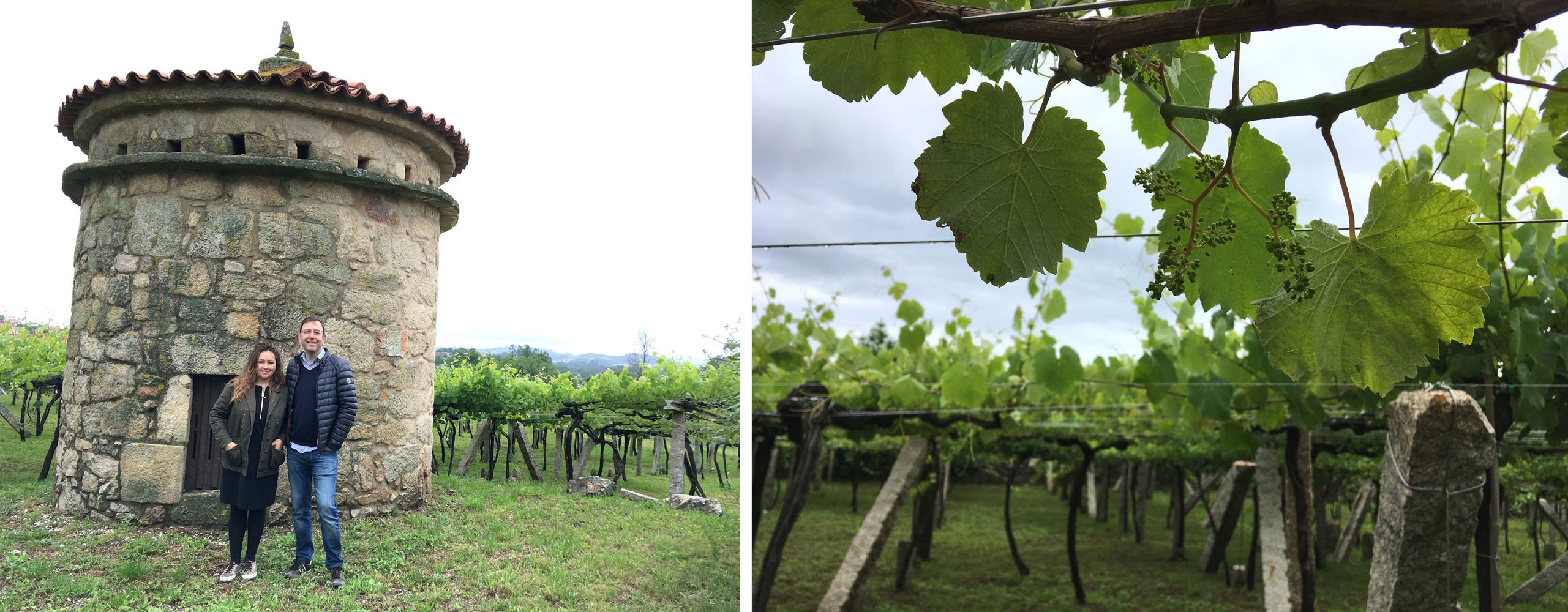 Eulogio and Rebeca next to the dovecote which gives Palomar vineyard its name. Flowering in the Balado vineyard.
The reason for the distinctive tall granite posted pergolas, called emparrados in Gallego, is to keep the vines off the damp ground and dry them in the Atlantic winds – a bit like hanging them on a washing line. Plus Albariño has thick skins, which makes it more resistant to the moulds and fungus that thrive in this cool damp climate.
Since 2000, when Eulogio took over his family vineyards, he has been focused on improving them. He started to work organically, abandoning mineral fertilisers, which he describes as ‘dead minerals’. Instead he uses shells from the surrounding coastline which provide the calcium and magnesium the vines need and don’t get from the acidic soils, but come from living animals. He also uses seaweed as compost. Albariño is a vigorous variety, I asked if he green harvests.
He said: “Green harvesting is a result of poor vineyard work, if you seek balance in the vineyard using natural composts the vines won’t overproduce and you won’t need to do that extra work”.
Next we walked a couple of minutes along the road to the Balado vineyard, Eulogio’s favourite parcel. The 1.5 hectare plot is surrounded by a low granite wall, like a French clos. All the Zarate vineyards are around the family home near Cambados. Eulogio’s grandfather was pivotal in promoting Albariño in the area, which was in danger of being replaced by hybrid varietals which are mildew resistant and higher yielding. In 1954 Ernesto Zarate joined together with three friends to found the Cambados Albariño Festival. In those days white wines were seen as for the rich, workers drank reds. Ernesto’s wines won for the first three years, he didn’t enter after that. The festival now attracts hundreds of people and Albariño is well regarded within Spain and abroad.
As we walked back to bodega Eulogio explained that there are two types of soil. Most of his parcels are on white granite, flecked with black and silver mica. This sits in a layer around 30 centimetres below the topsoil and is impenetrable for the vine roots. The other is red/yellow granitic soil flecked with iron and other metals, it breaks down much more easily than the white granite, and vine roots can penetrate deep into it.
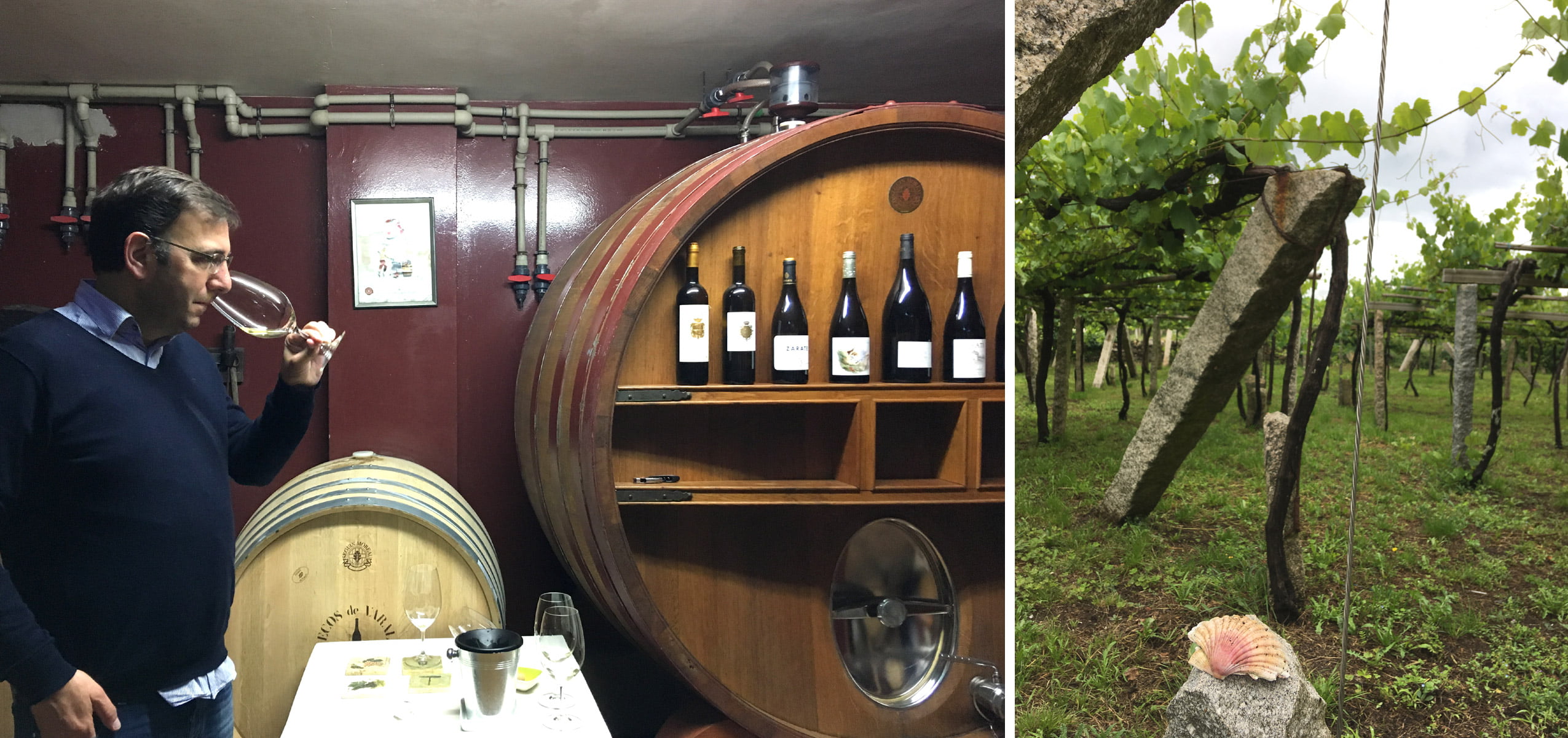 Eulogio tasting from barrel in the cellar. Shells from the surrounding coastline which provide the calcium and magnesium the vines don’t get from the acidic soils
We tasted the 2017s from tank and barrel. Balado 2017 is fermented in stainless steel and ages for 9 months on fine lees with no batonnage. Bursting with green fruit, and with a lovely tension and long finish. Tras da Viña 2017 is more floral with a riper softer feel, it spends longer of the lees than Balado and is normally only bottled after two years. El Palomar 2017 is the only Albariño that spends time in (old) wood, the 2017 was quite lactic on the nose, fresh and textured in the mouth. Zarate have some of the only remaining plantings of Caiño Tinto, Loureiro Tinto and Espadeiro, and in 2009 Eulogio started to recover some vineyards. Espadeiro has a long growing cycle, the 2017 smells of bay leaves and has a fresh, earthy, smoky flavours. Perfumed peppery Caiño Tinto 2017 is fermented 30% with stems as the variety is low in polyphenols. Eulogio says it needs 5-6 years in bottle to soften.
The Consejo Regulador in Rías Baixas hailed 2017 as a textbook vintage. Spring was warm and dry with rainfall 15% below the average, which led to healthy flowering. June was warm, July brought erratic temperatures, and despite big variations in the weather in August conditions remained relatively dry. September was mild and low rainfall continued leading to a good accumulation of sugar in the berries, medium acidity and good balance. Healthy grapes were harvested in the first quarter of September, two weeks earlier than average.
Eulogio says that despite the warm dry conditions, the 2017 wines are fresh with a vibrant acidity which he predicts will evolve well in bottle and can be kept for 5-10 years.
Eulogio and Rebeca will be visiting us in London on 25-27 March, showing his 2017s including the new bottling of his delicious single-vineyard Albariño Carralcoba. Drop us a line if you’d like to meet Eulogio when he’s over.
Historic Rioja Wines
Over the last few years we’ve been working with Johnny Hartwright, who is based in Barcelona and has a passion for sniffing out consignments of old vintage Rioja. The wines have typically been cellared in the same place ever since they were released and sold, and have aged into elegant, ethereal wines which match beautifully with food.
I caught up with Johnny recently to find out more about his vinous treasure hunts and why he thinks Rioja wines age so well.
When did you realise there was a market for these wines?
“Since moving to Spain I had tried and enjoyed mature wines from Rioja. Someone tipped me off about a huge collection of over 100,000 bottles which had been stored in a basement car-park – near perfect cellaring conditions! I sold the whole lot – seven lorry loads, the largest single parcel of old wines sold – to a UK indy wine retailer. Seeing the demand was there I saw the potential, and started to look for other stashes!”
Johnny never buys large collections of wines without first checking out the storage conditions and tasting some of the bottles. Spain can get hot and unfortunately some wines have not been well stored. He was understandably tight-lipped about how he sources the wines, many of which have been stored in their original cellars since release, however he has some unusual anecdotes about their discoveries which he’ll share with us when he comes over.
What is behind these Rioja’s longevity and ageing ability?
“There are two factors, grapes were picked earlier and at lower sugar levels in the 70s and 80s – the pH of the juice produced is lower and the acidity of the wines was higher which gives them freshness and good aging potential. Secondly it was common in the 70s to keep Crianza wines in barrel for at least two years, the requirement is a year, the Reseva and Gran Reserva wines were often kept in barrique for much longer. This longer aging in wood is only practiced today by a few producers such as Lopez de Heredia, it helps to stabilise the wine as well as concentrating the aromas and flavours giving them the concentration for a long life.”
This tradition for oak aging was born in the late 19th century when Bordeaux producers, fleeing from the twin plagues of mildew and phylloxera brought their barriques over the Pyranees to Rioja. This is when many of the grand old bodegas such as La Rioja Alta, CVNE, López de Heredia, Muga, Marqués de Murrieta and Marqués de Riscal were founded.
And what of Riojas today will they go the distance like the examples from the early 20th century?
“I’m not sure, wines today are often picked riper and therefore have lower acidity. There is also a shift away from long oak aging as consumers seem to prefer more fruit driven styles. I don’t think modern day wines will go the same distance as those produced in the 70s, 80s and early 90s, I guess only time will tell.”
So it seems we should enjoy these graceful old Riojas while we can.
We’ll be opening a selection at a tasting at The Larder on Wednesday 18th October – if you’d like to join us for a glimpse into Rioja’s history or would like a list of the wines we have available contact us.