

Our Blog
Mutiliana – a new language of Sangiovese
When Giorgio Melandri, the founder of Mutiliana, and his daughter Livia visited we had the opportunity to catch up with Giorgio and discuss the inspiration behind the project.
Sine sole sileo. Without the sun I am silent.
You might have seen this phrase on a sundial in Italy, it’s the inspiration for Mutiliana’s labels, the words curving at the centre of a smiling Italian sun. For Giorgio Melandri the significance of the inscription is twofold: Firstly, in a fundamental sense wine simply would not exist without the sun, or as Galileo put it “wine is sunlight held together by water”. The second meaning is more metaphorical, and underscores the role of time and place in winemaking, just as the time on a sundial is exact in its unique setting, the qualities that exist in a vineyard at a given particular moment are inherently distinct. Both ideas deeply rooted in Giorgio’s project.
As a native Romagnolo, Giorgio has a profound passion for Emilia-Romagna and its vinous heritage. He spent 20 years tasting and writing about these wines for Gambero Rosso. He has also spearheaded several initiatives (Enologica, Stell dell’Apennino) that promote the diversity and potential of wines from the region. Few people know the area and its varied terroirs as well as he does, so it was a natural step to turn his hand to winemaking. Inspired by his intimate knowledge of the region, combined with a fascination with the region’s native Romagna Sangiovese clone, Giorgio founded Mutiliana. His focus is a terroir-driven expression of Sangiovese, moving away from the overripe and heavily-oaked style prevalent within the region.
“Sangiovese speaks a different language – less alcohol, fresher acidity and more herbal and floral notes”
Based in Modigliana, a small city in the foothills of the Apennine Mountains, Mutiliana takes its name from the ancient name for the town. During his years with Gambero Rosso, Giorgio recognised something special in the wines from this sub-region; according to Melandri “Sangiovese speaks a different language” on the soils above Modigliana, with “less alcohol, fresher acidity and more herbal and floral notes”. Unlike the majority of Romagna, which has clay-based soils, the valleys surrounding Modigliana are comprised on marl and sandstone. Rising from the foothills of the Apennines are the three valleys – Ibola, Tramazzo and Acereta – which give their names to three wines made from the Romagnan Sangiovese clone. Giogrio personally selected the best vineyards and determines when to harvest, so that each wine expresses a unique mineral style that highlights the terroir of its valley of origin.
This focus site-expression extends to the cellar, with the adoption of low-intervention winemaking and maturation in concrete vats allowing the unique geographical characteristics to shine through in the wines. The vineyards and wines are overseen by viticulturalist and winemaker, Francesco Bordini. Giorgio became aware of Francesco through his label, Villa Papiano – also based in Modigliana – and partly provided the impetus behind his decision to try to create something new. Their friendship and work together has fostered a shared desire to challenge the status quo within the Emilia-Romagna wine community and to show the greatness of the terroir and the unique Sangiovese wines that come from there. Giorgio sees Mutiliana as part of a growing movement within the region to bring attention back to the land and believes this is indicative of a wider change taking place in Italy.
If you missed Giorgio at our Portfolio Tasting, you can find more information on the Mutiliana wines on our website, or contact your sales rep.
Bodega Lanzaga – Re-framing the history of Rioja
On the surface Rioja seems steeped in tradition: historic wineries with lofty cellars stacked with barrels that define a well-known classification system based on time spent in oak. In fact this is a tradition that dates back to the 18th century when phylloxera forced Bordeaux négociants to look further afield to supplement their ravaged stocks. As well as barrel ageing the Bordelais encouraged a focus on Tempranillo and Garnacha, and the investment they brought led to large wineries being set up that functioned like cooperatives buying in volume from local growers.
Before this the wines of Rioja were field blends made from co-plantings of dozens of different varieties. Over time growers began to abandon the higher sites and concentrated on growing Tempranillo on the flat, fertile land closer to the river. Farming was less labour intensive here and grapes ripened more reliably. All these factors led to increasingly uniform wines with little sense of regional identity or terroir.
In 1994 Telmo Rodríguez and his partner and friend Pablo Eguzkiza set-up Compañia de Vinos Telmo Rodriguez. In 1998, while working at Telmo’s family estate Remelluri, they noticed and started to buy small parcels of abandoned vineyards around the town of Lanciego. Their aim with Bodega Lanzaga is to rediscover the ‘true’ historic taste of the villages of Rioja that has been camouflaged by oak ageing. They believe these higher altitude sites with a long tradition of viticulture have the potential to produce exceptional wines.
Bodega Lanzaga is located in the village of Lanciego amongst six hills and three valleys. The Sierra Cantabria shields the vineyards from the Atlantic winds and rains from the north, creating a unique microclimate with low rainfall. Soils are stony with a palm-deep layer of iron-rich calcareous clay overlaying the mother rock. The whole estate is dry-farmed and worked organically, it’s the second largest organic certified estate in Rioja – the largest is Remelluri. Production is relatively small: they currently produce between 180-250,000 bottles a year, compared to many of the more well-known estates that produce several million.
Telmo thinks it’s important to talk about the quantity of wine they make, all the cuvées state the number of bottles produced: “Much Rioja is an industrial product, it’s ugly to say we produce 12 million bottles”.
 Lanzaga vineyard. Concrete tanks inside the cellar at Lanciego
Their vineyards are mainly mixed plantings. They have managed to maintain some older vines, especially in the Las Beatas plot, but are in-filling or replanting at most of the sites. They are using massal selection to re-populate the vineyards with cuttings of Garnacha from the El Velado vineyard and Tempranillo from La Estrada vineyard. This enables them to use the more traditional Tinta Fina Tempranillo clone rather than the much more common Tinta de Toro that they could buy from vine nurseries today. Some people think the smaller, tighter bunches of Tinta de Toro produce better quality wine, but Telmo and Pablo think time has made the selection in Lanzaga’s old vineyards: “Generations of growers in Rioja have made a quality selection of the vines through massal selections from the original clones planted in the vineyards close to a century ago”. Juan, the winemaker at Lanzaga, showed us how they hand-graft their cuttings on to American rootstocks.
They use a Burgundy style classification for the wines: Corriente is their négociant wine, they use the grapes that don’t go into their village wines and also buy some grapes for this from next door village Labastida. The term corriente was used in the early 20th Century to describe good, approachable everyday wines drunk by ordinary people, that reflect their region. They’re particularly pleased with the 2016 vintage. LZ is their young village wine, grapes are taken from several different plots across their estate. It’s a field blend from younger vines of around 90% Tempranillo plus some Graciano, Mazuelo (known elsewhere as Carignan) and several white varieties. The grapes are mostly de-stemmed and whole berries are fermented in concrete tanks to retain freshness. It’s bottled the summer after the harvest – historically wineries did this to free up their tanks for the new vintage – and the heady fruit perfume almost leaps out of the glass. Lanzaga is their other village wine from older vines, it’s 90% Tempranillo plus Graciano which adds structure and a herbal, liquorice note, Lanzaga is aged in old foudre.
Telmo isn’t a fan of new oak: “Oak is a cosmetic, it masks the taste of the village and the grapes”.
Having worked in Lanciego for for 20 years Telmo and Pablo have singled out what they consider the best sites and make a selection of four single vineyard wines: El Velado, La Estrada from sites around Lanciego and Tabuérniga and Las Beatas from Labastida. I asked Telmo how they identified these exceptional sites, of course there’s not a simple empirical answer:
“Vineyards are like people, they have personalities which are a mix of all their characteristics”.
El Velado is one of the first vineyards that caught Telmo and Pablo’s eye when they started working in Lanciego. It’s a small plot of under 1 hectare planted with 80-year-old bush vines, mainly Garnacha which thrives in this warmer south-east facing site, but with some Tempranillo and other varieties. La Estrada is even smaller, just 0.6 hectares of poor calcerous-clay soils in the highest part of the village. This site is planted with 80-year-old vines, this time mainly Tempranillo with some Graciano.
 Old vines in the Las Beatas vineyard. Tasting Las Beatas in the renovated cellar at Ollauri
The other single vineyard wines come from nearby Labastida and are vinified in a small winery in Ollauri which they have renovated. The Tabuérniga vineyard had been farmed by the same grower for 50 years before it was bought by Telmo and Pablo in 2012. There is a higher percentage of Graciano on this site. Soils are sandy and rich in limestone and clay. The final wine Las Beatas is a labour of love – a tiny 1.9 hectare plot – slowly assembled by acquiring smaller neighbouring parcels on the abandoned old terraces. Telmo refers to this wine as ‘the museum’ many of the vines are over 80 years old and there are perhaps 11 varietals in the vineyard. They are also replanting to fill in any gaps with their massal selections cuttings. Soils here are mainly sandstone and marl which produces more perfumed and delicate wines.
Ben has been following the development of the Lanzaga project for several years and is a big admirer or the vision that Telmo and his partners have in reinvigorating some truly extraordinary vineyards. We’re delighted that Bodega Lanzaga is joining the Indigo portfolio and can’t wait to see how the projects and wines develop as they continue their work. You can read more about the project on our website.
The wines will be arriving at the beginning of July. We will have very limited quantities of the single vineyard cuvees, contact your sales rep if you’d like the taste the wines or enquire about availability of the single vineyard wines.
Javier Revert’s fresh take on the past
“The future lies in the past” has become something of a battle cry for a new generation of winemakers in Spain who are reviving long abandoned vineyards and rediscovering a wealth of native grapes. Javier Revert is very much part of this renaissance, when he spent a few days in London recently we took the opportunity to find out more about this young project and his winemaking inspirations.
Javi grew up in a small village called Font de la Figuera, south of Valencia and around 60 km inland from the coast. Grapes have been grown here since the 4th Century BC and, like most local families, his family were farmers until his father’s generation. When phylloxera hit the region the hillside vineyards were abandoned, when people replanted many did so in the easier to work valleys, and started to sell their grapes to coops rather than making their own wine. Javi feels a strong connection to his home landscape, so knowing he wanted to work in the countryside he studied agricultural engineering. He didn’t specifically want to work as a winemaker at that point, but as he finished university a job came up at Celler del Roure in his home village. This was the perfect base for Javi to explore the local area while developing his winemaking skills.
He cites fellow Spanish winemakers and Indigo’ers Dani Landi and José Maria Vicente (Casa Castillo) as a big influence, and as good friends. They all enjoy visiting and trying wines from other producers that they admire, with a particular penchant for Burgundy and the Rhone – their Instagram feeds are a catalogue of enviable bottles. As Javi says:
“The important thing is to know what you’re aiming for!”
Javi is close to his grandfather and has always loved hearing his stories about the local area. One afternoon they were walking together above the village when they came across a vineyard that had been planted by Javi’s great-grandfather. This discovery prompted Javi to look out for other old, terraced sites and he has amassed around five hectares. These plots hadn’t been worked for years so had become overgrown with scrub, olive and almond trees. The vines which survive are field blends of local varietals such as Tortosí, Trepadell, Malvasía, Merseguera, Verdil, Garnacha Tintorera, Monastrell and Arcos.
All the old varieties had long growing cycles, many weren’t harvested until early November. This allows the grapes to ripen steadily and develop phenolically, but can be risky if Autumn rains arrive before you harvest. On the other hand with the the evidence for climate mounting and winemakers reporting earlier harvests, Javi thinks that working with later ripening varieties could be the future, unless people want to be harvesting in August.

His first vintage was 2016. Until 2018 he as been making his wines at Celler del Roure – 2019 will be the first vintage at his new cellar (pictured below).
Micalet is his only white wine. The grapes come from that original plot he discovered with his grandfather. The vines were planted in 1948 by his great-grandfather. They’re a mixture of Tortosí (40%), Trepadell (25%) with the rest made up from Malvasía, Merseguera, Verdil and Macabeo. He has worked with his grandfather and other older winemakers from the village to identify these forgotten varietals. The soils in the vineyard are chalky, not unlike the Albariza around Jerez. Some of the vines are on their own roots and other are grafted. These vineyards are between 700 and 900 metres above sea level so too remote for phylloxera to have reached in some cases.
The first year he harvested all six varietals and vinified them separately before blending – mainly because he had never tried single varietal wines of most of these grapes. But he found the resulting blend didn’t gel so now he co-ferments. In the first year he fermented and aged his white in amphora but found the result fruitier than he was aiming for. Now he uses 54 litre glass demi-johns and old oak barrels as he’s aiming for a fresher more linear wine which really expresses its chalky origins.
He makes two reds. Sensal is his ‘village wine’ grapes come from three plots. The blend for 2016 and 17 is Garnacha Tintorera (Alicante Bouchet) and Monastrell which are co-fermented and Bonicaire (Trepat). This will change as Javi is clearing old terraces and planting new vineyards which in the future will go into Sensal. He’s planting Arcos cultivated via massal selection and Garnacha with cuttings from his friend José Maria in Jumilla. This smoky, plumy red with a touch of pencil shavings on the finish is fermented 60% whole-bunch and rests in old oak for a year where it undergoes malo.
His other red is called Simeta, it’s made with 100% Arcos from a plot planted in 1975 on sandier soil. 30% of vineyards in the area used to be planted to Arcos but now only 2 hectares remain. It’s a late ripening variety with loose clusters of small berries with thick skins. He ferments 100% whole cluster and transfers the wine into amphora for 1 year. The result has a pure red fruit nose and a fresh juiciness in the mouth. The tannin is more apparent than Simeta, Javi sees this as a more serious wine than Simeta that should age well. Luis Gutiérrez. in his recent report on robertparker.com, gave Simeta 2017 94 points and said: “It has a super fine palate with very fine, chalky tannins. Plain great, elegant Mediterranean red.”
Javi describes his wines as having an “old fashioned Mediterranean style” which for him means a freshness and purity of fruit – not what people expect from such a warm dry region.
 Terrace sites above the village ready for replanting. Javi’s new micro-bodega in Font de la Figuera.
What of the future? He’d like to make a bit more wine. He’s clearing the old terraces which were abandoned after phylloxera and replanting them with traditional varieties using massal selection to produce new plants. He’s also continuing to tweak the blends and winemaking – 2019 will only be his fourth vintage after all. These pure vibrant wines are tasting great already, we see a bright future for Javier and modern/old fashioned wines.
Envínate: four heads are better than one?
The first thing that Roberto Santana explained when we arrived at their Palo Blanco vineyard in Valle de la Orotava was that he, Laura Ramos, Jose Martínez and Alfonso Torrente make the wines together, even though they come from different parts of Spain and live in different areas. The four friends who met while studying oenology at the University of Miguel Hernández in Alicante are Envínate – a collective who focus on making terroir-transparent wines from mainly Atlantic-influenced regions.
Roberto: “All the wines involve four brains!”
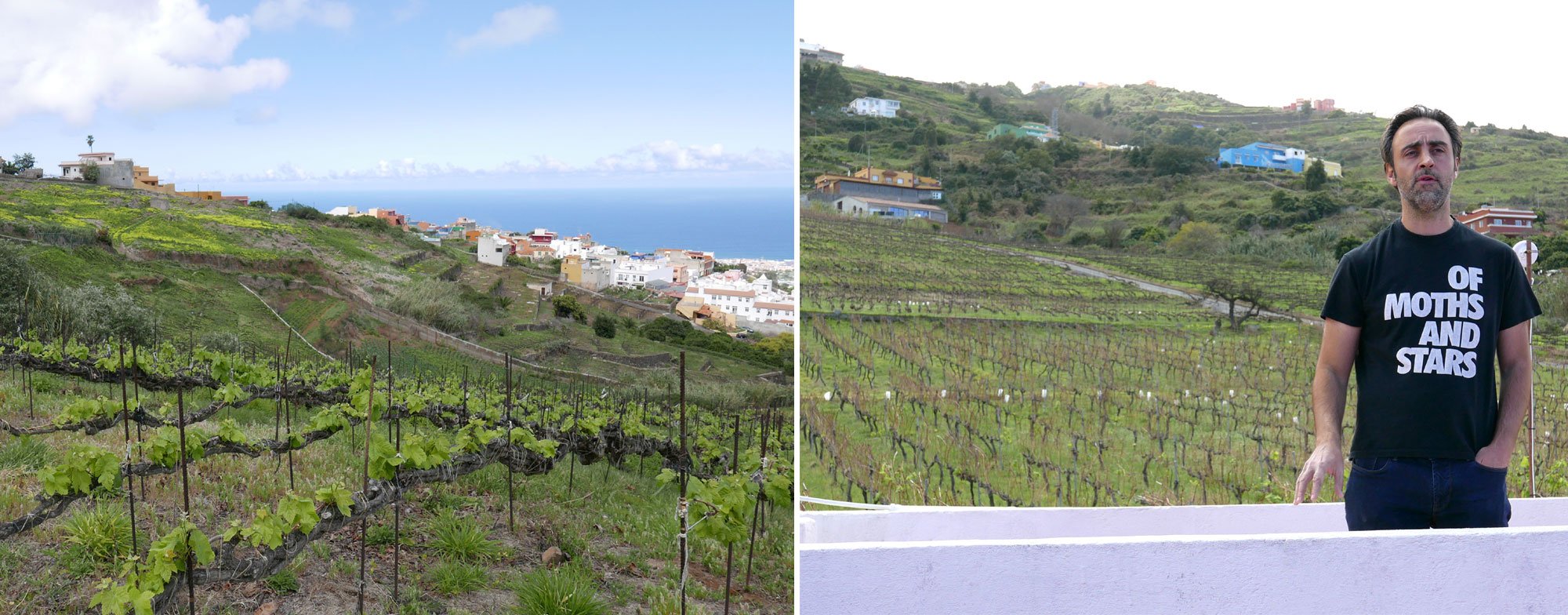
They work in three areas on Tenerife: the Taganana vineyards perched right above the Atlantic Ocean in the north east of the island; a selection of high-altitude sites in Santiago del Teide in the Yconden-Daute-Isora DO, where the two Benje wines come from; and they have Migan and Palo Blanco vineyards near the town of La Orotava. Soils in Palo Blanco where we stopped are 80% black basalt and the harvest is more than a month later than some of their other sites. The Listán Blanco (Palomino) from here has a sharp, natural acidity, reds would never ripen on this site.
Given that Tenerife is phylloxera free they establish new vines by layering, although the originals in the plot are 100 years old. One vine can have six strands. The length of the plant changes every year, but doesn’t always increase, depending on the pruning. Roberto noted that it’s important to prune so the vine produces new wood along its length, the first few buds are blind. They tie the vines in the traditional way with strands of banana leaf – you see the palms growing all around the island. The soil in Palo Blanco looks quite bare for an organic vineyard, until 2016 it was owned by someone else who used herbicides, so is recovering its mojo so to speak! Also they cut the grass and will rotovate the soils this year. The island is humid, so canopy management is really important for grape quality. To dry the morning dew and discourage mildew they dust the vines with sulphur and bentonite instead of using systemic products.
Roberto: “Our vineyard work is the most important work that we do”.
 Palo Blanco vineyard with 100 year old Listán Blanco in Cordon Trenzado. Roberto explains how they prune cordon trenzado.
On the winemaking front, they tend to ferment at low temperatures without stems. “If the stems have become ripe the grapes will be over-ripe”. Roberto commented. They don’t use new oak, they buy used Burgundy barrels from producers they know. Neither do they use SO2 during winemaking, they minimise racking and allow the lees to control the wine development. They just use a touch of SO2 before bottling to stabilise the wines. They’re looking for freshness, spice, fine tannins and a long finish.
2017 was a good year for the Taganana and Orotava vineyards. It was more difficult for the higher Benje sites – there was a hot, windy week, the vines lost leaves and some were stressed. “It isn’t a year for ageing Benje, five years would be enough, but on the other hand it’s tasting great now” admits Roberto. They think 2017 was one of the best years yet of Albahra. Harvest in 2018 was early and wines have good acidity levels.
We then headed up to a covered terrace where magnums of their latest releases were waiting – yaas!
Highlights for me were: Táganan Tinto 2017 – a blend of varietals including Negramol, Vijariego Negro, Listán Negro and Listán Gacho, planted on cliffs just above the Atlantic, on black basalt soils which the roots can penetrate. It’s aromatic, really fresh and fruity with a touch of spice; Benje Blanco 2017 – from a high site 100m above the cloud level on the volcanic slopes of Mount Teide. From this vintage they have started to ferment 40% of the wine in concrete under flor, with the rest in old barrels, and in 2018 they fermented 60% under flor in concrete which gives the wines a spicy texture and a fresh saltiness.
Thank you Roberto and Alfonso for a really memorable tasting. You can find more details on all the wines on our website. And we’re expecting a delivery of Benje Tinto, Palo Blanco and Táganan Parcela Margalagua 2017s in May, drop us a line for details.
Indigo on Tour: A history lesson and a great party at Suertes del Marqués
Tenerife is an island of contrasts. Mount Teide at 3,718m dominates, and also defines the climate which is completely different on the north and south sides of the island. The volcano catches clouds that blow in from the Atlantic and this makes the north side of the island much more humid and rainy. The lush green north has a tropical feel with its banana palms and brilliant flowers. The drier south side of the island on the other hand is an arid moonscape, peppered with holiday complexes and theme restaurants. Luckily we were headed for the north to Suertes del Marques to check out their new cellar (pictured above).
Owner Jonatan Garçia Lima is part of the growing breed of intensely passionate producers who are looking to the island’s winemaking heritage, restoring old vineyards and working with lesser known grape varieties. The estate has some incredibly old, low-yielding vines which have to be seen to be believed. The vineyards at Finca El Esquilón are planted on a steep slope of the Orotava Valley. Driving up towards the winery felt like we were strapped into a rocket headed for the stratosphere!
 El Esquilón vineyard with 80 year old Listán Negro. Jonatan welcomes us to the winery.
Jonatan is a natural host, he welcomed everyone and led an eager crowd of wine importers, somms, journalists and winemakers up to a terrace with a birds-eye view of their plots. He started by explaining a bit of the background and history of winemaking on the island. Valle de la Orotava is one of five appellations on Tenerife, the others are Ycoden Daute Isora and Tacoronte-Acentejo in the north and Abona and Valle de Güímar in the south. Vines were originally brought over to Tenerife in the 15th and 16th centuries on boats from Portugal and Spain which stopped at the island on their way to the New World. At that time wines from the region were mainly exported to the UK, Shakespeare mentions ‘Canary wines’ in several of his plays. They had to be fortified to survive the journey.
“There’s a lot of history with Tenerife Wines, winemaking isn’t new to us”.
There is a variety of soils across the Orotava Valley, in the east the soil is clay rich and Listán Negro makes up 95% of plantings. In the west nearer Teide the soil is more volcanic and Listán Blanco makes up 95% of plantings. Soil type also changes as you move down the slopes – red loamy clay in the highest vineyards and paler sandy loam towards the lower sites such as El Ciruelo and El Esquilón at 450-550 metres. Suertes own nine hectares of vineyards and rent a further two. In addition the grapes for 7 Fuentes and El Lance come from plots across the Orotova valley, where Jonatan works with a number of growers. There are hundreds of small plots across the valley, this is due to traditional inheritance laws which split family land equally between sons. The name ‘Suertes’ refers to these little plots of land, individually owned by local families.
The vines on Tenerife are un-grafted, phylloxera didn’t take hold here which Jonatan attributes to their isolation.
“Nobody brought international varietals over here, so phylloxera didn’t make it to the Orotava Valley”.
The thing about the vineyards here that strikes you most is that many of the Suertes vines in the Orotava Valley are grown in a trellising system called Cordon Trenzado. It’s rare, in fact the valley is home to most of the Cordon Trenzado vines in existence. Vine branches are plaited together and supported on stakes, and eventually grow into gnarly arms, sometimes several meters in length.
 Heading down the steep hill past El Esquilón. Close up of one of the plaited arms in Hacienda las Cañas.
There’s a long growing cycle in the valley. The winters aren’t cold so vines wake up early and the summers aren’t really hot up on the hillside so ripening is gradual. Jonatan described it as “Like slow-cooking food”
Jonathan picks relatively early as he is looking for fresh wines with lower alcohols of 11-12%, some grower pick later if they want to make a more powerful style of wine. The majority of organic production around Orotava is managed by Suertes, and when you look at the hillside you can pick out the green plots.
After this introduction we all walked down the steep road and across the top of El Esquilón vineyard, planted with 80 year old Listan Negro. We carried on down the slope ending up in Hacienda las Cañas, the lowest plot at 300-350m. The vineyard is surrounded by palms and orange trees, a heady aroma of orange blossom hung in the air. Originally planted in the 18th century, Suertes rented it for 15 years before the opportunity arose to buy. Las Cañas is planted with Listán Negro, Listán Blanco, Negramoll y Malvasía Rosada. Some of the Listán Negro and Blanco there is 200-250 years old. These are some of the oldest vines in the world. There are also some younger plantings.
“Is cordon trenzado the best training method to use on these vines in the valley?” Jonathan muses, “we’re looking for the best wines we can make with the traditional system we have”.
The soil is rich with a pH of 3.9-4.1 which over time is toxic for vines. Traditionally growers would add lime to the soil to raise the pH which is what Jonatan does as well. He asked one of the retired vineyard workers, who remembered his grandfather adding lime but he didn’t know why. Traditional methods became traditional for a reason.
Jonatan explained a bit about pruning cordon trenzado. If you prune the arms back they’ll grow like cordon royat. You can’t balance yields this way, you need at least four buds. Sometimes four arms come from the same base, and there are productive shoots all along the vines. They prune and tie along the length of the arms, this used to be done individually but now they wrap strings along the arms. There’s a lot of work to be done in his vineyards between pruning and harvest. The arms are staked at intervals to keep them off the ground and then a wire is run along the top of the arms. They train the shoots vertically to this wire to aerate them and avoid botrytis in this humid climate. In two months there will be “walls of leaves along the arms” Jonatan explained.
 Pruning in El Esquilón. Hacienda las Cañas, this plot has some really old Listán Negro and Listán Blanco.
They get around 600mm of rain per year in the north, in the south it’s more like 60mm. “That’s good for the tourists” commented Jonatan. In the north it’s normal to treat the vines 10-12 times per year that includes low doses of copper for mildew, a bentonite and silicon clay powder for botrytis and a blend of sulphur and cinnamon – which smells really good – for Oidium.
The DO allows yields of 10,000 kg/ha, but Jonatan tends to aim for 6,000 kg/ha which gives the final wines more complexity. Any lower and the wines can be unbalanced.
No cellar opening is complete without a party, in fact Jonatan had organised two! A relatively chilled gathering on Sunday evening for around 300 of his closest friends at his parent’s house in La Orotava. The main event however was the next day, a tasting above the vineyards involving 18 wineries, all friends and favourites of Jonatan from Spain and beyond. It was impossible to get round them all but highlights for me were Cesar Marquez’s Parajes and my first try of his single parcel Sufreiral; Pedro from Guímaro showing the development from village to a single parcel wine from Ribeira Sacra; Alain Graillot’s rich and delicious Crozes-Hermitage La Guiraude; and Ramiro Ibáñez and Willy Perez’s almacenista revival of Bodega de la Riva – that Oloroso… The band started and the tasting flowed seamlessly into party mode.
 Niña Coyote eta Chico Tornado rock the party.
A huge thank you to Jonatan and his family for inviting us to share this memorable weekend with them. When I spoke to Jonatan in London last June he was really excited about the direction the wines were taking with the support of new winemaker Luis Seabra. You can find more information on all of the Suertes del Marqués wines on our website.
A visit to Eulogio Pomares in Rías Baixas
There’s something slightly mystical about Galicia. As we headed west to meet Eulogio Pomares and his wife Rebeca at Bodegas Zarate we passed rolling valleys, with wisps of cloud trapped in the granite hollows like watchful ghosts.
There are five subzone D.O.s in Rias Baixas. Zarate are located in the Val do Salnes, named after the ‘sal’ (salt) the Romans used to harvest there, and home to around 70% of the regional production. Albariño is dominant here, but across Rias Baixas you can also find Treixadura, Loureiro, Caiño (tinto and blanco) and Torrontes (not the Argentine varietal). Eulogio also makes a wine called Liebre y Tortuga from Condado do Tea which is further south tucked around a peninsula, it has a more Mediterranean climate and they tend to harvest there two weeks earlier.
We started our tour in the Palomar vineyard, named after the large granite dovecote that overlooks it, and the oldest of the 40 small parcels which they farm. The vines date from circa 1850, and grow on their own rootstocks. Phylloxera can’t survive in the very well drained sandy/granite soils. The challenge here explained Eulogio is mildew, “in the late 1890’s, mildew arrived and killed 99% of the vines, the area went from 25,000 hectares to 250”.
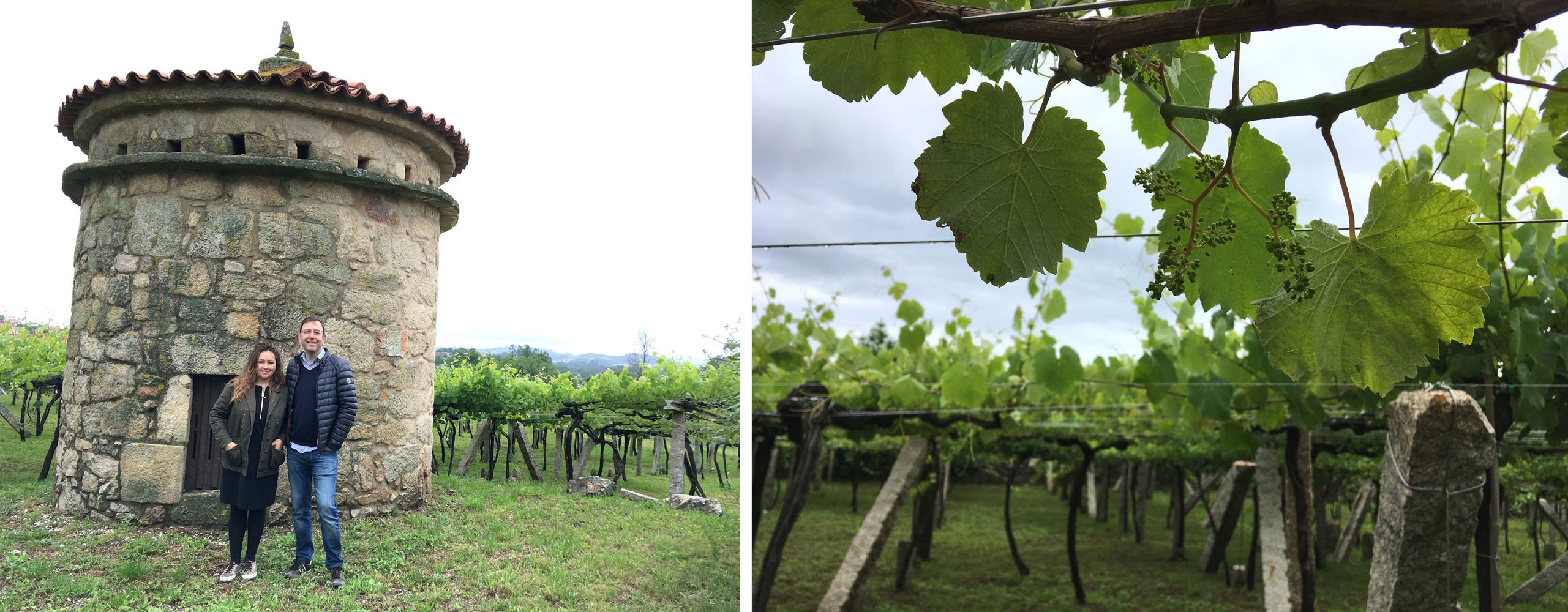 Eulogio and Rebeca next to the dovecote which gives Palomar vineyard its name. Flowering in the Balado vineyard.
The reason for the distinctive tall granite posted pergolas, called emparrados in Gallego, is to keep the vines off the damp ground and dry them in the Atlantic winds – a bit like hanging them on a washing line. Plus Albariño has thick skins, which makes it more resistant to the moulds and fungus that thrive in this cool damp climate.
Since 2000, when Eulogio took over his family vineyards, he has been focused on improving them. He started to work organically, abandoning mineral fertilisers, which he describes as ‘dead minerals’. Instead he uses shells from the surrounding coastline which provide the calcium and magnesium the vines need and don’t get from the acidic soils, but come from living animals. He also uses seaweed as compost. Albariño is a vigorous variety, I asked if he green harvests.
He said: “Green harvesting is a result of poor vineyard work, if you seek balance in the vineyard using natural composts the vines won’t overproduce and you won’t need to do that extra work”.
Next we walked a couple of minutes along the road to the Balado vineyard, Eulogio’s favourite parcel. The 1.5 hectare plot is surrounded by a low granite wall, like a French clos. All the Zarate vineyards are around the family home near Cambados. Eulogio’s grandfather was pivotal in promoting Albariño in the area, which was in danger of being replaced by hybrid varietals which are mildew resistant and higher yielding. In 1954 Ernesto Zarate joined together with three friends to found the Cambados Albariño Festival. In those days white wines were seen as for the rich, workers drank reds. Ernesto’s wines won for the first three years, he didn’t enter after that. The festival now attracts hundreds of people and Albariño is well regarded within Spain and abroad.
As we walked back to bodega Eulogio explained that there are two types of soil. Most of his parcels are on white granite, flecked with black and silver mica. This sits in a layer around 30 centimetres below the topsoil and is impenetrable for the vine roots. The other is red/yellow granitic soil flecked with iron and other metals, it breaks down much more easily than the white granite, and vine roots can penetrate deep into it.
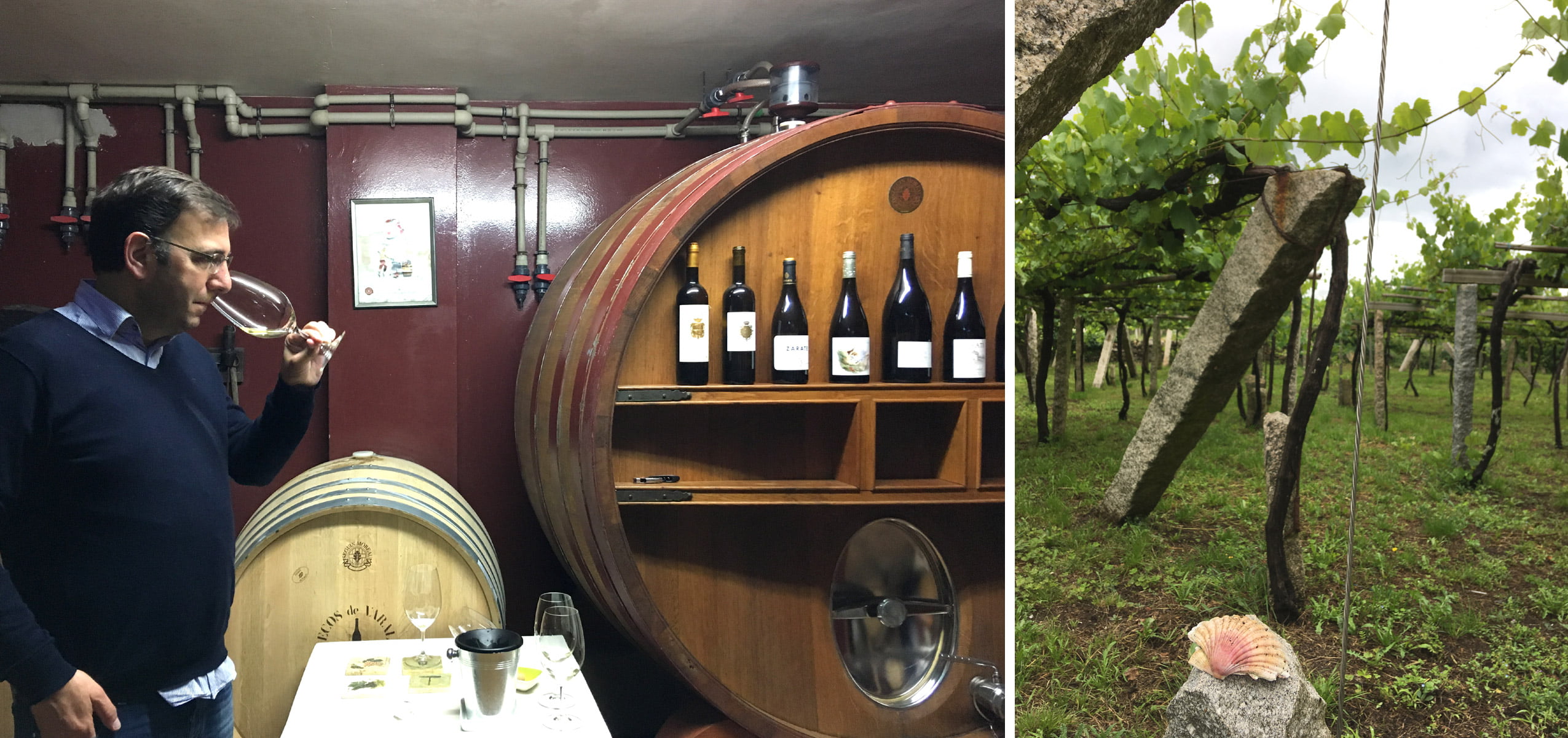 Eulogio tasting from barrel in the cellar. Shells from the surrounding coastline which provide the calcium and magnesium the vines don’t get from the acidic soils
We tasted the 2017s from tank and barrel. Balado 2017 is fermented in stainless steel and ages for 9 months on fine lees with no batonnage. Bursting with green fruit, and with a lovely tension and long finish. Tras da Viña 2017 is more floral with a riper softer feel, it spends longer of the lees than Balado and is normally only bottled after two years. El Palomar 2017 is the only Albariño that spends time in (old) wood, the 2017 was quite lactic on the nose, fresh and textured in the mouth. Zarate have some of the only remaining plantings of Caiño Tinto, Loureiro Tinto and Espadeiro, and in 2009 Eulogio started to recover some vineyards. Espadeiro has a long growing cycle, the 2017 smells of bay leaves and has a fresh, earthy, smoky flavours. Perfumed peppery Caiño Tinto 2017 is fermented 30% with stems as the variety is low in polyphenols. Eulogio says it needs 5-6 years in bottle to soften.
The Consejo Regulador in Rías Baixas hailed 2017 as a textbook vintage. Spring was warm and dry with rainfall 15% below the average, which led to healthy flowering. June was warm, July brought erratic temperatures, and despite big variations in the weather in August conditions remained relatively dry. September was mild and low rainfall continued leading to a good accumulation of sugar in the berries, medium acidity and good balance. Healthy grapes were harvested in the first quarter of September, two weeks earlier than average.
Eulogio says that despite the warm dry conditions, the 2017 wines are fresh with a vibrant acidity which he predicts will evolve well in bottle and can be kept for 5-10 years.
Eulogio and Rebeca will be visiting us in London on 25-27 March, showing his 2017s including the new bottling of his delicious single-vineyard Albariño Carralcoba. Drop us a line if you’d like to meet Eulogio when he’s over.
Portfolio Tasting – Tuesday 12th February 2019
Meet the brilliant people behind the wines
A common thread across our diverse portfolio is the connection our winemakers have with their land. They’re artisans who work in harmony with their environment and the traditions of their regions. Over half our winemakers work organically or biodynamically, 30 are certified organic and a further 10 certified biodynamic.
You’ll find new faces: Remi Leroy who is making beautifully balanced, structured Pinot Noir focused Champagnes in the Côte des Bar; Château du Mourre du Tendre who work with whole-bunches to make fresh graceful Côtes du Rhône and Châteauneuf-du-Pape; Frank John who is working biodynamically in Pfalz and making one of the best Pinots we’ve tried this year; Viña Somoza distinctive Godellos with a vivid sense of place; and Gaintza Txakolina from the cool Atlantic coast of Spain.
They’ll be joined by familiar faces from the Indigo family including Telmo Rodriguez, Terroir al Límit, Suertes del Marqués, Colet, Sashi Moorman and Vitor Claro. Plus, the Fedellos boys will be showing their new project called Peixes from the Galician highlands.
Free pour is back with a focus on the southern hemisphere producers who will be harvesting and therefore unable to make it to London. Including new (for us) Argentine projects Super Uco and Gen del Alma from the talented Michelini crew; Viñedos de Alcohuaz pure mountain wines from 2,000 metres up in the Elqui Valley in Chile; Novum from Marlborough; Thousand Candles from the Yarra Valley; and some new arrivals from Ochota Barrels. We’ll also be highlighting a short, sharp list of wines that we feel represents real value in our portfolio – the sweet spot between quality, character and drinking pleasure.
Everyone agrees craft beer is a ‘thing’ brilliant for food pairing and a must on any serious drinks list. But it’s complicated with many different styles and the smorgasbord of seasonal specials. Fear not Nick and Theresa from our partner Biercraft will be on hand at the Biercraft Hub to talk you through the best solutions for your list. They’ll be joined by Lost & Grounded, Braybrooke, Verdant, Cloudwater, Kernel, Burning Sky and Beavertown Tempus Project. Need a break from the booze? There’ll be a refreshing collection of non-alcoholic alternatives to taste including Lucky Saint and Square Roots Sodas.
40 producers, 200+ wines, curated free pour, craft beer clinic, grown-up soft drinks. Such a unique, top-quality gathering of the artisanal wine and craft beer worlds is rare and not to be missed.
Producer list:
Alberto Nanclares | Rías Baixas
Andreas Bender | Mosel | Germany
Barco del Corneta | Castilla y León
Birgit Braunstein | Burgenland
Bodega Maestro Sierra | Jerez
Bodegas Marañones | Vinos de Madrid
Bodegas Peixes | Galicia
Can Rafols del Caus | Penedès
Castro Ventosa | Bierzo
César Márquez | Bierzo
Château du Mourre du Tendre | Rhône Valley
Clos i Terrasses | Priorat
Colet Vins | Penedès
Coto de Gomariz | Ribeiro
Dominio del Águila | Ribera del Duero
Eugenio Bocchino | Piedmont
Evening Land | Willamette Valley | Oregon
Familia Nin-Ortiz | Priorat
Fattoria di Sammontana | Chianti
Fedellos do Couto | Ribeira Sacra
Frank John | Pfalz | Germany
Gaintza Txakolina| Txacolí de Getaria
Hirsch | Kamptal
Hoffmann & Rathbone | Sussex
Hure Fréres | Champagne
Jonathan Maunoury | Loire
Juan Antonio Ponce | Manchuela
Muxagat | Douro
Pamela Geddes – Lobban Wines | Penedès
Peter Wetzer | Sopron
Quinta Pellada – Alvaro Castro | Dão
Rafael Cambra | Valencia
Remelluri | Rioja
Remi Leroy | Champagne
Suertes del Marqués | Tenerife
Terroir al Límit | Priorat
Toro Albala | Montilla Morilles
Viña Somoza | Valdeorras
Viña Zorzal | Navarra
Vitor Claro | Portalegre
Joan d’Anguera: a winemaking partnership to be reckoned with.
The history of cinema is built on iconic partnerships: Butch Cassidy and the Sundance Kid starring Robert Redford and Paul Newman, the quintessential Western for many people, was followed by The Sting, arguably the best heist movie of all times. Redford and Newman only needed these two films to cement an on-screen relationship with unmistakable chemistry: Newman plays the quiet cerebral character with a hard-headed attitude to business; Redford a passionate individual who follows his heart and his gut.
Despite working with brothers Joan and Josep Anguera for some time, it wasn’t until we visited them this January that we realised how similar their working relationship is to the Redford-Newman partnership! Joan is watchful with a cool and serene personality, whilst Josep is gregarious and sociable, confidently leading the conversation, and it’s their complementary personalities that make the whole thing work so well. When it comes to winemaking, however, their visions are perfectly aligned.
Based in the village of Darmós in DO Montsant in Catalunya, the brothers find themselves continuously fighting to shake off the misconception of being a cheaper alternative to neighbouring Priorat. There are distinct differences between the two regions: Montsant vineyards sit on limestone and clay, not the famous licorella slate soils, and don’t have the steep gradients, but Joan and Josep think they are no less deserving of the recognition that the best sites down the road enjoy.
 Chalk and sandy soils in the Anguera vineyards in Montsant
When their father died in 2000, the brothers became the seventh generation of their family to run the estate. After several transitional years they decided to turn the philosophy on its head, and work towards expressing the unique character of the vineyard sites around their village. In their view these sites show as many nuances as more lauded regions such as Rioja or Priorat, where more effort has gone into defining the differences between each village.
They started by adopting biodynamic principles in the vineyards, culminating with the Demeter certification in 2011. They gradually started to remove the trellises installed by their father – this is still a work in progress and has halved yields from 120 to 60 tonnes per hectare. Garnatxa (Grenache) and Carinyena (Carignan) were top-grafted on to existing Syrah and Cabernet Sauvignon vines. In the winery they sold the destemming machine, dramatically cut sulphur use so it’s now used sparingly at bottling only, and they stopped buying new oak barrels.
As a result there is a new focus to their range. They eliminated the entry-level wine as the quality of the fruit was now high enough to be used in individual cuveés, and no longer make a varietal Syrah. In their place, they have vinified two single-vineyard wines since 2016: Vinya de la Gloria, from a small north-facing, low-yielding plot planted with 100% Garnatxa; and L’Hostal, a Carinyena from an even smaller site co-planted with almond and olive trees. These wines form the pinnacle of the new range, supported by old-favourites Altaroses, another varietal Garnatxa; Planella, a Carinyena/Syrah blend with decreasing amounts of Syrah as vintages go by, and Finca l’Argatà, a 100% Garnatxa, made from the best selection of grapes from the Argatà lieu-dit.
 Carinyena for their top cuvee L’Hostal is co-planted with olive and almond trees.
This story unfolded before us on a crisp January day in their vineyards, and while tasting the new vintages with the brothers at their cellar in Darmós. The steady tireless work on their land, and changes in the cellar were crystal clear in the glass, the results made our hearts soar! These are truly exceptional, elegant Mediterranean wines, future classics that will outlive most of us, and appeal to generations to come, just like The Sting. Coinciding as this does with Robert Redford’s announcement that he is hanging up his acting boots, we can only hope that the Anguera brothers have an equally long and prolific run ahead of them.
Joan and Josep will be visiting London in October to coincide with the arrival of their new wines. Drop us a line if you’d like to hear more about the project and taste these beautiful wines.
Indigo on tour: Riesling safari hits the Mosel Valley
We continued our trip with a gentle ferry ride across the Rhine, and were soon speeding towards Leiwen on the River Mosel for a dinner date with Andreas Bender. Not literally speeding I might add, well Luis may have been in his Golf GTI… We couldn’t resist stopping to admire the view above Leiwen (photo above).
Andreas grew up surrounded by wine, he learned the trade from his father who was a vine propagator, and made his first wine in the family basement aged 13. After studying at Geisenheim, and working in wineries across Europe and the US, he started his own project in 2008. He doesn’t work in the classic German way. Instead of following a model where top single vineyards are vinified and bottled separately, he vinifies each site separately, but then blends according to three different styles. Paulessen is a modern dry Riesling typical to the Mosel; Dajoar means ‘as before’ in the local dialect referring to a more traditional off-dry style; and Hofpäsch has a Spätlese or Auslese character depending on the vintage. He also grows some Pinot Noir and Cabernet Sauvignon in warmer Pfalz.
Andreas welcomed us with a chilled glass of his traditional method Riesling Sekt at the semi-building site which will soon be his new tasting room . It’s built on top of his existing cellar and has panoramic views over the surrounding vineyards.
 Enjoying a glass of Rosé Sekt at Trittenheim Wein und Taffelhaus
Our eyes lit up when we arrived at our dinner destination – Wein und Tafelhaus in Trittenheim, run by husband and wife team Daniela & Alexander Oos. Let me set the scene: balmy evening, a long table set on the terrace overlooking sunlit vineyards, blackbirds singing, the pop of a cork… The meal more than lived up to the setting. Daniela kept arriving with more plates of delicately cooked local vegetables, smoked fish and meats. Their deconstructed take on ramen, with the stock brought to the table in shiny copper pans, was a hit giving an intensely moreish unami hit. Andreas’ range of Rieslings from dry to sweet, plus his Pinot Noir and Cabernet from the Pfalz covered all bases and really showcased the food matching capabilities of wines from these areas.
Day two and a geology lesson
The next morning Andreas took us to some of his vineyards, he has sites across the middle Mosel. First stop was Leiwener Laurentiuslay, named after the little chapel of St Laurence at the top of the ridge. Andreas owns five parcels within this vertigo inducing south/south-west-facing slope outside Leiwen. The dark, decomposed Devonian slate topsoils store daytime heat and radiate it back at night, assisting ripening.
Our next stop was at Schweicher Annaberg where Andreas owns three hectares. This south facing hillside (pictured below) was classified as first-class terroir on the historical Mosel maps of 1868. It has a complex soil structure of sedimentary rocks combined with red slate and greywacke – a hard, dark sandstone with quartz fragments. In warm dry years this site come into its own as the heavier soils store more moisture, resulting in rich, mineral driven wines. They have to be good to compensate for the huge amount of time and manpower that goes into maintaining these vineyards. As we clung tightly onto the posts we all made a vow that the Mosel was a place we probably wouldn’t be volunteering to do harvest, not without crampons and a harness!
 Steep sites on Schweicher Annaberg
The Mosel River forms a meandering spine through the region, constantly changing direction as it flows northeast, covering almost 250 km. It’s this twisting course, and the steep slopes of the river gorge that give the Mosel such as range of vineyards of varying heights, soils and expositions.
“My wines are made by nature in the vineyards”
Having lived and worked in the region all his life Andreas knows each area well, and which sites are likely to thrive under different weather patterns. He describes his choice of vineyard sites as “having a whole piano to play on” when he selects the plots that go into each of his wines. He ferments each day’s harvest, and each plot separately, tasting once or twice a day during fermentation, and again afterwards. Only then he can decide which tanks will become Dajoar and which Paulessen wines. On good years the best cuvées, from single vineyard sites with the most concentrated fruit are bottled as his black label ‘Zenit’. The hillsides that make the grade vary from season to season. You can find a full overview of Andreas’ wines, including his Pinot Noir from Pfalz on our website.
Time to get back on the road and head east for our final visit of the trip to Clemens Busch. Clemens and his wife Rita have gained a cult following over the past three decades for their laser-sharp, terroir defined wines. Most of their production comes from the iconic Pündericher Marienburg, a south-west-facing hillside vineyard just across the river from their house. They inherited two hectares but have since bought adjoining plots and now own 16 of the 25 hectares which make up the Marienburg.
As a young winemaker in the 70s Clemens was already questioning the use of herbicides and reducing the sulphur levels in his wines. When he and Rita inherited his parents’ winery and vineyards in 1984, they had the chance to put these ideas into practice.
Our visit started with a tasting which proved a masterclass in both VDP classification and a clear illustration of the impact of vineyard site and geology on the final wine. Clemens vinifies and bottles each plot separately. In the winery he works with wild yeasts, and ferments mostly in very old 1000-litre barrels. Nothing is added to the wines at any stage, apart from a touch of sulphur at bottling.
 Tasting at Clemens Busch
The VDP Grosses Gewächs classification isn’t part of official German wine law. It was conceived by a group of top producers in the early 2000s and defines wines according to terroir. At the base of the pyramid is Gutswein, literal translation ‘good’ wine which is a regional classification. Clemens’ zesty, grapefruit Riesling Trocken, from their secondary sites and fruit declassified from their Grand Crus, sets the bar very high for their entry level wine.
Next comes Ortswein which are village wines, ort means ‘place’; then Erste Lage (First Growth) and Grosse Lage (Great Growth) which denotes top parcels, with expressive site-specific characteristics and aging potential. The GG classification is specific to dry wines (with less than 9 g/l residual sugar), and like the Grands Crus of Burgundy, take the name of the vineyard and not the village.
We tasted two of Clemens’ village wines. Clean, floral 2016 Riesling “Vom grauen Schiefer” grown on grey slate which brings a fresh minerality and almost salty tang to the wines. And earthy, spicier and more textured 2016 Riesling “Vom roten Schiefer” from grapes grown on the iron-rich red slate sectors of Nonnengarten and Marienburg. The 2016s are generally showing a steeliness and vibrancy in contrast to the riper fruit of the 2015s.
Then we moved to some of the Grosse Lage single vineyard wines. Rothenpfad, an area of red slate above the Pünderich viaduct, has historically been recognised as a top site. 2016 Marienburg “Rothenpfad” GG had generous rounded fruit, and a long spicy herbal finish.
Fahrlay in contrast is a stony, terraced south-facing slope with blue slate soils. 2015 Marienburg “Fahrlay Reserve” GG Reserve wines spend 24 months on gross lees before bottling. Fahrlay Reserve had a minerality mixed with jasmine, and a creaminess wrapping around the acidity.
A slightly contemplative silence had descended on the group as we mulled over the exceptional wines we’d just tasted, just a small snapshot of the range Clemens produces. Our reverie didn’t last long, it was time to cross the river and see the vineyards with their patchwork of slates and verdant ground cover for ourselves. The recent warm, humid weather has caused a surge of growth and you could see Clemens mentally calculating what pruning needed to be done. He tucked in tendrils and broke off the odd shoot as he explained each site to us. After a picnic lunch at the top of the Marienburg hillside we reluctantly headed back to our cars and on to Frankfurt airport.
In the trade we like to understand the facts about a wine, note the methods a winemaker uses, put them neatly on a tech sheet. It helps us ‘understand’ a particular producer or region. If one thing became clear on this trip, it was that if you work in a region like the Mosel or Rheingau at the northern tip of the winemaking 28-50 rule of thumb, you need a phlegmatic temperament and an adaptable approach. All of the winemakers spoke about the necessity of having vineyards in a range of locations, and all vinified plots separately. As Theresa Breuer summed it up: “we work with what we get” and I think we’d all agree they do an incredible job of it.
If you’d like more information on any of the producers mentioned you can find details on our website or contact your sales rep. Clemens will be in London on 25-27th July for visits and tastings. Please get in touch if you’d like to meet him.
 Vineyards opposite Clemens and Rita’s house: on the far right is Pündericher Marienburg, in the middle Fahrlay Terrassen, and on the left Falkenlay. Sketch and the real thing!
 Clemens in Farlhay Terrassen with the famous blue slate.
Click here if you missed part 1 of our Riesling safari.
Indigo on tour: Riesling safari (part 1)
Riesling, infinitely versatile, source of wines that are fresh as a daisy to lusciously sticky, and always with a hallmark mouth-watering acidity. This flexibility can be both a blessing and a curse. Wine geeks and sommeliers love these complex, food friendly wines, said to transmit the character of a place, and capable of ageing for decades, but it makes it hard for the everyday drinker to understand and embrace Riesling. In the lead up to Wines of Germany’s annual 31 Days of German Riesling July celebration, we visited three producers, based less than 100km apart in Rheingau and the Mosel Valley, but with distinctly different wines and styles.
It was an early start, isn’t it always on wine trips? But this meant by midday we were motoring along the autobahn towards Weingut Georg Breuer in the village of Rüdesheim on the River Rhein. The estate was founded in 1880 by Peter Breuer, and owns some of the steepest, most well-drained vineyards of the Rheingau communes of Rüdesheim and Rauenthal. After World War II the estate made the decision to focus on winemaking, rather than selling grapes. Peter’s grandson Bernhard was a real ambassador for Riesling, playing an important role in restoring Riesling’s respectability in world markets after the lost Liebfraumilch years. “I wish to produce wines that make the specific characteristics of their origin visible” was his motto. His daughter Theresa, who took over at the age of 18, is continuing that tradition and has converted their vineyards to organics.

Our visit started with a cable car ride, which took us up and over some of the plots which go into Theresa’s village wine (Estate Rüdesheim). From this birds-eye view you really get a feeling for the range of parcels Theresa has at her disposal. In a marginal winegrowing climate this is a huge advantage. Rheingau is around 50˚ north but with many south facing slopes, depending on how warm or cool, wet or dry a vintage is different plots thrive. Theresa and her team therefore vinify and keep each plot separate until they do their final blending. We disembarked the cable car at the imposing Niederwalddenkmal monument and took a walk down through the vineyards back towards the river. Theresa explained that disease pressure has been low so far this vintage so they’ve only needed to spray three times, as they work organically she uses a variety of copper, sulphur and fennel sprays depending on the issue. 2017 was an exceptionally dry year, often the vintage following a dry year produces low yields, but not this year. She is planning to take away the ‘shoulder’ of larger bunches in a couple of weeks time, which creates looser bunches and allows the vine to concentrate all its energy into ripening the remaining grapes. All of this work is carried out by hand in the steeper vineyards.
As we continued down the slope we came to one of the parcels which is sometimes used for Grand Cru Berg Rottland. Plots closer to the river benefit from its moderating influence and tend to be warmer. In recent years grapes from this site have lacked the crystalline purity of fruit to make it into the Grand Cru selection, and instead go to Terra Montosa, a blend of grapes from each of the estate’s single vineyards.

After all the talking about wine it was time to drink some. We stopped for a picnic with an awesome selection of local breads, cheese and sausages, washed down with a fresh, zesty Estate Rüdesheim 2017, bottled just a couple of weeks ago. Theresa also opened Berg Rottland 2016, this was a cool late ripening vintage, which meant the final blend used a percentage of grapes from the riverside plots we had just passed by. It had a delicate mineral nose, Theresa explained “We don’t want to push the fruit to the extreme edge of ripeness, we would rather pick a little earlier when it feels right”.
We headed back into town, to the winery and cellar. Being in the centre of Rüdesheim they don’t have a lot of space. At harvest time they set up their presses in the street, being careful to finish before 10pm and not keep their neighbours awake. Luckily their vineyard structure, a patchwork of small plots, matches the winery. They don’t have cooling facilities so ferment grapes as they come. There’s often fog over the river in the morning, so that’s when they pick their best vineyards when the grapes are cooler and work up to the higher sites later in the day.
“It’s a garage winery”
Theresa unlocked an unassuming looking door in the corner of the courtyard revealing some steep steps heading down into a cool, dark cellar. On the left we passed a cobweb encrusted room, worthy of any Dracula movie, where they keep some over their back-vintages. They ferment each of their plots separately, either in stainless steel or 1,200l oval stück and half stück (typical to the Rheingau area), depending on the quality level of the wine. They use wild yeasts to start the ferment if it’s warm enough, otherwise they’ll use a culture. They rack after fermentation has finished, add a touch of SO2, and leave on fine lees until bottling. They only use battonage in very high acid years, as it’s not their goal to have malo. “We follow the wine in the cellar, we don’t push it in a particular direction”.

Theresa, her cellar and vineyard managers do their first tasting is before Christmas, then they taste every 3-4 weeks following to understand the vintage. Then they each produce a blend and they taste all three. On blending Theresa says: “It’s about the feeling… You know the pieces, but not how the puzzle will look”
“It’s about the feeling… You know the pieces, but not how the puzzle will look”
Last stop was the tasting room. A personal highlight was a sneak preview of the 2014 Berg Roseneck, which will be released in the autumn. It was starting to show some age, petrol and rose petals, but still had lush citrus layers, a creaminess and an incredibly long finish. You can find a full overview of the Georg Breuer wines on our website.
Read part two of our travelogue: Riesling Safari hits the Mosel Valley